Opera foundations

Genoa’s Carlo Felice Theatre seeks private investors to revive its fortunes

The target for 2026 is 1.6 million euros. Over 600,000 euros have already been raised thanks to the fundraising campaign aimed at businesses and professionals

 Clarissa Lapolla

4' min read

Translated by AI
Versione italiana

4' min read

Translated by AI
Versione italiana

The aim is ambitious: to raise 1.65 million euros from private donors (companies, professionals, organisations and members of the public) by the end of the year in order to stabilise the theatre’s finances and avoid it being placed under administration.

Ambitious but achievable: this is the conviction of Michele Galli, superintendent of the Carlo Felice in Genoa, who took the helm of the opera foundation in April 2025, and it is also the conviction of Andrea Compagnucci, head of fundraising projects at Anfols (the National Association of Opera and Symphony Foundations), who was approached by Galli to collaborate on engaging as many private individuals as possible in the theatre’s revival.

Loading...

The Captains of the Lighthouse

To date, over 600,000 euros have already been raised thanks to the ‘I Capitani del faro’ fundraising project launched by the Carlo Felice at the end of 2025, which makes use of the Art Bonus scheme: a corporate membership scheme aimed at 45 companies, which also includes the ‘Le stelle dell’Orsa’ project – a sort of ‘spin-off’ dedicated specifically to Genoa’s professional community.

‘Every day, a new window opens. I see a great deal of interest from businesspeople and professionals whom we meet almost daily and to whom we present the initiatives we have planned: in addition to artistic activities in the strict sense, we are implementing educational programmes for schools, inclusion projects aimed at people with disabilities, and other initiatives to bring music and art to places of suffering”, explains Galli, who tomorrow will present the theatre’s new season, featuring eight operas, five ballets and 13 concerts on the programme, in addition to the many activities mentioned above.

A new pact of trust with the city

The priority now is ‘to rebuild trust with the public and, in particular, with businesses’, adds the superintendent, who identifies the word ‘transparency’ as the common thread running through the many initiatives carried out over recent months to reorganise the theatre and lay the foundations for its revival, including the public meeting held on Friday 19 June to share data, prospects and objectives regarding the Foundation’s path towards financial stability and development.

“This is how we communicate with business owners, and the figures give us cause for optimism: many local businesses have understood the initiative we are pursuing and have responded, even of their own accord. Furthermore, we have the support of the authorities,” says Galli.

The legacy of the past and the revival

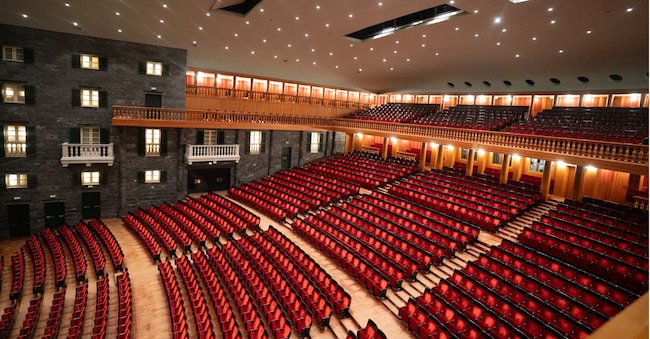
The theatre has been through several difficult decades in terms of its finances and management, which have even led to the Foundation being placed under administration. ‘The Carlo Felice is one of the country’s 14 leading opera and symphony theatres, but it suffers from some fundamental issues, linked above all to the building’s perhaps excessive ambition, which is out of proportion to the city’s population density,’ observes Galli. The stunning design by Aldo Rossi, dating from the mid-1980s, was conceived in a Genoa that envisaged reaching a population of one million, whereas today the population stands at around 550,000. With 2,000 seats, the auditorium is one of the largest among Italian opera houses (the Comunale in Bologna, a city with a similar population, has 900 seats), furthermore, the building comprises 16 storeys above ground and three below, with extremely high routine and capital maintenance costs.

A great deal has been achieved over the last 12 months to contain costs and increase revenue: operational and management efficiency has been improved, and significant efforts have been made to engage with the public, institutions and schools. All this has led, and will continue to lead, to savings and, above all, to an increase in audience numbers, with an average attendance of 1,400–1,500 in 2025 and a rise in season ticket holders from 1,371 in the 2024–2025 season to 1,932 in the 2025–2026 season, whilst season ticket holders for the symphony season have risen from 117 to 388. Box office takings have also increased by 200,000 euros.

The decisive contribution of the private sector

Despite this, 2025 – due to operating costs that are structurally higher than revenue – ended with a loss of 1.3 million euros, which was covered by drawing on the Foundation’s assets. Now, in order to break even in 2026 (or indeed, to make a profit of over one million, as per the budget), the contribution from private donors – which is expected to rise from 2.1 to 4.3 million euros – will be crucial.

And this is where the Custodi del Faro come in: ‘The new management has tackled costs and is now focusing on revenue, but in an opera house, the potential for audience growth is limited. Ticket sales currently generate around 2.6 million euros; this can be increased by up to 10 per cent, but it’s difficult to go beyond that,’ explains Andrea Compagnucci. There are other sources of income, such as venue hire or guided tours. But that’s not enough: to make a difference, both now and in the coming years, we also need contributions from businesses and professionals who believe in the revival and future of this theatre. I am certain we will succeed, not least because the city itself is undergoing major transformations, and I believe that the revival of the Carlo Felice will go hand in hand with the revival of Genoa.”

Copyright reserved ©
Loading...

Brand connect

Loading...

Newsletter

Notizie e approfondimenti sugli avvenimenti politici, economici e finanziari.

Iscriviti