Fishing

Carloforte tuna a resource for local gastronomic tourism

Japanese market much less profitable than it used to be: instead, much of the catch ends up in restaurants on San Pietro Island (South Sardinia) where the Girotonno has developed a virtuous circle for the economy

by Emiliano Sgambato

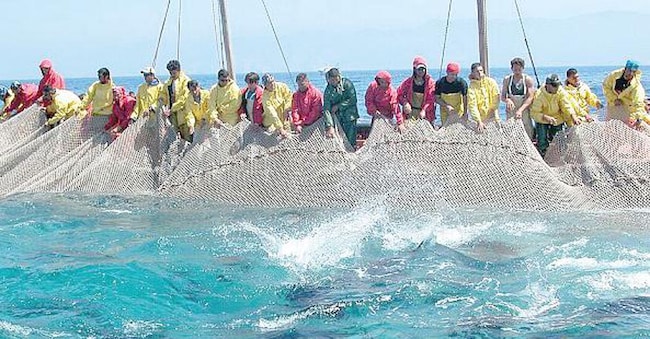
Un fase della mattanza dei tonni

6' min read

6' min read

In Carloforte, on the island of San Pietro, there is one of two tuna nets still in operation in Italy. The other is in Portoscuso, on the Sulcis coast. Separating them are only a few kilometres of sea, traversed by the tuna that arrive in the crystal-clear waters of Sardinia to reproduce. Their frantic races, since Phoenician times, run into a system of trap nets that ends up in the death chamber.

Tuna fishing in Italy

.

Today the slaughters are less bloody, with the tuna not harpooned in a pool of blood, but hooked one by one with hooks and hoisted by winches into ice-filled barges. Instead of hooked irons waiting for them, there is the ikejime, a Japanese technique that, through mechanical penetration into the fish's nervous system, aims at calming its spasms and causing a less bloody death, which at the same time maintains the quality of the meat (not only aesthetically, but also by preventing the release of substances that alter its taste and texture).

Loading...

Tuna fishing is one of the most sustainable (also according to WWF) and controllable fishing methods, capable of selecting the best tuna by releasing the smallest specimens. But it is also more costly in terms of time, effort and use of human resources than the others practised in the Mediterranean. It is mainly for this reason (but not only, from overfishing, pollution and climate change to political choices: the issue is complex) that over time the numerous Mediterranean tuna nets (in Italy there were many throughout the south of the peninsula) have been decommissioned and that now this type of fishing in Italy is reserved for 8% of the quotas established by Iccat (the International Commission for the Conservation of Atlantic Tunas).

Of the 5,283 tonnes of bluefin tuna that can be caught in Italy, 70% is reserved for seining - which uses large nets to catch entire schools of live fish that are then generally destined for fattening and the Japanese market - 13% for longlines and 6% for small-scale fishing.
The majority of seiners do not kill the tuna but leave them in the nets for fattening (there are no such facilities in Italy at the moment). These specimens are then mainly destined for the Japanese market and are paid at the lowest prices, while those from the longliners are mainly destined for fishmongers, restaurants or for preservation.
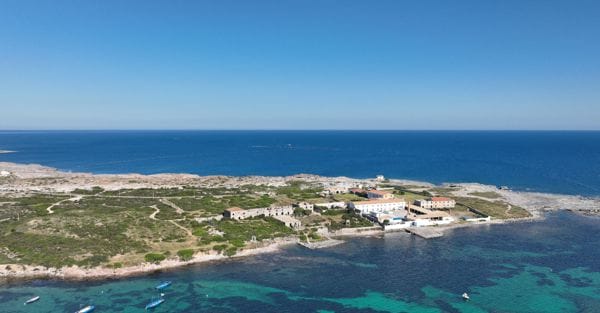
Una veduta della Tonnara di Carlorte

In Carloforte, 'tuna tourism'

.

But the tuna fishery in Carloforte also endures thanks to the special link between the Island of San Pietro and its tuna. A virtuous circuit has been created that has also made tuna a tourist attraction resource based on gastronomic leverage, and has linked quality bluefin tuna to the very name of Carloforte.
"This year we ceded about half of the quota reserved for us to the tuna seiner,' recounts Giuliano Greco, head of Carloforte Tonnare, which has belonged to the same family since 1654, 'and of the remaining 125 tonnes, 60 have been earmarked for our canned tuna, which is our historical vocation. We put a lot of emphasis on processing in oil, which we have always done here in the tuna fishery, because it allows us to enhance our brand and because it is a production that is less subject to the price fluctuations to which fresh produce is subject. While in 2023 the live tuna quota sold for 12 euro per kg, last year the price was 5 euro and this year 7. The problem is that if we don't manage to fill the quota one year, it's not like I can compensate with more catches the next year. A tuna can, on the other hand, is kept for five years'. And in the tuna emporium, the price of a 350 gram can starts at 29 euros.

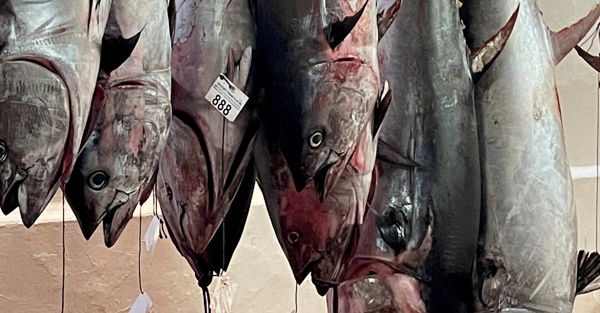
Tonni appena pescati a Carloforte

"The other 50 tonnes went on the fresh market and to restaurants with quotations of 12-14 euro per kg for whole fish. Of these,' continues Greco, 'about twenty tonnes remained here in Carloforte'.
A figure that concretely demonstrates how tuna has become a generator of wealth that moves a considerable amount of business on the island.

"Over the years, Carloforte has become increasingly synonymous with tuna. It is indeed a historical, identity and cultural factor,' says Mayor Stefano Rombi, 'but also the result of a long and coherent communication and territorial marketing strategy. Among other things, the candidacy of all the tuna fisheries as Unesco intangible heritage is being studied, with Carloforte as the leader. The Girotonno has certainly played a crucial role in this process'.

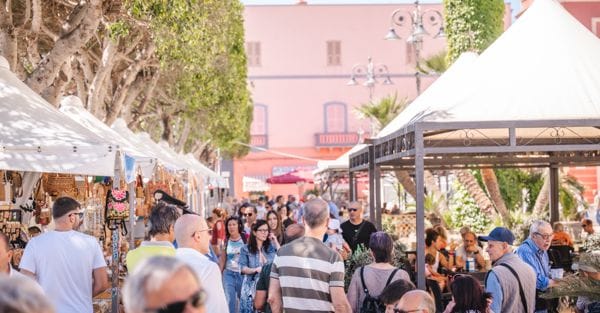
Turisti all’Expovillage di Carloforte durante il Girotonno

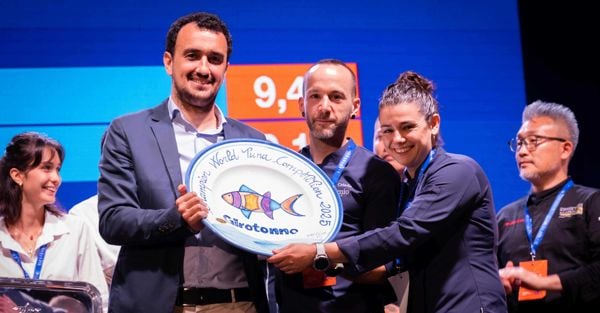
At the heart of this event. organised with the Agency Feedback and now in its 21st edition, is an international competition between chefs called upon to enhance the Carlofortino tuna through new recipes, which are then voted on by two juries, one technical and one popular. In addition to the 1,400 portions served to the popular jury (€25 ticket), this year 5,000 tickets were also purchased for the tastings of Carloforte specialities offered at the quayside (€13 or €20). During the days of the event, some 24 thousand people landed on the island, allowing, as every year, the start of the tourist season to be brought forward to the 2 June long weekend. But the Girotonno makes it possible not only to lengthen the season, but also to make the tuna a source of attraction even in the periods away from the event.

The official seasonal presences are around 33,000, "but this is a largely underestimated figure," emphasises the mayor, according to whom the significant data must be sought in the ranking of presences in south-western Sardinia, "where Carloforte has been constantly on the podium for years, and we must consider that Sant'Antioco, which is in first place, is much larger and does not need to be reached by ferry. Spreading the presences over a longer period than the classic July and August is fundamental for an island like ours, which has physical limits that must be respected in order to safeguard its natural patrimony'.

Il sindaco di Carloforte Stefano Rombi premia i vincitori del Girotonno 2025: gli chef spagnoli María Busta Rosales e Abel Criado Peliz

For Rombi, there are at least two other figures to underline: 'Where twenty years ago the number of accommodation facilities in Carloforte could be counted on the fingers of one's hands, now there are 450. In a town of 6,000 inhabitants, then, there are about 25 restaurants, and I am talking about quality establishments, with the Girotonno itself having contributed over the years to raising the level, making us a gastronomic destination. If we also consider the pizza restaurants, pubs and so on, the number at least doubles. In general, a high-spending clientele comes to Carloforte, also for the gastronomy. And in recent years there has been a marked increase in the number of yachtsmen occupying our 800 berths. Property values have also grown much more than the Sulcis average'.

Coldiretti: a supply chain to be valorised

In short, Carloforte is an example of how the Italian fishing heritage can be enhanced. It is no coincidence that here in May the 'Signed by Italian Fishermen' label was presented, valid for all types of fish and promoted by Coldiretti Pesca. Since 26 May, on the other hand, the ministerial obligation to affix a guarantee seal to every bluefin tuna that arrives in Italian ports has been in force.

"On the one hand, tuna seem to abound in our waters today, and indeed in our opinion they are sometimes becoming a problem for other species of which they are predators," says Daniela Borriello, Coldiretti fisheries manager. "On the other hand, the Japanese market is no longer as profitable as it once was. The objective must be to enhance the supply chain. We are also evaluating where to set up so-called farms (areas where tuna are fattened in water, nda). On these topics an international event dedicated to bluefin tuna is being planned for 12 and 13 September in Cetara, focused on sharing strategies, critical issues and concrete proposals aimed at strengthening the role of Italian operators'.

"Consumers should get used to informing themselves more about the provenance of the catch. Passing off racing tuna from Carloforte or in any case Italian quality tuna with other types of tuna is unfortunately a widespread practice in Italian restaurants,' comments Greco, 'but it would be enough to take a look at the markings that must be affixed to the catch by law to avoid fraud. I hope this awareness grows as it has grown in recent years with meat, now people are willing to pay more for the most prized, depending on where it comes from and how it was farmed. Tuna catching needs more labour, which accounts for 80 per cent of business costs, this should be recognised'.

Copyright reserved ©
Loading...

Brand connect

Loading...

Newsletter

Notizie e approfondimenti sugli avvenimenti politici, economici e finanziari.

Iscriviti