
The project

Waiting lists: cataracts are assessed from the bottom up – a chatbot for the public is launched in Lombardy

An AI-based system anonymously collects citizens’ experiences of appointments, tests and procedures: the aim is to build an independent snapshot of real-time data and pass this information on to the relevant authorities

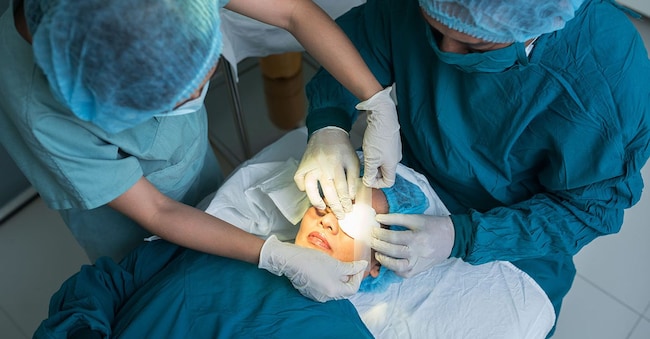
 (Adobe Stock)

4' min read

Translated by AI
Versione italiana

4' min read

Translated by AI
Versione italiana

How long do people actually have to wait for cataract surgery in Lombardy? It is not a simple question to answer. Data on waiting lists is available via regional systems and, from 2025, also via Agenas’s National Waiting List Platform, but capturing the actual experience of individual citizens, facility by facility, can be more difficult. This consideration gave rise to an idea by Domenico De Felice, a doctor and healthcare commentator, who has developed a chatbot to collect reports from members of the public on the waiting times for consultations, tests and operations relating to cataracts in Lombardy.

The project

The project, presented at Milan Digital Week and available at www.oclombardia.com, focuses on grassroots participation. Citizens can report their experiences and the system collects them in aggregated form, assigning each a unique identifier. The data made available for public consultation does not reveal the identity of the person who submitted the report and may be subject to administrative verification. The idea is to transform a series of individual experiences into an overall picture, to be made available to the authorities.

Loading...

This is not a trivial matter. Cataract surgery is one of the most common surgical procedures: in Italia, around 650,000 operations are carried out each year, according to figures reported by the Italian Ophthalmological Society and cited by ANSA in 2025. Given the sheer number of procedures, a system for collecting patients’ experiences is therefore particularly significant. ‘I recall that cataract surgery is the second most common operation performed in Italia, with around 650,000 cases a year,’ writes De Felice in the project’s presentation document.

The issue of waiting lists

The problem is that behind a national figure lie regional differences and, above all, very different waiting times. A report published in 2024 indicated that in Lombardy, the wait for cataract surgery through the National Health Service could be as long as around a year and a half, compared with much shorter waiting times in the private sector. Whilst this figure relates to that period and is not based on up-to-date regional monitoring, it illustrates the gap that can exist between the public and private healthcare systems.

In the meantime, the regulatory framework has changed. Decree-Law 73 of 2024, converted into Law 107 of 29 July 2024, introduced new measures for managing waiting lists and stipulated that citizens must be guaranteed treatment within the timeframes set out for their priority category. If the public health service is unable to meet these deadlines, the service must be provided through in-hospital private practice or by an accredited private provider, with the citizen required to pay only any applicable patient contribution.

The same reform provided for a National Waiting List Platform, developed by Agenas and made available in June 2025. The system collects data from the regions on bookings, priority categories, average waiting times and the volume of services provided. The stated aim is precisely to make the phenomenon measurable and to increase transparency.

Yet, according to De Felice, there is still scope for a monitoring system developed directly by citizens. ‘There is no real picture of the situation,’ he argues, proposing an independent system that can be modified and adapted to different specialities and services.

AI and chatbots

Artificial intelligence, in this case, is therefore not used to make clinical decisions, but as an organisational tool for collecting, classifying and comparing information. The chatbot is designed as a reporting tool: the more citizens who take part, the more meaningful the sample can become. ‘It is certainly a system that could be implemented if deemed useful,’ writes De Felice, whilst emphasising, however, that the quality of the results will depend on the accuracy and genuine participation of users.

The challenge is therefore to transform these individual experiences – which are often difficult to bring to light through normal administrative channels – into collective data. Not a new, parallel waiting list, then, but a potential tool for civic oversight. Reports are in fact forwarded to the Lombardy Cataract Observatory, which is expected to collate them and make them available to the relevant institutions.

Cataracts: a ‘test case’

This issue is particularly relevant at a time when managing waiting lists has become one of the priorities of the public health system. In January 2025, the NAS (National Anti-Fraud Unit) had identified irregularities in 27 per cent of the approximately 3,000 inspections carried out in healthcare facilities, with critical issues also relating to the management of appointment books, the closure of booking slots, the use of priority categories and the use of private practice within public hospitals.

Loading...

The new National Plan for the Management of Waiting Lists 2026–2028, approved in June 2026, aims to strengthen monitoring, transparency, the harmonisation of procedures and safeguards. Within this framework, the Lombardy project seeks to introduce a further level of observation: that of those who experience the waiting list first-hand.

Cataract surgery, with hundreds of thousands of operations carried out each year, can thus serve as a test case. Not so much to replace institutional monitoring systems, but to check whether the official figures fully reflect citizens’ experiences. And to understand whether, alongside the large-scale national and regional dashboards, a small tool built from the ground up can help shed light on what happens when healthcare services are delayed.

Copyright reserved ©
Loading...

Brand connect

Loading...

Newsletter

Notizie e approfondimenti sugli avvenimenti politici, economici e finanziari.

Iscriviti