
Cersaie: training and culture to attract over 100,000 visitors
Bologna is hosting the international exhibition of ceramics for architecture and bathroom furnishings. The organisers say: ‘We must sell not just a product, but the “Made in Italy” brand.’

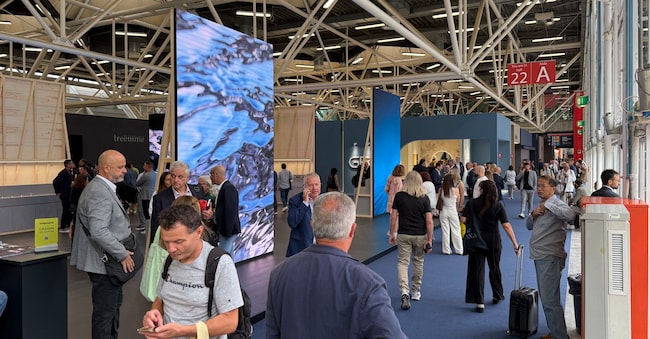
Cersaie is aiming to bring the trade fair back above the symbolic threshold of 100,000 visitors, and to do so it is focusing on business, training and culture. From 21 to 25 September, the International Exhibition of Ceramic Tiles for Architecture and Bathroom Furnishings returns to Bologna for its 43rd edition, featuring 597 exhibitors from 24 countries and 145,000 square metres of exhibition space. In 2025, attendance stood at 94,577, of whom 44,906 were from abroad and from 158 countries: almost one in two visitors. “Reaching 100,000 would be a very, very ambitious target,” admits Filippo Manuzzi, chairman of Confindustria Ceramica’s promotional activities and trade fair committee. “Cersaie is holding its own,” he says, whilst the trade fair sector “is in decline in terms of numbers”: following the Covid pandemic and with the rise of digital technology, the way we interact has changed.
The range on offer extends from ceramic and non-ceramic surfaces to bathroom furnishings, from raw materials and equipment to installation systems and services. The scale is smaller than in 2025, when there were 627 exhibitors spread over 155,000 square metres, but the available space is fully booked and, according to Manuzzi, there are ‘hundreds’ of companies on the waiting list. “It is not a trade fair where Italia showcases itself to the world: it is the trade fair where the world showcases itself to the ceramics industry,” he observes. Quality remains the priority: “The aim of the Italian manufacturers’ association organising the fair is to create a high-quality event.”
Cersaie Business, the visitor programme supported by ICE – Italian Trade Agency, will help to reinforce the event’s global character: over 340 architects, designers, developers, contractors, trade professionals and specialist press representatives from 45 countries, with visits also planned to the local ceramics district. “We must sell not just a product, but the genuine ‘Made in Italy’,” says Manuzzi, pointing out that in the ceramics sector, the Italian production chain covers every stage, from raw materials to finishing.
At stake is the competitiveness of a sector with a turnover of 7.5 billion euros, which contributes 5 billion to the trade surplus and employs 40,000 people, both directly and indirectly. It is no coincidence that the inaugural conference on 21 September is dedicated to ‘Sustainable Energy for Competitiveness’. The topic will be discussed by Ministers Adolfo Urso and Tommaso Foti, Confindustria President Emanuele Orsini, Eni Chief Executive Claudio Descalzi, the President of Emilia-Romagna, Michele De Pascale, the President of ICE, Matteo Zoppas, and the President of Confindustria Ceramica, Augusto Ciarrocchi. The focus will be on the issue of energy costs and the ETS, factors which affect investment and competitiveness.
The aim is to turn the five days in Bologna into more than just a showcase. “We are working to make Cersaie a platform, not just a trade fair,” emphasises Manuzzi. There are three key areas: trade and networking; technical and commercial training; and design culture. At the Città della Posa in Hall 19 – which is sold out for the second year running – demonstrations on large slabs and innovative techniques take place alongside the World Tiling Lab and students from construction colleges. A free training programme for showroom sales staff is also making its debut, organised by the Accademia dello Showroom and dedicated to the sale of premium products and advanced consultancy. On the cultural front, ‘Costruire, abitare, pensare’ returns: Pritzker Prize winner Alejandro Aravena is due to appear on 24 September alongside Annabelle Selldorf, whilst the 15 Café della Stampa events will cover design, the home, hospitality, leisure and the city. “We want a platform where people can meet, learn and engage with exclusive cultural content,” summarises Manuzzi.

