

Ceuta, Ventotene and Leipzig: the EU’s common border is defended by removing the right of veto
Liberal democracies can still build a Europe that is both normative and powerful, capable of protecting and producing. Europe will be truly united when a crisis in Ceuta triggers the same instinctive response of solidarity in Helsinki as an attack in Leipzig would in Madrid or Rome. Today more than ever, majority voting is fundamental to the concept of continental sovereignty. Otherwise, a federal vanguard open to all who wish to join must step forward

Key points
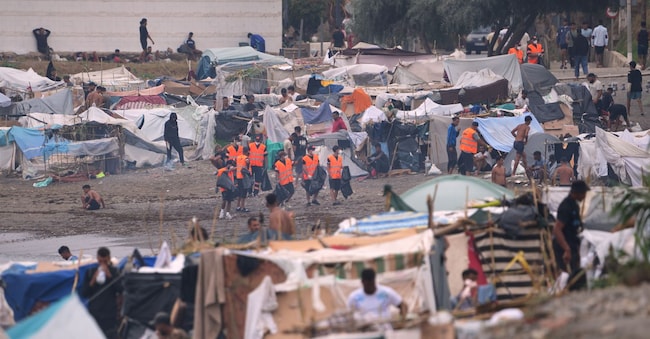
Years ago, I heard a passionate speech in the European Parliament by a Belgian Liberal MEP. Europe, he said, will be truly united when a citizen from the South regards Finland’s border with Russia as his own, and when a Scandinavian citizen feels that Greece’s border with Turkey is his own. In recent years, I had come to believe that this aspiration had largely been realised. The European reaction to the Russian invasion of Ukraine seemed to confirm this. The crisis in Ceuta has forced me to reconsider my optimism. At the end of July, more than 70,000 people entered Ceuta illegally within the space of a few hours. The initial reaction of some European partners was not to ask how they could work together to protect an external border, tackle a humanitarian emergency and clarify whether the situation was being exploited. Italia called for Spain to be suspended from the Schengen Area and subsequently reintroduced border controls. Ceuta is part of the European Union, even if not part of the Schengen Area: the authorities of the Member States ought to be aware of this. Its unique legal and geographical status does not make it any less European. It is legitimate to debate migration policy and demand effective border management. It is equally essential to remember that those crossing the borders are people, not weapons. And we must get to the root of the issues, at a time of profound shifts in the geopolitical tectonic plates. Population movements can be encouraged, organised or amplified to exert political pressure. Much remains to be clarified, but this crisis involves a combination of trafficking networks, state decisions, disinformation and viral messages. What is happening in Ceuta is a reflection of what is happening across the world. To reduce it to a Spanish migration issue is to fail to understand the world that is emerging. And, sometimes, politics remembers for a long time the silences, the solidarity and the harsh judgements of those early hours: the mistakes and the right choices.
A comparison between Ukraine and Ceuta
Ceuta is not just a European problem because of migration. It is a European problem for the very same reason that the Russian invasion of Ukraine constitutes an act of aggression against Europe. And for the same reason that the drone carrying 600 grams of explosives, discovered on the night of 4 August next to a Ukrainian cargo plane at Leipzig/Halle Airport, was not merely a German incident. Germany has attributed the operation to Russia. Making such an accusation officially marks a qualitative leap in the escalation between Europe — the epicentre of the West — and Russia. In Leipzig, the immediate target may have been an aircraft; the political target was the security of the entire continent.
The Logic of Hybrid Wars
This is the logic of hybrid wars. They do not begin with a formal declaration and do not end with an armistice. They unfold below the threshold of open warfare and take the form of a toxic cocktail of sabotage, cyber-attacks, economic coercion, manipulation of information, the exploitation of migration flows and electoral interference. Let us recall what happened during the last presidential elections in Romania and the parliamentary elections in Moldova. In both cases, voters’ attitudes shifted in the light of broader and more varied information, perhaps through means that were not so very different. Hybrid wars aim to conquer territories — Russia remains obsessed with the doctrine of its spheres of influence — but above all to erode trust, exploit our divisions and slow down the democratic decision-making process. They create anxious and bewildered societies, unable to make sense of reality amidst all the noise. All too often, Europe continues to react as if each incident were the responsibility of a different ministry and a different state. That is a thing of the past.
The appeal from eleven countries
In this context, the appeal issued on 1 September by eleven EU governments — Austria, Belgium, Denmark, Finland, France, Germany, Luxembourg, the Netherlands, Romania, Spain and Sweden — to put an end to ‘obstructionist’ vetoes in foreign policy and to explore, within the framework of the Treaties themselves, the transition from unanimity to qualified majority voting in this area. They also propose making greater use of constructive abstention and ceasing to use foreign policy decisions as a bargaining chip in matters that have nothing to do with them. It is still a modest step, but it breaks a taboo. Qualified majority voting compels states to build majorities. The veto, by contrast, all too easily turns a national interest into paralysis for all Europeans. We cannot treat every national election as a game of Russian roulette on the very future of the European project. Everything is changing very rapidly, and we must adapt just as quickly. Abolishing the veto is a matter of urgency for the EU: it means moving from a confederation to a federation. A Union that can grow from 27 to 37 members cannot retain a system in which every government has a master switch. If agreement amongst the Twenty-Seven continues to be blocked, a federal vanguard must step forward, open to all who wish to join. In this phase of profound transformation, powers are emerging that are no longer entirely public nor entirely private. States are outsourcing strategic functions — a particularly worrying trend in the field of security — whilst private platforms are shaping public debate. We must be aware of this. Powerful networks of capital, technology and influence identify opportunities and exploit them for short-term profit, whilst governments are losing the capacity to make an impact and exercise their authority. Iraq and Afghanistan, and now the conflict surrounding Iran, illustrate the cost of using force without a clear political vision. Strategies run out of steam before military contracts do, and the profits find their owners. Are liberal democracies dazed in a world of plunder? The risk exists, but it is not yet our inevitable fate.
Foreign propaganda vs majority voting
The divide between left and right will not disappear: it will continue to shape the debate on taxation, rights and the welfare state. But another divide is cutting across it with increasing force. On the one hand are those who advocate greater European integration and open trade governed by rules; on the other are the new state nationalists, advocates of borders, tariffs and vetoes. The 2027 French presidential elections will be a decisive test and could close the window that is now opening. Those who promise to reclaim sovereignty through the national veto may find that the veto is the cheapest tool our opponents have at their disposal to paralyse Europe. Artificial intelligence makes this debate even more urgent. In his essay published on 26 August, Bill Gates warns that AI could become the greatest equaliser in history or an extraordinary source of injustice. This transformation will soon reach entry-level and mid-level jobs, first in offices and then in manual labour too. Waiting until the shift in employment becomes massive would mean it is already too late. A proactive European response is urgently needed.

