Football & business

Champions final, American Inter against Qatari Psg with double the turnover

In the Champions League final scheduled for Saturday 31 May in Munich, the models of a US investment fund and a sovereign wealth fund will also be compared

by Marco Bellinazzo

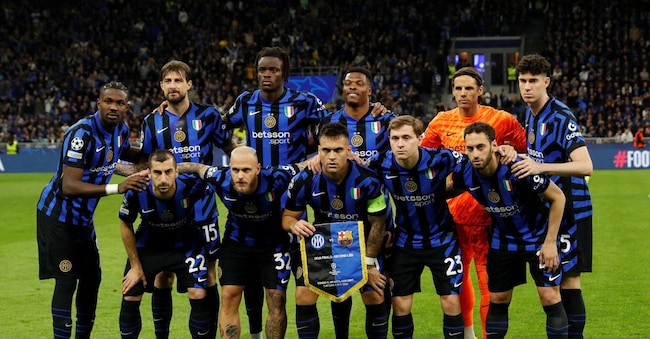
FILE PHOTO: Soccer Football - Champions League - Semi Final - Second Leg - Inter Milan v FC Barcelona - San Siro, Milan, Italy - May 6, 2025 Inter Milan players pose for a team group photo before the match REUTERS/Alessandro Garofalo/File Photo

5' min read

5' min read

The finals and the final of the SuperChampions above all are the last place in football where it is not turnovers and economic factors that count. In the dry game - and it is the luck of the sport - any ranking, of brand, of heritage, of blazon, can be overturned by the football gods.

However, the challenge for the award of the continent's highest trophy scheduled for Saturday 31 May in Munich says a lot about what has been the development process of European (and other) football over the last 15 years.

Loading...

In the days of the Last Cup

.

Taking the field are two teams that 15 years ago were at the antipodes of the football pyramid. The Inter of Massimo Moratti and Josè Mourinho in 2010 lifted the Champions Cup to the sky at the Santiago Bernabeu after beating Bayern Munich in the final act of the competition. The club's turnover was 225 million in a context where the top of the class, Real Madrid and Barcelona, were travelling just over 400 million.

At the time, Paris Saint-Germain was living in the 'banlieue' of football that counts, under the ownership of a star-studded consortium formed by Colony Capital, Butler Capital Partners and Morgan Stanley, which had taken it over from Canal+ for 41 million euros. There were just two French championship titles and a Cup Winners' Cup in 1996. At the time, the French team struggled to reach 100 million in annual revenues, less than half of the Nerazzurri.

The Qatari Turning Point

.

The football-financial revolution, however, took place shortly thereafter. In the autumn-winter of 2010, Seppe Blatter's FIFA assigned the 2022 World Cup to Qatar. An attribution that triggered controversy and endless investigations, but which in fact changed the geopolitics of football. A few months later, in order to intensify and propagandise its sports investments, Qatar Sports Investments bought Psg for a hundred million. The Qatari sovereign fund started a policy of massive capital injections and super-sponsorships that swelled the Parisian club's revenues by bringing the world's best players to the Ville Lumiere.

Nasser Ghanim al-Khelaïfi, president of the Qatari Federation and vice-president of the Asian Tennis Federation, was installed as president. He immediately set the ball rolling with pharaonic market campaigns that brought Pastore, Beckham, Lavezzi, Verratti, Thiago Silva, Ibrahimović, Lucas, Cavani and Di Maria, among others, to the Parc des Princes. Expenditures of more than 600 million have pushed Psg to the top of European football in terms of results (with French titles won in a series and constant participation in the final stages of the Champions League) and also in terms of turnover, with revenues that are rocketing towards half a billion.

An exponential growth to which Doha, as mentioned, contributes through the sponsorships of the Ooredoo group, a Qatari telecommunications company, or the Qatar National Bank. But above all through the agreement with the Qatar Tourism Authority. The contract between Psg and Qta signed in December 2012 provides for bonuses of between 150 and 200 million euros per year. Uefa challenged these transactions circumventing the financial fair play stakes by imposing (mild) sanctions on Psg in May 2014, including a 60 million fine. For Qatar, however, more than a canonical sponsorship contract, the partnership with Psg represents a unique form of promotion for the country, also in view of the 2022 World Cup and should be safeguarded and extended at least until that appointment.

Milano, protesta ultras sotto sede Inter per biglietti finale Champions

The Evolution of the Two Clubs/Inter

Inter has changed ownership three times since 2010, passing first from the hands of the Moratti family to those of the Indonesian Erik Thohir, and then from those of Suning and the Zhang family to the US fund Oaktree. A whirlwind of reference shareholders who invested (especially Suning in the first years, spending almost a billion) to keep the team at the top of Italian and European football in a context that was not always favourable, in particular, with the 'perfect storm' that hit the club between the pandemic (which caught Inter in an expansive phase of investment in the market) and the disengagement of the Zhang family, costing 573 million red in four years, from 2019 to 2023 (an average of 150 million per year).

However, the 2023/24 season saw a record turnover (473 million) and a deficit of just 36 million. The exciting Champions League campaign has brought a haul approaching 200 million in revenues, including Uefa bonuses (over 135) and around 35 million in box-office receipts (raising the trophy would be worth another 6.5 million, to which another 4-5 million would be added for the possible Uefa Super Cup match), pushing the next budget into the black and the turnover well over the half-billion mark.

This is a not-to-be-missed boost to better face the crucial 2026/27 season in which it will be necessary to meet the maturity of the EUR 415 million bond (Oaktree has already repurchased EUR 15 million of it and is working on refinancing it so that it does not become a debt of less than 12 months and therefore impacting the liquidity index) and to bring the net equity back into positive territory (negative at 30 June 2024 by EUR 66 million) after having benefited from like all Italian companies for which the government allowed this option during the Covid emergency, of the five-year deferral of the losses incurred in 2021 and 2022 (for 341 million, largely already covered by capital injections). In the summer, Inter is expected, in any case, to take two crucial steps: on the field, the World Club Championship (the winner will receive up to 125 million); and off, the purchase, together with Milan, of the San Siro area in order to finally accelerate the process of building the new stadium.

The Evolution of the Two Clubs/Psg

Psg's economic 'model' has been characterised in recent years by a constant increase in both revenues and costs, especially those related to wages and amortisation, and by balance sheets constantly in the red. In the last five seasons alone, Psg has accumulated losses of 887 million, despite the new revenue record reached in the 2023/24 season, which reached 989 million (808 without considering player trading).

The financial year to 30 June 2024 ended with a deficit of 60 million, despite the fact that player trading brought in more than 180 million, thanks to the disposals of, among others, Neymar and Verratti.

While commercial and sponsor revenues secured 380 million, TV rights 178 and stadium 73 million, costs rose to 1 billion. In particular, personnel costs have risen to 658 million, depreciation to 131 million and agent costs to 36 million. 12% more than the UEFA 'squad cost rule', which dictates that no more than 70% of revenue should be spent by adding these three items together.

At the debt level, PSG had debts totalling EUR 1.050 billion as at 30 June 2024 and a negative net financial position of around EUR 78.1 million in the light of cash of EUR 36.1 million against financial debts of around EUR 114.9 million.

The economic situation and the poor sporting results in Europe, with the Champions League taboo not being broken, have therefore led to a turnaround in investment policies last summer to lower costs, with the farewell to the collection of stars - emblematic is the farewell to Kylian Mbappé - in favour of the inclusion of players functional to the technical project of coach Luis Enrique. Without skimping on spending, as demonstrated by the signing of Khvicha Kvaratskhelia from Napoli for 75 million in January. A change of course that has paid off so far.

Copyright reserved ©

Brand connect

Loading...

Newsletter

Notizie e approfondimenti sugli avvenimenti politici, economici e finanziari.

Iscriviti

Tutto mercato WEB