Weather

There are fears of power cuts in Italia. Temperatures in nurseries and pre-schools in Milan are reaching 36 degrees

The weather conditions that were once typical and unique to North Africa have literally spread across the entire Mediterranean region, encompassing Spain, Italia and Greece.
aggiornato alle ore 14:10

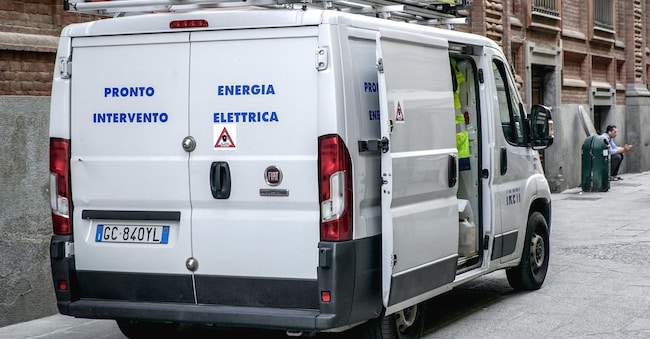
Un camioncino di pronto intervento Irenreti per ripristino energia elettrica, dopo i blackout in piazza Carignano. Torino, 24 giugno 2026. ANSA/TINO ROMANO ANSA

6' min read

Translated by AI
Versione italiana

6' min read

Translated by AI
Versione italiana

A heatwave is sweeping across Italy, increasing the risk of power cuts. This has already happened in some neighbourhoods of Milan and Rome. And with temperatures not set to drop any time soon, the phenomenon could recur. This scenario could complicate matters for local health authorities and hospitals, which must remain operational 24 hours a day, but the Italian Federation of Healthcare and Hospital Organisations (FIASO) is monitoring the situation.

“In hospitals across Italy, generators and systems are in operation to ensure the continuity of the electricity supply, particularly in areas where a power cut is unacceptable: operating theatres, cardiac intensive care units and A&E departments”. This is what Giuseppe Quintavalle, president of Fiaso, told Adnkronos Salute.

Loading...

“Healthcare organisations are closely monitoring how the situation develops, particularly with regard to the strain on the electricity grid during this spell of intense heat. “The message we want to convey to the public,” says Quintavalle, “is one of reassurance: healthcare – particularly in the most critical situations, such as surgery, a cardiac emergency or a visit to A&E – is not jeopardised by the heat or by any power cuts.”

The unusual heatwave that has been affecting our country and much of Europe for the past week could, over the next three days, put the health of 1.5 million workers in Italia at risk. This is the finding of an analysis carried out by Greenpeace Italia and CGIL, combining heat risk forecasts from the Worklimate project run by CNR and INAIL with ISTAT employment data.

Emergency in Milan’s nurseries and pre-schools: children in classrooms where temperatures reach up to 36 degrees

 Temperatures of up to thirty-six degrees inside nursery schools and crèches in Milan: this is the temperature recorded on the afternoon of Wednesday 24 June in one of the municipal nurseries where the heatwave is taking its toll. It was spotted – and photographed – by some parents as they were collecting their children. “There are three ‘Pinguini’ air-conditioning units for seven classrooms,” says a nursery teacher who wishes to remain anonymous.

Dozens of reports and identical photographs showing digital thermometers reading temperatures in excess of 31–32, and even 34 degrees Celsius, are being sent to the secretary of the UIL Public Service branch in Milan and Lodi, Angelo Greco, who on Wednesday sent a “request for the adoption of extraordinary measures to tackle the heatwave in educational services” to the mayor, Giuseppe Sala, the deputy mayor, Anna Scavuzzo, and ATS Milano.

A letter in which Palazzo Marino is “urgently” asked to “reduce the hours of municipal educational and school services for children aged 0–6” and “an early finish during the middle of the day, when the heat is at its peak”, following the example of what is already happening in numerous European cities and, in Italia, in the municipality of Livorno. The trade union refers to “essential preventive measures” for the “protection of the health and safety” of “educational staff” and “children”.

Reports are coming in from all over the Lombard capital: at the Fontanile 2 Nursery, situated between Via Melchiorre Gioia and the Martesana Canal and catering for children aged between 3 and 36 months, the temperature reached 32 degrees at 11 am. “Yesterday it was 33 degrees,” a mother tells LaPresse; she has two children enrolled respectively at the ‘Nenni’ nursery in the Adriano district, in the north-east, and at the ‘Bigatti’ nursery school, not far away. “The parents got together and organised a collection to buy portable air-conditioners.”

There are logistical issues, such as the fact that the drainpipe has to be positioned manually outside the windows – which therefore remain partially open – as well as organisational issues. ‘For some time now,’ points out a nursery teacher, ‘we have been unable to accept donations from parents for safety reasons and because these items are not approved products.’

. We make do with what the local council provides: namely the Pinguini and tower fans, which are too small and not powerful enough to cool “classrooms with 25 children”, he continues.

The workers were also reportedly instructed “never to switch on all the devices at the same time”, confirms the Milan city secretary of Uil FP. This request was prompted by the risk of overloading the electricity grid, but it risks making the summer even more sweltering inside those facilities, which will be transformed into summer camps during the height of the summer.

Hearings at the Court of Palermo have been suspended

The President of the Court of Palermo, Piergiorgio Morosini, has ordered the suspension of court hearings until 29 June due to the heatwave. Work is currently underway to repair the systems, “and is proceeding as a matter of urgency”, Morosini emphasises, but “it is not possible to say when the air-conditioning will be guaranteed to function properly”.

“If the current microclimatic conditions persist, they are likely to make workplaces difficult to work in from a health perspective,” explains Morosini.

Hearings requiring urgent attention, as identified by the section presidents, will be held in the old Courthouse: the Presidency will provide air-conditioning units and portable fans to ensure a comfortable working environment.

From heatwaves to heat surges: Saharan temperatures

Perhaps the time has come to update our meteorological vocabulary. Carrying on talking about ‘heatwaves’ has lost its meaning in a context where the climate has changed so radically that it imposes on us, for almost the whole year, a constant temperature anomaly of 3–4°C above average. What were once brief periods of intense heat have now turned into veritable ‘storms’: unrelenting and prolonged heatwaves.

Lorenzo Tedici, the meteorologist in charge of media relations at iLMeteo.it, confirms that, with the planet overheated by human activity, the weather conditions that were once typical and exclusive to North Africa have literally spread across the entire Mediterranean region, encompassing Spain, Italia and Greece.

And the latest reports confirm this: health alerts are multiplying, emergency plans for vulnerable groups have been triggered across half of Europe, and our cities are experiencing a veritable heat stress blackout.

In conditions that we still describe as ‘exceptional’ (but which are likely to become the norm in just ten years’ time), this North African influence has spread as far as the centre-north of France and England, bringing temperatures similar to those of the Sahara Desert to the heart of continental Europe.

All this brings to mind a grim prediction contained in a 2014 study: French scientists had indicated 2050 as the year in which widespread temperatures of 43–45°C would be reached, including in France, as a result of global warming. Well, that dystopian scenario is unfolding before our very eyes, a full 24 years ahead of schedule.

It is stark and dramatic proof that Europe is a veritable climate hotspot, where temperatures are rising at a rate that is at least twice the global average.

For Italia, the worst is yet to come. The peak of this heatwave is expected between Sunday and Monday, when the African high-pressure system Caronte will be at its strongest. Temperatures will exceed the critical threshold of 40°C.

And what really gives pause for thought is the geographical distribution of this heatwave: we’re not talking about the inland areas of Sicily or Sardinia, but cities such as Florence and Parma, in the heart of Tuscany and Emilia. Meanwhile, cities such as Milan will continue to suffer in a climate that fluctuates between tropical, super-tropical and equatorial.

We are light years away from the Junes of the last century, when, beneath the Madonnina, people would enjoy days at 32°C and rest during cool nights at 17°C. Our perception has become so accustomed to extremes that, paradoxically, we now welcome a forecast of 34°C as good news, describing it as a ‘cool spell’.

The scenarios: a cooler July or a sweltering heatwave lasting until September?

By definition, predicting a ‘peak’ implies a subsequent decline. The hope is that July might surprise us by sweeping away this sweltering spell; however, recent events teach us to be cautious: the build-up of such immense thermal and hygrometric energy risks unleashing itself, at the end of the heatwave, in atmospheric phenomena of unprecedented violence.

However, a far more disturbing underlying scenario remains. If, as we have said, we are not facing a mere wave but a climatic ‘storm surge’, Charon’s retreat may well be nothing more than an illusion.

We risk being stuck in this Saharan limbo until September, drifting through a new and gruelling normality characterised by highs of 39°C and brief, temporary lulls at 34°C.

Copyright reserved ©
Loading...

Brand connect

Loading...

Newsletter

Notizie e approfondimenti sugli avvenimenti politici, economici e finanziari.

Iscriviti