
ChatGPT enters shopping: AI becomes the new e-commerce filter
With the Shopping Research service OpenAI turns product search into a guided dialogue

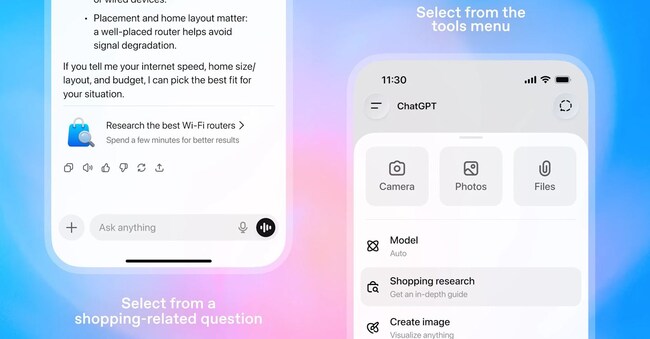
OpenAI has presented in recent weeks a new service called Shopping Research, a name that sounds like it was designed for a market report and instead indicates a conversational system that tries to do what users do every day in front of the screen: figure out what to buy, compare models, evaluate prices, avoid the maze of banners and promotions. It is a tedious, repetitive and low value-added task, precisely the kind of activity for which artificial intelligence should be a natural ally. How does it work? You open ChatGPT, ask something generic like 'a mobile phone under 600 euros with a good camera' and the model turns into a digital personal shopper. The dialogue begins, additional questions arrive - what use will you make of the camera, how much does the battery weigh for you, does it need wireless charging - and then a scan of the web for products, reviews and data sheets begins. In the end, a guide full of comparisons and compromises is produced, almost an automated version of those 'best five smartphones of 2025' posts that crowd Google, but with the disadvantage of being unsponsored and the advantage of being custom-built.
The Ai model underlying the service is GPT-5 mini, because it should be optimised to read product pages and transform heterogeneous text into structured data. This is a job that a human being does in half an hour with ten open tabs. The AI does it in a few minutes and without complaint. However, the quality of the result depends on the precision of the question: if a user asks 'I want a good computer', the system has the same reaction as a shop assistant being told 'I would like a fast car but not too fast'. The answer will be generic.
This is where the question becomes inevitable: is it a competitor of Amazon? At first glance, it would seem not. ChatGPT does not manage warehousing, inventory, shipping, returns or logistics. It has no proprietary catalogue. At the end of the guide, the user is still sent to an external site for purchase. Those who see the matter from a longer perspective identify another kind of competition: not that on the product, but that on the interface. For twenty years, e-commerce has been dominated by filters, sliders and drop-down menus. Shopping Research proposes a different paradigm: instead of browsing a catalogue, you describe a need. It is like entering a department store without walking down aisles and shelves but talking to an assistant who knows the entire inventory of the planet, or at least a very large part of it.
The real battleground is not the infrastructure, but the user's time. If ChatGPT becomes the place where people decide what to buy, whoever controls the first step also controls the rest of the supply chain. OpenAI knows this, and in fact has announced a second piece, Instant Checkout, a system that would allow users to complete purchases directly from chat through a protocol called Agentic Commerce Protocol. For now, support is limited and regulated by partners, but the direction is clear: turn conversation into transaction. At that point Amazon remains the supermarket, of course, but ChatGPT risks becoming the entrance to the supermarket. And he who controls the front door often also controls the purchasing choices.
However, structural difficulties remain. The shopping experience is not just about product selection: it is about managing temporary promotions, variable availability, flexible budgets and family trade-offs. A paper published in arXiv at the end of the summer (ShoppingBench) showed that even the best AI models get it wrong half the time when they have to make complex purchases with realistic constraints, and often for trivial reasons: misinterpretation of the budget, miscalculation of total costs or incomplete options. The promise of the autonomous agent exists, but it is not yet as reliable as a search engine or a traditional marketplace.


