Digital Economy

ChatGPT wants to become an operating system: OpenAI launches app ecosystem

At DevDay 2025 unveiled the ecosystem of apps integrated with AgentKit and advanced templates that complete the enterprise offering

3' min read

Translated by AI
Versione italiana

3' min read

Translated by AI
Versione italiana

ChatGPT is becoming an operating system. Or at least it is trying to. At DevDay 2025, the annual conference for developers, OpenAI unveiled an ambitious strategy: to turn the world's most widely used chatbot into a platform capable of hosting third-party applications, directly integrated into conversations. These are basically third-party apps running in ChatGPT: a new category of interactive tools that live inside the conversational interface.

Spotify, Figma, Canva, Coursera, Expedia, and Zillow are among the first partners. Uber, Instacart, and DoorDash will also arrive in the future. CEO Sam Altman stated that the innovation will enable 'a new generation of adaptive, interactive, and personalised apps to chat with'.

Loading...

Alexi Christakis, OpenAI's software engineer, launched a chat aimed at Canva during the demonstration, asking the app to first design some posters to advertise a dog walker and then a presentation aimed at raising funds for the business. The demo presented with Zillow is emblematic: a user can ask for flats in a certain price range and receive an interactive map that can be explored directly in the chat. With Spotify, one can create playlists on demand. With Figma, start design projects without changing windows.

An open SDK, but Europe waits

For developers, OpenAI has released the Apps SDK, a software development kit based on the Model Context Protocol (MCP), an open standard originally introduced by Anthropic. The SDK allows logic, interface and backend to be defined in a single flow, so as to create consistent and fully integrated chat experiences.

But there is one detail: the apps are not available in Europe. In fact, OpenAI specifies that they are now available to all ChatGPT users registered outside the EU with Free, Go, Plus and Pro plans. A move that probably reflects the uncertainties related to the Digital Markets Act and European privacy regulations.

The roadmap outlined by OpenAI foresees the arrival of a public app directory, which will serve as an access and discovery point for users, and the introduction of an integrated monetisation system. Developers will thus be able to earn money directly from their integrations, while users with existing subscriptions will be able to access premium features without leaving ChatGPT.

AgentKit: building agents gets (more) simple

In addition to apps, OpenAI launched AgentKit, a comprehensive suite for developing AI agents capable of managing complex workflows. Until now, creating agents meant juggling fragmented tools: complex orchestration without versioning, customised connectors, manual evaluation pipelines, prompt tuning and weeks of work on the frontend before launch.

AgentKit includes three key components: Agent Builder, a visual canvas to design multi-agent flows with versioning; Connector Registry, a centralised panel to manage data and tools between different workspaces; and Guardrails, an open source modular security layer to protect agents from malicious or unintended behaviour, masking sensitive data and detecting jailbreak attempts.

The Apple model (but different)

The strategy is closely reminiscent of Apple's App Store: create a closed but rich ecosystem, where developers find a huge audience and OpenAI controls distribution, monetisation and security. With a difference: here everything happens within a single conversation, without changing apps or opening new windows. A strategy to keep users on ChatGPT longer by creating a kind of chat-based operating system.

Sam Altman, CEO of OpenAI, summed up the vision as follows: 'It is the best time in history to be a builder. Today, going from idea to product is faster than ever'. The bet is that ChatGPT will become the starting point for any digital activity, from search to content creation, from design to e-commerce. In simple terms, a 'super assistant'.

The other innovations announced

At Monday's event, OpenAI announced that Codex, an optimised template for writing code, will move out of the research preview and become accessible to all. The GPT-5 Codex template is already among the most widely used in OpenAI's history, with over 40 trillion tokens processed and a tenfold increase in usage since last August. Now it becomes available to all, with new enterprise features, administrative dashboards and an extension for Slack.

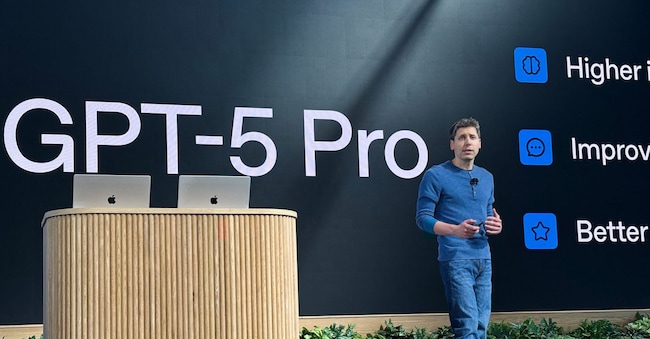
On the model front, OpenAI has made Sora 2 and Sora 2 Pro for video generation accessible via API, and GPT-5 Pro, the most advanced model intended for high-risk sectors such as finance, healthcare and legal. gpt-image-1-mini (cost reduced by 80 per cent) and gpt-realtime-mini (cost reduced by 70 per cent) have also been introduced to support large-scale implementations.

Copyright reserved ©
Loading...

Brand connect

Loading...

Newsletter

Notizie e approfondimenti sugli avvenimenti politici, economici e finanziari.

Iscriviti