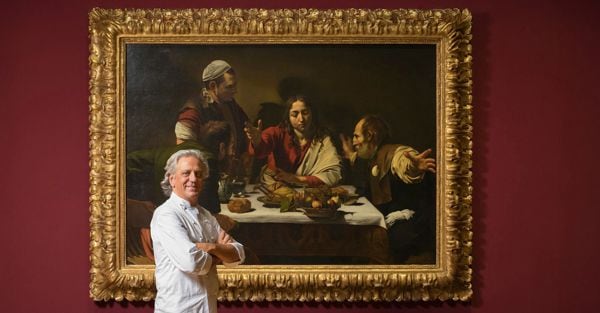
Chef Giorgio Locatelli after touring the world is now thinking of a return to (southern) Italy
At the start of the new Masterchef season, the celebrity chef recounts his long adventure abroad, always accompanied by the desire to never really leave his country

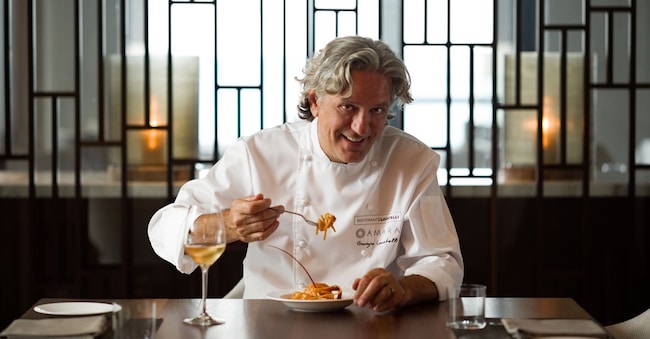
Chef Locatelli speaks of Italy as a thought that returns, that persists, that has never really left him. After 23 years in London, after the Bahamas and Cyprus, after the challenge of the National Gallery, after the years as judge of Masterchef (which returns today 11 December on Sky) he now says with a new clarity: 'I would like to open in Southern Italy. That is where I want to return, my wife loves the warmth of the people and the less hectic life. I want to open a project of my own'.
It is a statement that is only half surprising. Because Giorgio Locatelli, when he retraces his life, recounts it as a journey that starts in Italy, moves away from it and then finds it again everywhere: in the tomatoes that are impossible to find in the Caribbean, in the burrata that disappears in Cyprus in an instant, no time to replace it, in the boys in Camden Town who learn to cook spaghetti with tomato sauce. Italy has always been the compass, even when it seemed far away.
In Cyprus, where he landed seven years ago, inside the Amara hotel, Locatelli says he has found 'a happy island', a surprising place in terms of multiculturalism, light, possibilities. Limassol entered him almost without him noticing: a new coastline, a changing city, an international and curious clientele, a restaurant that over the years has become a staple of the local gastronomic scene. "But what really interests me," he explains, "is bringing Italy into this reality. He is in fact working on a new menu, a gastronomic bridge between southern Italy and the eastern Mediterranean, a way to tellthe Italian identity through Cypriot vegetables, cheeses, wines and flavours, which he finds very similar to those he yearns for, wherever he is.
"Quality dictates everything," he reiterates. It is a rule he also learnt in the Bahamas, where cooking means negotiating every day with what really comes. "You miss the tomato, you miss the fish you thought you were going to use. Then you adapt. You can't impose a menu on the environment. You have to listen to it. It's a very Italian lesson, after all: the territory decides, and new contaminations are created, Italy wins and is told even if it has to reinvent itself'.
Yet, despite these extraordinary experiences, it is from Italy that his new energy seems to come. When he speaks of the South, he lights up. He doesn't mention a city, he doesn't want to tie himself to a name; he prefers to imagine a place made of brighter light, of true seasonality, of a public that knows how to recognise Italian cuisine not as a cliché, but as everyday truth. In Italy,' he says, 'he would find a different rhythm, more natural, more instinctive.