Products

Smartwatches for children: your first mobile phone that you wear on your wrist

Calls, GPS and parent-approved contacts: connected watches promise to keep families in touch and delay the arrival of a smartphone. With models ranging from those without games or social media to more feature-rich devices, prices start at around 120 euros.

3' min read

Translated by AI
Versione italiana

3' min read

Translated by AI
Versione italiana

If we’re worried that our child might get lost on the way home from school or at the supermarket – or even get lost in the dark recesses of a social network – we’ve got quite a problem on our hands. A dilemma to overcome: how can we communicate with them and know where they are if we don’t want to give them a smartphone? In the past, some parents solved this with non-smartphones, limited to text messages and calls. Or with old smartphones restricted by parental control apps – which, however, children soon learn to get round.

A more high-tech – albeit more expensive – solution is now coming to the rescue of anxious parents: children’s smartwatches.

Loading...

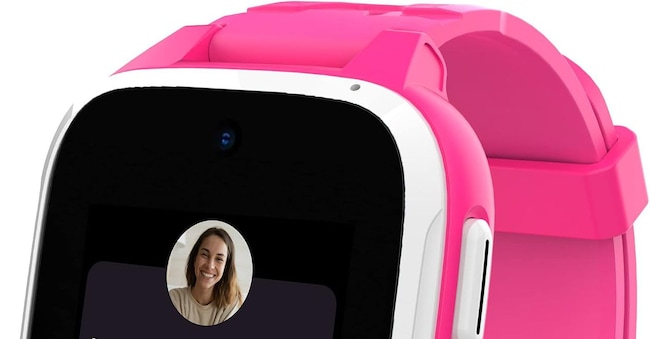
Let’s get this straight: they aren’t just colourful versions of the Apple Watch or Galaxy Watch for adults. Rather, they are small wrist-worn mobile phones, often equipped with a SIM card and 4G connectivity, which allow you to make calls, send messages and track your child’s location via GPS. However, it is the parent who decides who can contact the child, via an app installed on their own smartphone. And in the most restrictive models, there are no web browsers, social media platforms or even the option to install apps freely.

The features tend to be the same across different products. First and foremost, there is a standalone mobile connection, via a nano-SIM or eSIM: this means the child does not need to have their parent’s phone nearby. Then there are GPS and geofencing features, which allow parents to define a safe area within the app and receive an alert when the device leaves or enters it.

Another key feature is the restricted contact list. Instead of being able to receive calls from anyone, the watch can be set to communicate only with numbers approved by the family. There is also almost always an SOS button and a ‘school mode’ which, during lessons, disables calls, messages and other functions, whilst leaving the watch itself – and, in some cases, the emergency call function – available.

The range currently available on the Italian market already offers a variety of interpretations of this philosophy. The second-generation Xplora XGO3 costs around 210 euros. It features 4G, calls, texts and voice messages, GPS, ‘safe zones’, SOS and school mode. The interesting feature, however, is what is missing: in the manufacturer’s default configuration, there is no open access to the internet, social media or standard apps and games. These functions are managed via the parent app.

It is probably the model that comes closest to the idea of a ‘stripped-down’ smartphone: it takes the functions from a mobile phone that are considered useful for a child who is starting to get about on their own, whilst leaving out most of those that cause parents concern. Even more radical is the German Anio 6, which is also available in Italia for around 199 euros. It allows you to store up to twenty authorised contacts, blocks calls from strangers and enables phone calls, family chat, GPS tracking, geofencing and an SOS call. On the way to school, you can temporarily increase the frequency of location tracking.

Anio has deliberately chosen not to include a camera, games or even a calculator, precisely to minimise the risk of the watch becoming a source of distraction in the classroom. The manufacturer states a typical battery life of 24–48 hours, and it uses a standard nano-SIM. Then there’s the Imoo Z1; it’s also worth noting that Imoo is the international brand of the Chinese company Little Genius, which is very popular amongst anxious Chinese parents (they exist there too). In Italia, the Z1 costs around 120 euros. It offers 4G voice and video calls, chat, location tracking via GPS and other satellite systems, a ‘class mode’ and the option to reject calls from unknown numbers.

A different approach is taken by the Spanish SaveFamily Iconic Plus 2, which is also sold directly via the company’s Italian website for 129 euros. It retains GPS, safe zones, calls, video calls, SOS and classroom mode, but significantly expands its scope: it also integrates WhatsApp in a supervised manner, educational games, Spotify and a number of AI-based features.

There are serious reasons for supporting this technological approach. The latest recommendations from the Italian Paediatric Society advise postponing the use of a personal smartphone, where possible, until at least the age of 13, and avoiding independent, unsupervised access to the internet before that age.

Loading...

It is precisely this market that children’s smartwatches are aiming to tap into. They differ slightly from one another in terms of price and features, to suit different budgets and varying levels of parental concern.

Copyright reserved ©
Loading...

Brand connect

Loading...

Newsletter

Notizie e approfondimenti sugli avvenimenti politici, economici e finanziari.

Iscriviti