
Cities, urban regeneration also through supermarkets: Lidl to 800 stores
From the renovation of historic buildings to brownfield sites, the group invests 220 million and opens 24 new shops in just under two months

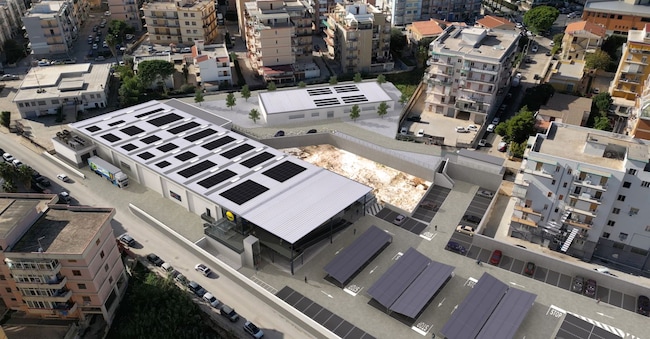
Urbanregeneration is no longer just a playground for developers and real estate funds. Increasingly, it is also the big retailers who are able to transform disused and degraded areas into new service poles for neighbourhoods.
Lidl in Italia for example reaches 800 shops, a quota that will be reached on 26 February with the opening of the new store in Viale Corsica, the largest in Milan. An operation born from the acquisition of a business branch: until last June the shop was part of the Bennet brand, now the property has been taken over - together with its 33 employees - and relaunched under the brand of the German group. Although more complex and costly, today seven out of ten Lidl operations in Italy are linked to a re-development or urban regeneration project; 80% of the properties are also owned by the group.
Redevelopment projects around Italia
"Our standard building format envisages about 1,400 square metres of sales area and 100 parking spaces, but in large centres we can be more flexible, going down to 800 square metres, giving up the parking, to be closer to customers and adapt to the urban area," explains Emilio Arduino, managing director of real estate development at Lidl Italia. The project in viale Corsica - which revived an old shop - is just the latest of the examples of redevelopment undertaken by the German giant.
In Trieste, Lidl has renovated the historic headquarters of the daily newspaper Il Piccolo, transforming it into a modern shop. The ground floor has been completely redeveloped, while a car park has been added to the first floor. In Trento, the group intervened in a degraded area of great social relevance that required major reclamation: a problematic urban void - also from the point of view of safety - that required a significant investment, but which has restored value to a slice of the city. In Turin, Lidl demolished an old industrial building in the city centre and built a new shop with urban gardens on the roof, entrusted to a local non-profit organisation which assigned them to local families. In Syracuse, on the other hand, archaeology and education meet in a Lidl store. The project involved the creation of an outdoor path dedicated to the Roman quarry found during renovation work and - inside the building - floor-to-ceiling glass windows to view the remains. In the area, the company, part of the German Schwarz Group, is also building a primary school as compensation for theurbanisation charges.
The expansion plan and investments
From North to South - in addition to Milan - cities such as Gorizia, Verona, Foligno, Rome, Taranto, Barletta, or Elmas (Ca) and Palermo are part of the expansion plan. Lidl will also open the doors of another11 branches on 26 February, bringing to 24 the number of new shops opened in less than two months: an investment of more than 220 million euro that has created a total of 320 jobs. "The goal is defined: to exceed 1,000 shops by 2030 and become the discount store of reference in Italia. We have at least another ten years of development ahead of us,' Arduino adds. The strategy for the next three years is already mapped out: in 2026 Lidl will look mainly at opening in large metropolitan cities, from Venice to Catania to continue with Naples, Rome, Milan and Turin.
Brand connect


Newsletter RealEstate+
La newsletter premium dedicata al mondo del mercato immobiliare con inchieste esclusive, notizie, analisi ed approfondimenti
Abbonati