
Clashes between students and police at the Bastille. 3,000 supply teachers to be deployed soon
Black Bloc protesters dispersed using water cannons and tear gas. Education Minister Geffray promises new teachers by Tuesday

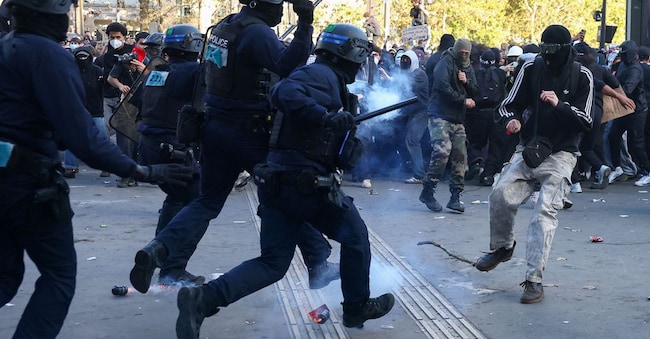
“The protest will continue until Macron gives in.” At the very moment that Parisian students were clashing with the police at the Place de la Bastille – with pieces of chimney being thrown from the roof of a building – a delegation of secondary school pupils was holding a press conference in Marseille: “We’ve been asked how long the protest might last. It will continue until Macron gives in and responds to our demands,” a representative of the Union étudiante told *Le Monde*. “The minister claims our demands are vague. That makes us smile. They are well known; you just have to listen to them.” In the evening, the Minister for Education announced the arrival of 3,000 supply teachers “between tomorrow and Tuesday”. The education budget may also see increases in excess of the 1.2 billion already planned, if necessary.
The Government, however, remains at the centre of the controversy
‘Macron démission’ was also the slogan chanted during what has been dubbed the ‘Storming of the Bastille’ – the demonstration in the square commemorating the now-defunct fortress that was stormed during the French Revolution. Thousands of people were present, and the demonstration soon took a very violent turn due to the involvement of some ‘black bloc’ protesters: cobblestones, fireworks and, according to *Le Figaro*, pieces of chimney were thrown from the roofs of one of the surrounding buildings. The police used water cannons and tear gas to disperse the most violent demonstrators. Place de la Nation, one of the students’ main gathering points, was cordoned off by officers. In Bordeaux, a secondary school was ransacked. In other cities – Marseille, Lyon – the protests – organised in part by school staff unions – were more peaceful. Although the Ministry of the Interior spoke of a ‘rise in urban violence’ across the country. There were 704 arrests and 48 police officers injured; 71,500 people took part in the demonstrations.
Protests against police actions are also showing no sign of abating: a number of incidents have led to the opening of around twenty investigations, and a video showed a police armoured vehicle moving rapidly towards the crowd in Dunkirk on 5 October. The government, however, stands by the police: they do not have ‘disproportionate weaponry’, Maud Bregeon, the government spokesperson (and Minister of State for Energy), told France Info. Young people ‘are not in danger’, the police ‘know how to distinguish between different situations’ and act with ‘proportionality’ and ‘discernment’.
The Government is trying to calm things down
The emergency plan to fill vacant teaching posts was drawn up following a meeting between the Minister for Education, Edouard Geffray, the Minister for Universities and Research, Philippe Baptiste, and the three main secondary school pupils’ organisations: the Union syndicale lycéenne, Renouveau Lycéen and Lycéens!. The movement’s demands, published online, call for a massive recruitment drive for teaching, healthcare, support and careers guidance staff; a rethinking of the organisation of school and university timetables; an end to selection via Parcoursup and Mon Master (the websites designed to collect and manage admission applications from prospective university students); the creation of 250,000 new places in higher education; the reform of school democracy to enable secondary school pupils to participate meaningfully in decision-making; an increase in student grants, with the reinstatement and increase of housing benefit (APL) for all; the opportunity for all students to access meals for one euro; the repeal of the ‘Bienvenue en France’ scheme, which introduces differentiated university fees for international students, and of the CVEC contribution, a 105-euro fee; a freeze on rents in university halls of residence; making the rent control system permanent, alongside the launch of a programme to renovate and build university accommodation; and an end to police violence against students. A major new demonstration is planned for 13 October.


