
Claude: Anthropic changes rules on user data
The artificial intelligence company revolutionises its privacy policy, extending data retention to five years. 28 September deadline to decide

2' min read
2' min read
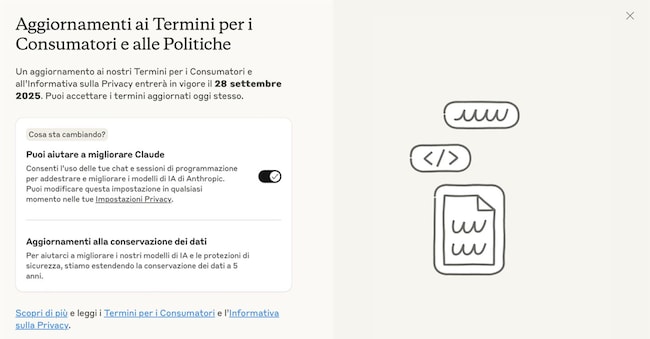
Anthropic is putting all users of the chatbot Claude in front of a crucial choice: by 28 September they will have to decide whether to allow the company to use their conversations to train artificial intelligence models. This is a radical change that marks a turning point in the strategy of the company founded by ex-OpenAI and comes after ChatGPT has been offering this opt-out possibility since May 2023.
The policy revolution
.The change of course is clear. Until yesterday, Anthropic did not use data from consumer conversations for training its models, except on a voluntary basis through user feedback. Now instead, the company wants to use chats and programming sessions, extending data retention to five years for those who do not object. Previously, inputs and conversations were automatically deleted from the servers within 30 days, unless there were legal obligations or violations that could extend retention up to two years.
AI's hunger for data
.Anthropic frames the change as a matter of user choice: those who do not object 'will help improve model security' and contribute 'to future Claude models in skills such as programming, analysis and reasoning'.
In essence: help us help you. But the intentions, though painted in an altruistic and noble tone, are of a practical nature. Like any other artificial intelligence company, Anthropic desperately needs data - more than it cares about brand reputation. Training requires huge amounts of high-quality conversations, and millions of interactions with Claude represent the ideal content to strengthen the competitive position against OpenAI and Google.
The problem of informed consent
.The implementation of Anthropic's new policy follows a familiar pattern: new users will choose their preference during registration, but existing users are faced with a pop-up with 'Updates to Consumer Terms and Policies' and an 'Accept' button automatically set to 'On'. The concern is that users may quickly accept without noticing that they are agreeing to data sharing. For many experts, the confusion created by these changes is tangible. It is true that technological evolution requires policy updates, but many changes are only mentioned in passing.

