
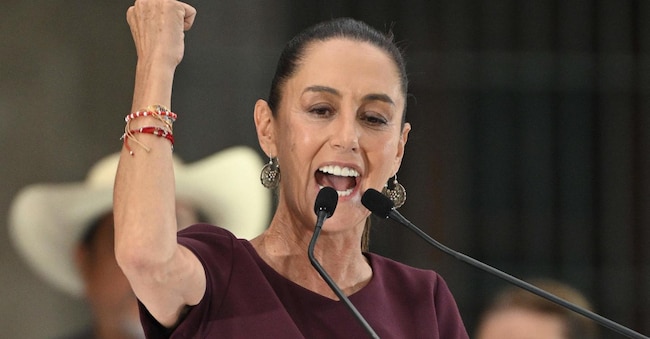
Claudia Sheinbaum: Mexico's first female president and the challenges of her term in office
The candidate of the progressive platform (Morena, Pvem and Pt) beat the challenger Xóchitl Gálvez, representing Pan, Pri and Prd

4' min read
4' min read
He took the Nobel Prize in 2007 with the Ipcc, the UN panel that reports on climate change, but promises that if he wins the challenge for the presidency - as he did - he will continue all the policies of his predecessor Andres Manuel Lopez Obrador, champion of fossil fuels.
This is one of the contradictions she is accused of: being an environmental engineer with expertise in renewables and climate issues, a Berkeley graduate with a university background, but also being too loyal to her mentor. Thus, the fact that Claudia Sheinbaum, 61 years old, will be the first woman to lead Mexico after the elections on Sunday 2 almost passes into the background in a highly polarised country prey to the violence of narcos.
Mayor of Mexico City
The results confirmed the polls, which were largely on her side: Sheinbaum won with the progressive Morena party against another woman, also an engineer, an expression of a right-wing party platform, Xochitl Gálvez. The question is now what she will do. Whether she will break free from the charismatic Obrador who has been banned by the Constitution from a second term, or whether she will continue her policies in the shadow of the man who allowed her rise well before Sheinbaum became mayor of Mexico City in 2018. The partnership between the two dates back to 2000 when Obrador, mayor of Mexico City, named Sheinbaum as the holder of the Environment because he wanted to reduce pollution in the city. But what critics and commentators now remember is the willingness of Mexico's new president to do anything to make her boss happy. And now, twenty-four years later, anecdotes abound about this possible submission of the first woman president to AMLO, the acronym by which Obrador is called.
Others actually report traits of Sheinbaum's character that do not suggest a marked propensity for subalternity. The New York Times reports comments from people who have been part of her staff who paint her as tough, someone who shouts at her staff, in short a bad character. Her biographer asked her about this and received the reply 'I can't stand lazy people'. Sheinbaum also implied that these objections about her character are a sign of sexism and machismo, accusations that are not entirely unfounded given the country in which they were made.
Sheinbaum, a biologist and academic mother and a chemist father, political activists, Jewish but not observant religion, a past as a dancer and guitarist, studied Physics at the prestigious National Autonomous University of Mexico and describes herself as a 'daughter of '68', but she will and should continue the policies of Obrador, who will not only be remembered for doubling the minimum wage and lifting millions of Mexicans out of absolute poverty, but also for being the one who exalted the military, prioritised fossil fuels, and weakened, critics say, the country's democratic institutions.


