
Clear skies, smart flight paths: sustainability in aviation also relies on AI
A UK study to identify the least polluting routes for transatlantic flights. Google will provide the AI-generated maps. Sustainable aviation fuel (SAF) alone is not enough

Key points
From contrails to artificial intelligence, the aviation sector is exploring new ways to reduce its environmental impact. A British trial being conducted on both sides of the Atlantic aims to assess the extent to which simple changes in altitude can help reduce the environmental impact of air travel. Changing the type of aircraft, fuel or engine is not always necessary to make a flight more sustainable. Sometimes, simply adjusting the flight path by a few hundred metres can be enough.
Operation Blue Skies teams up with Google on AI
This is the hypothesis underpinning Operation Blue Skies, a research programme supported by the British government which will involve hundreds of commercial flights in the north-east Atlantic over the next two winters. The aim is to measure in the field whether small adjustments to flight altitudes can prevent the formation of so-called contrails – the condensation trails that, under certain atmospheric conditions, can contribute to global warming. Google UK will also be providing technological support, making available forecasts generated using artificial intelligence to identify areas where atmospheric conditions are most favourable to the formation of contrails.
The operating principle of Operation Blue Skies is relatively simple. During the test windows scheduled for the next two winters, air traffic controllers will be able to ask certain flights to adjust their altitude by up to 2,000 feet – approximately 610 metres – in order to avoid areas where weather models indicate a higher probability of contrails forming. This is not, therefore, a radical overhaul of air traffic management. The adjustments will remain within normal operating procedures and will be coordinated via the communication systems already used by air traffic control.
CO₂: the key indicator of harmful emissions
CO₂ remains the main indicator of harmful emissions from aviation, and reducing it is one of the sector’s most daunting challenges. However, the effects of emissions produced at high altitudes also include phenomena not directly linked to CO₂, such as contrails and aircraft-induced clouds. This makes the search for a path towards climate neutrality more complex. More efficient aircraft, sustainable fuels, electrification and new propulsion technologies can reduce emissions at source. But, at the same time, it is necessary to understand how flight operations can help to reduce the overall impact.
The SAF remains the main tool, but quantities are still low
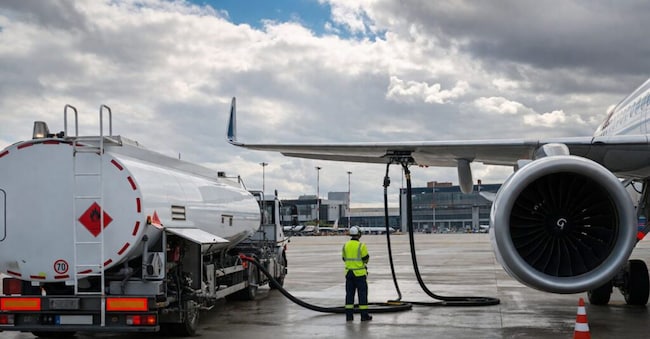
Aviation remains one of the most challenging sectors to decarbonise, despite accounting for only 2–3 per cent of global pollution, and forecasts for growth in demand for air travel are unlikely to reduce its environmental impact. Sustainable aviation fuel (SAF) is regarded as one of the key tools for reducing the climate footprint of air travel because it does not require a change of aircraft or engine, whilst direct electrification remains particularly complex, especially for medium- and long-haul flights.


