The report

Climate, Europe counts the damage: over 790 billion in economic losses. Italy among the hardest hit countries

From Northern to Southern Europe, droughts, floods and fires rewrite the geography of risks and challenge local economies and insurance systems

by Silvia Martelli

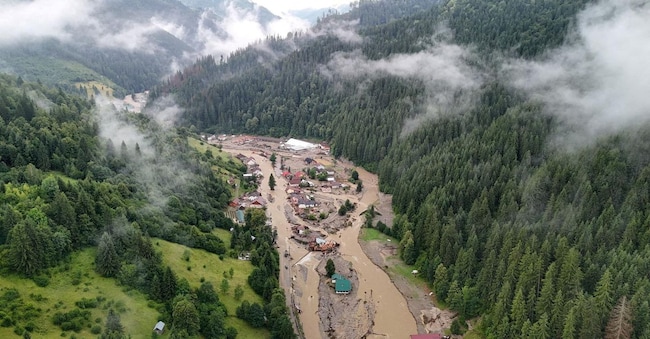
Contea di Suceava, in Romania

5' min read

5' min read

Since 1980, Europe has accumulated economic losses of more than EUR 790 billion due to extreme weather events: floods, droughts, heat waves, fires. This is the dramatic balance sheet drawn by the European Environment Agency (EEA) in its latest report, which accurately portrays a reality in which the climate emergency is now also a structural economic issue. At the centre of this disaster accounting is Italy, second only to Germany in terms of the scale of losses, with a total exceeding 135 billion euros.

Europe and the hefty bill of climate change

The country most affected in absolute terms is Germany (180 billion), followed by Italy (135 billion), France (130 billion) and Spain (97 billion). But narrowing the field to the last twenty years, other players emerge such as Austria, Belgium, the Czech Republic, Portugal, Romania and Slovenia, all with estimated losses of between EUR 12 and 15 billion. The economic impact is unevenly distributed, but the trend is clear: events once considered 'extraordinary' are becoming part of normality.

Loading...

According to EEA experts, the phenomena causing the greatest damage vary according to region: floods and droughts in central and Mediterranean Europe, heat waves and forest fires in the south, and storms and landslides in mountainous and coastal areas. In this scenario, inadequate insurance cover is a further risk factor: in at least 16 EU countries, more than 90% of losses are not covered by insurance. Only Denmark exceeds 50%.

Italy: a fragile country between landslides, floods and drought

With 135 billion euro in damages, Italy is among the countries most vulnerable to climate change. It is mainly the North that is paying the price for global warming, which is increasingly affected by intense cloudbursts and flash floods, while the South faces increasingly prolonged cycles of drought and desertification. ISPRA data confirm that in the last twenty years days of intense rain have increased by more than 30 per cent, while total annual rainfall is decreasing.

In this context, the Italian insurance system is highly inadequate: according to official estimates, less than 10% of damage from extreme events is covered by policies. Italy, unlike France and Spain, does not have a national public-private system for climate risk management. This often leads to post-event emergency interventions, partly financed by EU funds (such as the Solidarity Fund), but lacking a structured and lasting design.

Recent scars: Emilia-Romagna and Sicily

Two of the most devastating events in recent years occurred in Emilia-Romagna, in May 2023, and in Sicily, during the summer of 2022. In the first case, an unprecedented flood inundated 100 municipalities and caused damage estimated at over 9 billion euro, affecting infrastructure, farms and urban settlements. In Sicily, on the other hand, a combination of heat waves and fires led to the destruction of tens of thousands of hectares of forest and countryside, with very serious consequences for agriculture and tourism.

At the level of prevention, Italy has launched some important projects, such as the National Plan for Adaptation to Climate Change (PNACC), which includes interventions on hydrogeological instability, water management and resilient infrastructures. However, implementation proceeds slowly and with often insufficient resources.

Poland: between urban floods and rural droughts

In Poland, average annual losses are estimated at around 6 billion zloty (EUR 1.3 billion), with recent events such as the flooding caused by Cyclone Boris in 2023 leaving behind 13 billion in damage. According to the scholars of the ClimaMeter project, these phenomena are directly linked to climate change, which modifies atmospheric patterns and amplifies the intensity of precipitation.

In the North-East, on the other hand, the water crisis is draining the national parks, compromising natural habitats. The Biebrza National Park has seen its river level drop five times the historical average, with devastating impacts on flora and fauna. In parallel, the risks of self-burning peat bogs are increasing, a phenomenon that could become recurrent.

Spain: fires and desertification

Spain is one of the European states with the sharpest increase in economic losses in recent years. In 2023 alone, damage exceeded 7 billion euros, and in 2022 it was over 11 billion. Flash floods and mega-fires, such as the one that devastated the Levant in 2022, are weighing heavily. Desertification is advancing, and with it water and food risks.

However, Spain has an advanced public-private insurance system, managed by the Consorcio de Compensación de Seguros, which guarantees timely compensation. However, the increase in the frequency and intensity of extreme events is putting a strain on the sustainability of the system.

The country adopted the PNACC 2021-2030, which envisages actions on several fronts: water management, fire prevention, coastal zone regeneration, energy efficiency and resilient infrastructure.

Czech Republic: forests decimated and agriculture at risk

The Czech Republic faces two phenomena above all: drought and torrential rain. The annual damage varies between EUR 2 and 4 billion, but the most serious problem is the loss of spruce forests, decimated by the spruce bark beetle (a pest favoured by the warmer and drier climate). The losses particularly affect agriculture and forestry, vulnerable sectors that lack a systemic safety net.

The government intervenes with European funds to encourage reforestation with more resistant species, improve soil management and promote sustainable agricultural practices. However, insurance coverage remains low and fragmented, with compensation only for exceptional disasters.

Insurance: the great European void

At European level, the insurance gap is a critical issue. On average, less than 25% of losses are covered by insurance. And in 16 EU countries, the uncovered share exceeds 90%. Only Denmark has insurance coverage above 50%, thanks to a mature and universally spread system. The experiences of France (CCR) and Spain (CCS) represent replicable models, but still little adopted in the rest of the continent.

Italy is among the most backward countries, with an insurance market that is still marginal compared to the actual risk. The absence of insurance obligations for individuals and businesses, combined with a lack of awareness of climate risk, exposes the country to structural fragility.

Towards a common strategy?

The European Commission has launched studies and consultations to propose an EU system of protection and insurance against natural disasters, but we are still far from real harmonisation. The European Green Deal and the Next Generation EU funds represent an opportunity, but we need solid, integrated and permanently funded adaptation plans.

The road is marked: without a shared continental strategy, Europe risks finding itself more unprepared, more vulnerable and poorer every year in the face of a climate crisis that knows no borders.

*This article is part of the European journalism project "Pulse" and was contributed by Justė Ancevičiūtė (Delfi, Lithuania), Kamil Fejfer (Gazeta Wyborcza, Poland), Maciej Chołodowski (Gazeta Wyborcza, Poland), Petr Jedlička (Denik Referendum, Czech Republic) and Ana Somavilla (El Confidencial, Spain)

Copyright reserved ©
Loading...

Brand connect

Loading...

Newsletter

Notizie e approfondimenti sugli avvenimenti politici, economici e finanziari.

Iscriviti