
Comacchio: birdwatching sets a precedent
In the heart of the Po Delta Park, a training course designed to promote the proper observation of birdlife

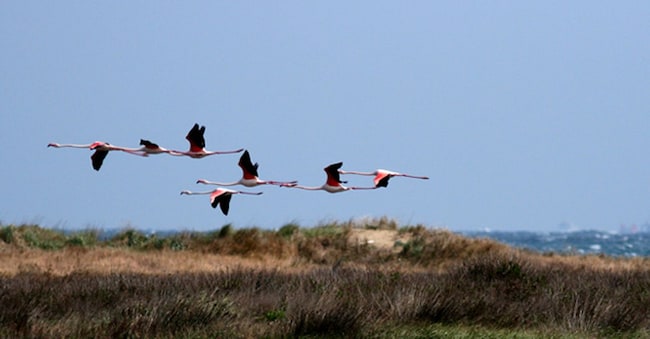
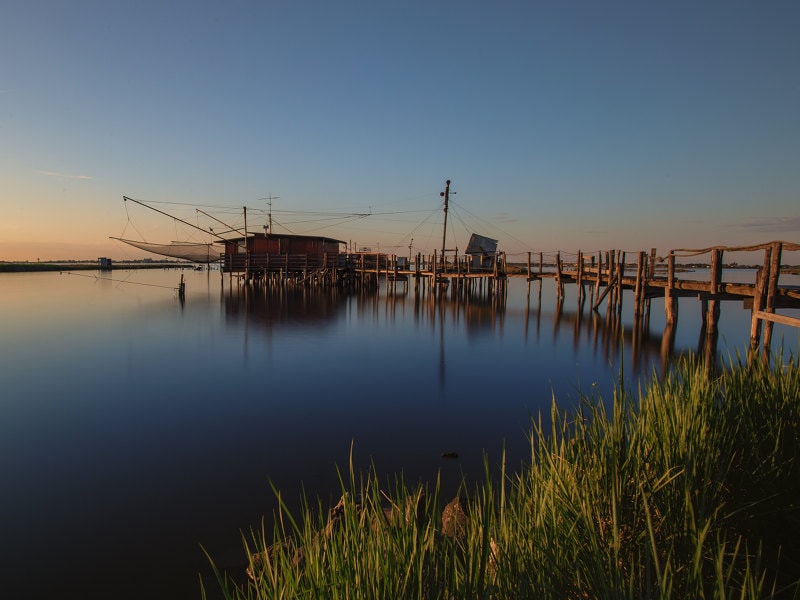
COMACCHIO. Sturdy yet vaguely graceful, the casoni jut out over the water, suspended amongst the myriad wires of the balancing beams, which, in a tangled web on the horizon, divide the sky into segments and rectangles. And it is they who set the pace along the embankments, as you wander on foot or, better still, by bicycle, whilst your gaze is lost in the mirror-like surface of a water that inevitably smells of salt and sourness. And it is the Delta—the legendary and beloved mouth of the Po—that determines its banks and boundaries, and that overturns, patches up and blurs the shapes that centuries upon centuries of human activity have etched into a composition of marshy meanderings, which, beneath the scorching sun of this unusual heatwave, almost seethes with heat and life. For the Po Delta Park is one of Europe’s most important birdwatching hotspots, where 370 species can be observed, according to the most recent censuses. And the strength of this seemingly chaotic ensemble lies in its extraordinary concentration of different habitats within a relatively compact area. Within a few kilometres, one can move from salt marshes to reed beds, from brackish lagoons to lowland woodlands, from fishing valleys to river mouths, encountering completely different bird communities. From an educational perspective, the Park offers a rare opportunity: it allows ecology to be explained ‘in the field’. In just a few hours, visitors can be shown how water salinity, the depth of the basins, and the presence of reed beds, salt marshes or riparian woodlands directly influence the distribution of species. Birdwatching thus becomes a tool for interpreting the landscape, understanding migrations and addressing issues such as biodiversity, climate change and wetland conservation.
Aida Morelli
Architect Aida Morelli, the first woman to serve as president of the Parco institution – founded in 1988 – which oversees these enchanted places that line the equally stunning Comacchio – with its bright red brick bridges linking the criss-crossing streams and canals – tells us how the preservation of these fragile habitats stems not from a sense of duty, but from love. “No one truly protects a landscape, a species, a language, a book or a community unless they have first developed an emotional bond with them. This statement is attributed to the Senegalese naturalist Baba Dioum, who in 1968 articulated a thought that has resonated ever since: ‘In the end, we will only conserve what we love; we will only love what we understand; we will only understand what we are taught’. And this is how the mission of this school comes about: to create an emotional connection – like the thrill of discovering the colours and behaviour of little birds perched on branches – to engage people in activities that stir the emotions; activities that are not tangible, but which endure over time. And in this way, to make them fall in love.”
Italia’s first birdwatching school
We were invited here to Comacchio because this is where Italia’s first birdwatching school was founded, which uses artificial intelligence-powered optics for the automatic identification of birds via AX Visio technology. The project, which was conceived and developed in the heart of the Po Delta Park in Emilia-Romagna – one of Europe’s leading areas for the conservation and observation of birdlife – is in fact promoted by the Po Delta Park and Swarovski Optik Italia, a world leader in birdwatching products, under the patronage of EBN Italia, and offers a structured training programme in the fields of birdwatching and ornithology.
And first and foremost, the golden rule: birds should be observed without disturbing them or interfering with them, and it is the techniques for approaching them that teach us this.
Returning to the Birdwatching School, there will be three course levels: basic, intermediate and advanced. The first level is designed to introduce the classification of birds. The courses at the first two levels will be free of charge and will last eight hours over the course of a single day, followed by a practical on-site test. For a self-taught learner, a basic understanding is essential. In addition, guidance on how to enjoy nature whilst always respecting it,

