Astronomy

Lemmon: guide to observing the comet on 21 October

Find out how and where to observe Comet Lemmon on 21 October, an ideal day to admire this celestial spectacle.

2' min read

Translated by AI
Versione italiana

2' min read

Translated by AI
Versione italiana

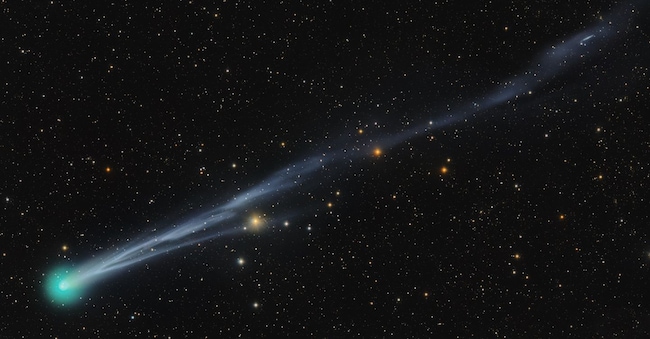
This is it, from 20 October to early November we can see in our skiesthe comet C/2025 A6 - Lemmon, which has been talked about since January. Of course we need to find the darkest possible location, but there is no need to go to the top of a mountain, just get away from the light. In the first week the moon will not be there, which makes it easier to see the faint snowflake that is the nucleus of the comet itself.

Mind you, beautiful pictures of this comet are starting to be taken, but with the naked eye you can see it less, for the reason that the camera accumulates light, while the eye discharges it every tenth of a second. It is still an exciting spectacle of nature.

Loading...

To find it, you can use a free app, such as Stellarium or Starwalk2, which are easy to use, or, more simply, look westwards after sunset, in the direction of Ursa Major, better to use binoculars, or go to a circle of sky enthusiasts who use small telescopes, which are excellent for this type of observation,

The comet was seen and catalogued last January, by the Mount Lemmon Observatory in Californi, which specialises in the discovery and surveillance of small celestial objects, asteroids and comets. It has lived up to its promises, growing in brightness evenly and at its peak, at the end of October, it will become magnitude 4, i.e. above the visibility limit.

It is a comet that has a very long period, so you either see it this time or nothing at all,

In the next few days, with binoculars, you will be able to see not only the nucleus, like a blurry wad, but also its tail, and towards the end of October it will also be higher in the sky, thus more easily observable. C/2025 A6 Lemmon is also visible in the morning at this time, but it takes enough passion to get up a couple of hours before sunrise.

A good day to observe the comet, and also the sky, is 21 October, because there will also be the maximum for a shower of shooting stars, the Orionids, also recurring like those on the night of San Lorenzo, but less well-known to the public.

The comet is approaching the sun and so the action of the radiation and particles forming the solar wind is at its greatest. This action, on the cometary nucleus, which is made up of a mixture of rocks, dust and ice, impacts and heats up the surface, which lets off small solid grains, even under a millimetre in size, that expand into space, forming a trail of tiny mirrors that reflect the sunlight, colouring differently depending on the substance they are made of.

This is how the beautiful comet tail is formed, made of very little matter, almost impalpable, but which in the best cases can reach a length of up to 150 million kilometres, which is a lot even for the distances of the solar system.

It is difficult, one realises, to make precise predictions about this phenomenon, but if all goes well, the spectacle is majestic.

Copyright reserved ©

Brand connect

Loading...

Newsletter

Notizie e approfondimenti sugli avvenimenti politici, economici e finanziari.

Iscriviti