
Commander Luongo: 'AI helps to handle 2.3 million complaints'
Commander General Salvatore Luongo: 'The challenge will be to combine innovation with a vocation for proximity to citizens'

Key points
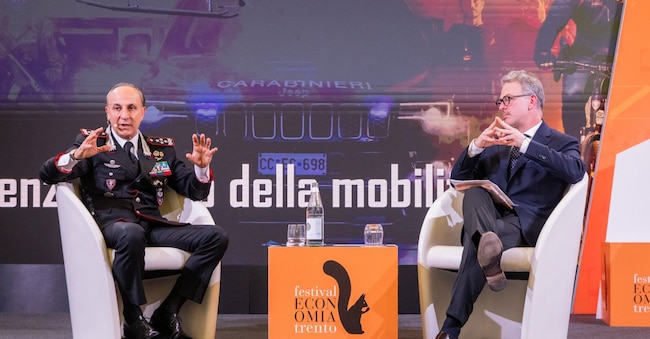
"I imagine the Carabinieri of tomorrow as an institution fully projected into modernity, but without ever losing its identity". At the Trento Festival of Economics 2026, the Commander General of the Carabinieri, Salvatore Luongo, indicated the trajectory for the coming years: technology, training, Stem skills, recruitment of young professionals and garrisoning the territory. Not a simple updating of tools. It is a project of operational and cultural transformation, built to face a crime that is changing skin: less visible, more economical, more digital. But also to speed up the daily relationship with citizens: 2.3 million complaints a year will soon be able to pass through the appIo.
Complaint with appIo
The first test case is precisely this. "We receive an average of 2.3 million complaints," explains the commanding general. "We asked ourselves what we can do to harness technology and speed up the system. Through the appIo it will be possible to file a complaint. Of course, it will still be possible to do this in the stations or barracks, but we are counting on this new channel to make the process faster. We have made a calculation: 61 million hours of low value-added work, 110 thousand tonnes of Co2 and 110 million sheets of paper would be saved. This is the technology. It is an ongoing project, but we will launch it soon.
No backtracking on the territory
Digitising, however, does not mean retreating from the territory. In Luongo's vision, modernity does not break the Carabinieri model. It pushes it forward without breaking the bond of proximity that remains the distinctive feature of the Carabinieri. Technology, he assures, 'will not replace the human factor: it will amplify its effectiveness. It will remain the heart of the mission'. The challenge will be to maintain 'a balanced synthesis between technological innovation and the traditional vocation of being close to the citizen'.
The Seizures of 2025
Speaking in the Depero Room of the historic Palazzo della Provincia in Trento, Luongo linked the future of the Carabinieri to the transformation of organised crime. "In the past year, the Carabinieri have seized over 168 million euro and confiscated around 44 million in investigations against organised crime. These numbers tell a clear evolution: mafias are no longer just about controlling the territory and violence, but real 'criminal holdings' that move according to economic logic to infiltrate the legal economy and alter competition".
"Present in 7,407 municipalities"
If crime changes, the training of those who fight it must also change. From the Station to the specialist departments. "We are present with Tenenze and Stations in 7,407 Italian municipalities, we are the only reference point of legality for 57% of the population: a responsibility that requires us to radically rethink professional training. An ecosystem that is nourished by collaborations with the academic world, especially in the Stem disciplines - science, technology, engineering and mathematics - because we are aware that the exercise of our functions today inevitably also passes through data analysis and the understanding of digital domains".

