Companies, only 24% of CEOs and 32% of managers are women
Rome Business School's study 'Gender Gap and Work in Italy' reveals a still high pay gap to the detriment of women in Italy

7' min read
Key points
7' min read
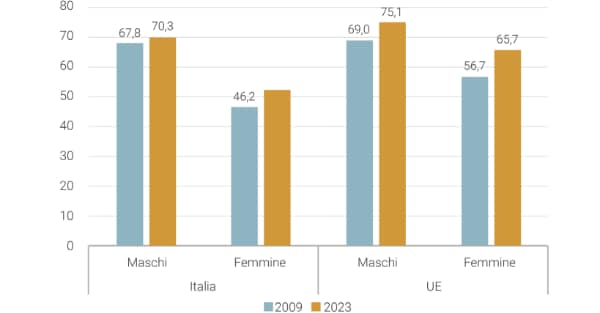
The digital and ecological transitions outlined in the NRP are the challenge of the coming years for the Italian labour market. A challenge that could see women as the great excluded because of an inadequate training for what will be the demands of companies and institutions in terms of specific skills, especially in Stem subjects. Gender inequalities risk being 'the ball and chain' of Italian economic growth, despite the slight positive signs that have come, for example, from female employment, which has reached 52.2%, a historical record, but at the same time a level that is still a long way from the European average of over 60%.
A specific study by Francesco Baldi, Massimiliano Parco and Valerio Mancini of the Rome Business School entitled 'Gender Gap and Work in Italy' was dedicated to the topic. By collecting data from various sources, it creates an overall picture of the current situation in our country in terms of gender inequality.
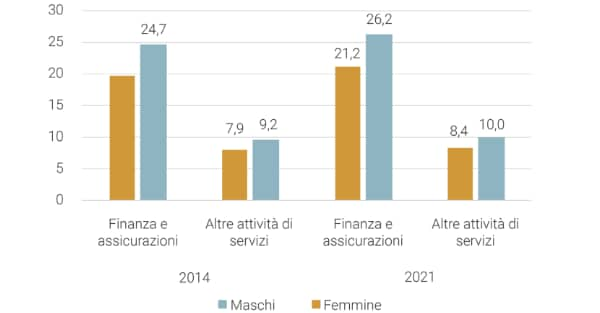
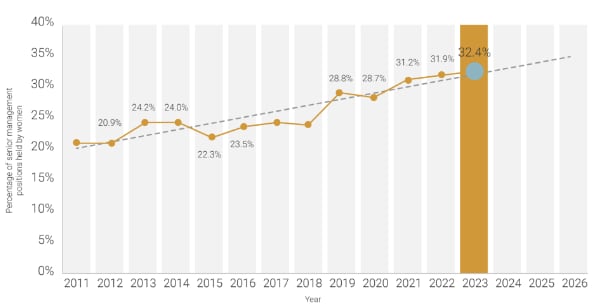
A couple of figures out of all give the measure of the road still to be travelled towards greater equality in our country: out of 17,000 Italian companies, only 28% of managers are women and only 19% occupy a managerial position (Observatory 4.Manager 2022), with an annual increase of +0.3% over the last 10 years; while at ceo level the quota is still 24%. The sectors with the highest number of women at the top are Oil & Gas (39%), Healthcare (38%) and Financial Services (38%), the lowest percentages in the Electricity, Gas & Water, Transport and Real Estate sectors.
Women's employment in Italy
.An overview of the figures for the European Union as a whole and Italy reveals some major differences, as we said, starting with employment rates: Italy has gone from a rate of
female employment rate of 46.2 per cent in 2009 to a rate of 52.2 per cent in 2023, an increase of 6.1 percentage points, while the European Union, on the other hand, increased its female employment rate by an impressive 9 percentage points over the same period, from 56.7 per cent in 2009 to 65.7 per cent in 2023.