
Cross-pollination between food and beauty: it’s a short step from food to cosmetics
The cosmetics sector is growing at a faster rate than the manufacturing sector as a whole, offering food companies both a profitable market in which to differentiate themselves and a way to make the most of raw materials and production waste.

Key points
The food industry is increasingly looking to the beauty sector: the cosmetics sector is growing at a faster rate than the manufacturing sector as a whole and offers food companies both a profitable market in which to differentiate themselves and a way to make the most of raw materials and production waste. In 2025, global turnover in the cosmetics sector reached $610.4 billion, up 2.9 per cent on 2024, according to Euromonitor data.
The sector’s turnover in Italia exceeds 18 billion euros, and is growing, with exports accounting for almost half of this figure. This field is seeing the entry of confectioners, olive oil mills and agro-industrial groups, with partnerships that are now much more than just occasional collaborations.
From the oven to the bottle
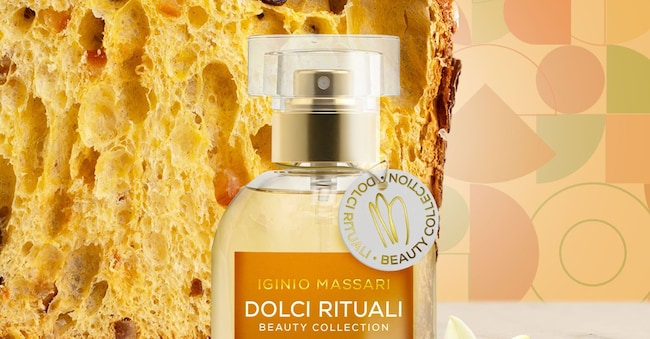
One of the most recent examples involves Iginio Massari, who, with the Dolci Rituali Beauty Collection, has brought the olfactory world of his patisserie to the world of perfumery. The project, developed in collaboration with International Beauty – a company founded in 2024 to develop and distribute beauty brands – was unveiled at Cosmoprof Worldwide in Bologna and hit the shelves in September 2026, featuring five Eau de Parfums inspired by panettone, pistachio, caramel, vanilla and watermelon, as well as shower gels, scrubs and body lotions.
‘The distribution strategy involves entering the perfumery channel – both chains and independent shops – and department stores,’ explains Gianluca De Nicola, managing director of International Beauty. He is not the first pastry chef to move in this direction: the Spaniard Jordi Roca has created three eau de toilettes inspired by his desserts, whilst Sal de Riso from Campania has produced seven fragrances.
The oil that turns into cream
One of the most well-organised initiatives in the olive oil sector in recent months – a sector that has always been linked to beauty treatments – comes from Frantoio Bonamini, in Val d’Illasi (Verona), which in June launched a complete range of cosmetics based on its own organic extra virgin olive oil, scented with iris. The project is the result of over ten years of research, explains Sabrina Sartorari Bonamini, owner of the oil mill: “This marks the rebirth of a project we have believed in for over ten years, back when very few in the olive oil world dared to talk about cosmetics.” The company, which has been in operation since 1965, produces 280,000 bottles of extra virgin olive oil a year; the cosmetics range utilises the same antioxidant polyphenols found in the table oil, incorporated into face creams, soaps and shampoos.
The (anti-waste) coffee supply chain
One of the most frequently cited examples of the circular economy is that of Intercos and Amarey, a start-up founded by the Illy family, which has used coffee silverskin – the film that coats the beans and is discarded during roasting – to produce a cosmetic emollient butter in collaboration with illycaffè. “We want to make the most of all possible types of waste, because we know they are still very rich in molecules that can be reintroduced into other production cycles,” said David Brussa, Director of Total Quality and Sustainability at illycaffè.

