Climate change

Cop29: climate aid agreement with 300 billion a year from advanced countries

The target will be reached by 2035. With private investments, the target rises to 1.3 trillion: a Roadmap will try to show how to get there. Agreement also reached on the global carbon credit exchange. A compromise that displeases everyone and highlights the limits of the multilateral system
by Gianluca Di Donfrancesco

Aggiornato il 24 novembre 2024, ore 01:03

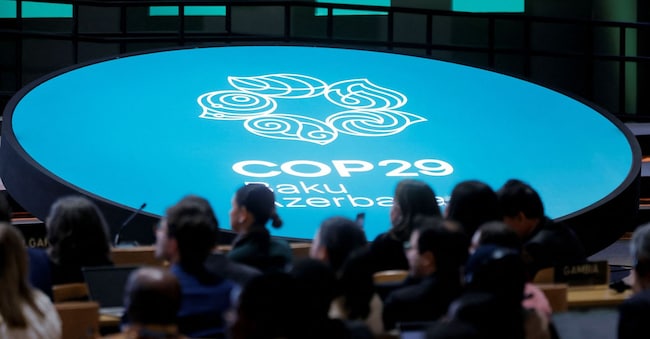
La riunione plenaria della Conferenza delle Nazioni Unite sui cambiamenti climatici, a Baku (REUTERS)

5' min read

5' min read

In the end the compromise arrived, although it satisfied practically no one and whose greatest merit seemed to be that it allowed the Baku CoP to close with an agreement. The negotiations, which were supposed to close on Friday 22, dragged on all day Saturday and into the early hours of Sunday, when the plenary turned green (around 2.40 a.m. local time). The struggle to find an understanding among the almost 200 participating states, the exchange of accusations and the controversy highlight all the limits of the COP system, forced to the ropes by the breakdown of multilateralism.

"Still not enough"

.

The extension of negotiations produced an upward bid by the advanced countries, which agreed to increase bilateral aid to the poorest nations to $300 billion, from Friday's $250 billion (per year, by 2035), at the urging of the United States and the European Union. Triple the current annual pledge due in 2025 and reached two years behind schedule. Resources will be raised through a wide variety of sources, including public funding and bilateral and multilateral agreements.

Loading...

Not enough for small islands, directly threatened by rising sea levels, and less developed nations. Two groups representing over 80 countries rejected the text on Saturday afternoon and temporarily abandoned consultations. Brazil pushed for 390 billion dollars.

The summit was on the brink of collapse for a long time. Then the will to reach some kind of understanding prevailed and, on Saturday evening, signs of a breakthrough arrived, which in the course of hours turned into the final compromise.

Through the involvement of actors such as the Multilateral Development Banks and the private sector, annual financing flows to poor countries should reach $1.3 trillion by 2035. This sum is in line with the demands made before the summit. However, the more resources arrive in the form of loans, the more the recipient countries end up under the burden of repayment charges. Many of them already have high levels of external debt and poor budgetary margins. That is why they demanded that at least 30% of those loans be guaranteed by public finance.

To try and take some of the vagueness out of the 1.3 trillion target, the final text sets out a roadmap from Baku to Belem, site of the next Cop30 in Brazil, to show how it can be achieved.

Advanced countries have been very insistent on involving rich states such as Saudi Arabia, China and India in binding bilateral aid. Emerging economies are encouraged to provide aid, but have no obligation, and their money does not count towards the 300 billion. Beijing made it clear during the summit that it has no intention of accepting constraints.

Weighing on the whole game is the Trump boulder: if the president-elect takes the US out of the Paris Agreement (as he has promised to do), how much will the commitments made in Baku be worth?

The clash over fossil fuels

.

Europe and the United States have tied the aid dossier to the reconfirmation of the commitment, made at last year's Cop28 in Dubai, to gradually 'transition away' from the use of oil and gas, as well as coal, in the face of resistance from the petro-states, Saudi Arabia in the lead, and the large consumers of fossil fuels among the emerging economies.

The clash, which had been going on since before the summit began, ended with a separate text calling on the parties to 'contribute to global efforts' towards that goal, without explicitly mentioning fossil fuels.

On 12 November, the day after the opening of Cop29, Ilham Aliyev, President of Azerbaijan and host, called oil and gas 'gifts from God'. Azerbaijan's economy is heavily dependent on fossil fuel revenues, which account for 60 per cent of state revenues and 90 per cent of export revenues, which are increasingly directed towards the European Union in search of sources of supply after the Russian invasion of Ukraine.

Saudi Arabia has always obstructed action to reduce the use of fossil fuels and was described at Cop29 as a 'wrecking ball'. The Saudi delegation was even accused of tampering with the draft text circulated by the Cop presidency.

The German Foreign Minister, Annalena Baerbock (of the Greens), was very explicit on Saturday: 'We are in the middle of a geopolitical power game by a few fossil fuel producing states playing on the backs of the poorest and most vulnerable countries.

Cop system in crisis

Increasingly open criticism has hit the Azerbaijani presidency, accused of a 'deplorable lack of ambition' by the Canadian Minister for the Environment, Steven Guilbeault.

In a surreal atmosphere, the president of Cop29, Mukhtar Babayev, convened a plenary around 8pm on Saturday (local time), with nothing concrete to put to the vote, but submitting to the parties the consideration of procedural issues that are usually approved at the end. The plenary was then adjourned and reconvened several times until the final call, leaving the floor rather bewildered.

Since the 2021 Glasgow COP, multilateral climate action has become frayed, exhausted, in a context of deepening geopolitical tensions, with the war in Ukraine and the Middle East threatening to widen. Successive summits, in Egypt in 20023 and in Dubai in 2023, have already produced insufficient results in the face of the challenge of global warming, which rises along with the death toll and damage caused by extreme weather events.

The reactions

.

India, now accustomed to last-minute twists and turns at the Cops, opposed the agreement, but only after it was formally adopted by consensus. Thus without any concrete effects. For correspondent Chandni Raina, 'the result clearly highlights the unwillingness of developed countries to take responsibility. This document is nothing but an optical illusion'.

For Nigeria, the USD 300 billion per year by 2035 is a 'joke'.

UN Secretary-General Antonio Guterres puts on a good face: 'I had hoped for a more ambitious outcome, both financially and in terms of mitigation, but this agreement provides a foundation on which to build. It must be fulfilled: commitments must quickly become cash".

The EU did not get what it wanted on cutting greenhouse gas emissions, as Commissioner Wopke Hoekstra acknowledges: 'We managed to safeguard Dubai and make some progress. It is less than we would have liked, but it is better than we feared'.

The environmental organisations are critical.

The Carbon Credit Exchange

.

A long-awaited result was achieved with the agreement on rules for the global market for the purchase and sale of carbon credits, under the auspices of the United Nations.

After almost ten years of negotiations, this understanding should give credibility and transparency to the mechanism. Credits can be created through projects such as planting trees or building wind farms in a poor country. Countries and companies can buy these credits to help achieve their climate targets.

The launch is planned for next year. The agreement had been announced on the first day of the Baku Conference, but further negotiations were needed to finalise a separate bilateral system allowing the countries to trade directly. Among the issues to be settled were the structuring of a registry to track credits, how much information the countries should share about their bilateral agreements, and what happens when projects fail.

According to Ieta, a business group advocating the expansion of carbon credit trading, an exchange under the UN umbrella could be worth $250 billion a year by 2030 and help offset an additional 5 billion metric tonnes of annual emissions.

Brand connect

Loading...

Newsletter

Notizie e approfondimenti sugli avvenimenti politici, economici e finanziari.

Iscriviti