
Crisis and global uncertainty, a recipe for overcoming them
Daring and looking to the long term: Bergami, Canzonieri, Mazzotta and Visentin draw the map of individual and collective risk behaviour

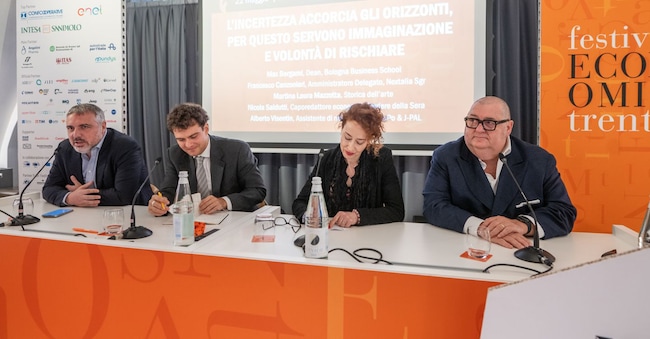
The list of crises since the 1990s is well known. Francesco Canzonieri, CEO of Nextilia Sgr, 2.2 billion in assets under management that will become four at the end of the year, he rolls it out like a lay rosary of finance: the Asian crisis, Cirio-Parmalat, subprime mortgages, sovereign debt. Then, from 2013 to 2019, the quiet before the pandemic. "Finance does not manage money," he says, "but uncertainty and risk. The most common mistake is to look at the everyday, narrowing the field of vision and losing the horizon. But it is precisely in crises, in risk management, that opportunities arise. Crises are not the end of the world. My first American boss liked to repeat that if you walk through hell, you have to keep going because at the bottom there is light, the way out'. Imagination and willingness to take risks are needed, as the title of the panel moderated yesterday at the Trento Festival by Nicola Saldutti, chief economics editor of Corriere della Sera.
Imagination. Imago, image, explains art historian Martina Mazzotta. The ability to see symbols, to conceive and form ideas from seemingly absent images, whose exact boundaries are impossible to trace, but in which we find constants that bring us closer and, as Goethe said, allow us all to feel like cousins, from Athens to Native Americans. Down the centuries and across borders.
Each on his or her own individual journey, born in the maieutic journey of education, in which the master teaches the pupil the art of learning, argues Max Bergami, dean emeritus of the Bologna business school. Methods, says Bergami, help up to a certain point. Management theories of planning cannot foresee the, indeed, unforeseen event, the uncertainty that attacks the link between cause and effect. Only learning to learn makes you an actor in the story you write.
A different story at every latitude. Alberto Visentin, economist at Sciences Po, studies Sub-Saharan Africa. His reasoning shifts the geopolitical horizon. In developing countries, he explains, risk management is about existence and runs on completely different dynamics than in the West. Banerjee, Duflo and Kremer, Nobel economists, recounted in an article for the WSJ that in Indonesia 75% of the population was unaware of the 2010 crisis. In Sub-Saharan Africa, 70% of the population will be under 35 years of age in 2035. It will be the young people who will manage the crisis and have the privilege of being able to take risks.
Will they know, in the end, after probing every algorithm and model, to act from the gut, as Canzonieri advises? Certainly better than the youth of the western world, children of henpecked parents and reluctant to emancipation. It is no coincidence, argues Canzonieri, that Africa and Asia are growing at double-digit rates, while the West is trudging along at zero point rates, with few leaders capable of making difficult decisions and taking others along. We need, as Mazzotta says, men capable of creating new maps from the rubble of old cultures. Like the Dadaists after the Great War, like all the avant-gardes capable of going beyond the past. We need generations who, as Bergami says, break out of the stigma of failure and enter into the culture of error as a tool for learning. Did you make a mistake? You are learning. Young people who, as Visentin says, are given the chance to take risks, in a system built, even by institutions, to give up a little immediate utility for a big advantage in the future. There is light at the bottom, which is perhaps the long culture of the horizon.


