
Crosetto: ‘We must maintain a presence in the Arctic.’ Tajani: ‘Without the armed forces, we cannot safeguard the national interest.’
The Second National Defence Conference on the Arctic and Antarctic. Tajani emphasises the issue of critical raw materials: “Look to Greenland”. Chief of the Defence Staff Portolano: “The North is having an ever-greater impact on the international balance of power, and its effects can be felt as far as the Mediterranean.”

Key points
The geography of security has changed. The Arctic is much closer to us than geography would suggest. It is no longer a periphery but a strategic frontier, along which the Chinese and Russians are moving to safeguard their own interests. It is a strategic area for the security of the North Atlantic Treaty Organisation. This is the message emerging from the Second National Defence Conference on the Arctic and Antarctica (“The National System in the International Arena and the New Challenges of Global Competition”), which is taking place on Thursday 29 October in Rome at the headquarters of the CASD, the Centre for Advanced Defence Studies.
In this scenario, Italia does not intend to play catch-up, but aims to be at the forefront. Deterrence is also at stake in the polar regions. “What happens in the far north has repercussions from the Atlantic to the Mediterranean,” explains the Chief of the Defence Staff, General Luciano Portolano. In his address, he highlights the fact that ‘the Arctic falls squarely within the scope of the Alliance’s collective defence. It is no coincidence,’ he adds, ‘that our document – the military defence strategy document, which has been adopted in Italia for the first time – lists the Arctic among the areas of significant interest. And from this framework, in my view, a number of strategic implications arise. The first – explains Portolano – is that the North is having an ever-greater impact on the international balance of power, and its effects can reach as far as the Mediterranean. The other implication is that competition at the poles does not arise suddenly but advances gradually. And finally, deterrence also comes into play in the polar regions. But I would like to be a little clearer, to go into a bit more detail. With regard to the growing influence the Far North is acquiring and the possible repercussions for our security, I wish to emphasise that, whilst the wider Mediterranean remains the sphere of influence for our military capabilities, we cannot overlook what is unfolding in the North-West, including the polar regions.”
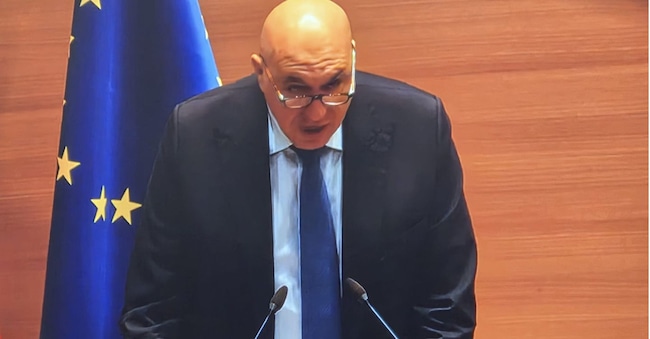
Echoing Portolano’s views, the Minister of Defence Guido Crosetto. “The Arctic is one of the key factors in future scenarios and the balance of power between nations, and for this reason it must be safeguarded, because anything that is crucial to a potential future enemy becomes important to us,” he stated in his speech. The gradual development of Arctic shipping routes could, however, create new vulnerabilities for Russia itself. Crosetto raised the possibility of new choke points emerging – strategic maritime passages whose control could enable European and Scandinavian countries to exert pressure on Moscow. “Any tap that I can turn off in some way to try and make someone who is unwilling see reason is an additional tool,” he explained.
According to the minister, the Arctic is therefore one of the regions where the future balance of power between nations will be determined. Hence the need for Italia to establish its own military, scientific and diplomatic presence in the region, including through cooperation with its allies.
The minister has just returned from a working visit to Finland, where he met his Finnish counterpart, Antti Hakkanen. During the meeting, as he reported in a post on X, emphasis was placed on “the strategic importance of the Baltic, the Arctic and the High North for security, navigation and the protection of trade routes and critical resources”.


