Havana-Washington

Cuba, the turning point: the director of the CIA at the table with the island's intelligence services

Havana accepts aid ($100m) offered by the US

by Roberto Da Rin

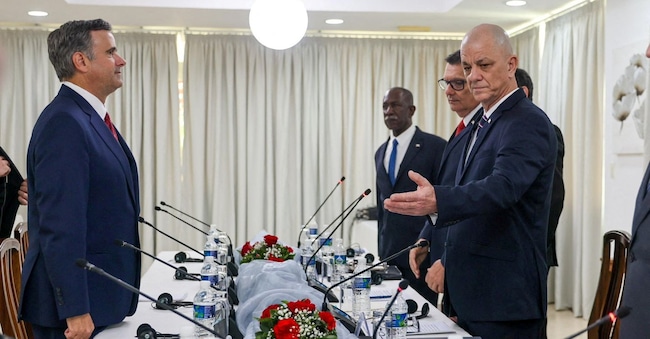
Il direttore della CIA John Ratcliffe partecipa a un incontro con funzionari cubani in un luogo indicato come L'Avana, Cuba, in questa immagine diffusa il 14 maggio 2026.     CIA via X/Handout via REUTERS

2' min read

Translated by AI
Versione italiana

Key points

  • John Ratcliffe (Director of the CIA) met with the leadership of Cuba's Interior Ministry.
  • Energy emergency results in hospitals not being operational
  • The UN alarm

2' min read

Translated by AI
Versione italiana

An unimaginable scene, for decades. And yet it happened. In Havana itself. The Director of the CIA, John Ratcliffe, sat at the same table as the Cuban Interior Minister and the Head of Intelligence of the island.
The US State Department, as a prelude to the meeting with the CIA, issued a statement offering the island 100 million dollars in aid, accepted by the Castro regime on Thursday, in exchange for 'significant reforms of the Cuban communist system'.

The meeting between Ratcliffe and the Cuban government leadership, documented by photos released by the US intelligence agency itself, is so far the most important stage in the two months of opaque negotiations between Washington and Havana.

Loading...
Fiaccolata all'Avana per protestare contro le minacce degli USA

A stunted dialogue 

Both sides announced their commitment to 'seriously address economic and security issues', just when the energy and food emergency is at its harshest: the US embargo has become suffocating over the past four months.

The day before the Boeing C-40B Clipper, the state plane, landed in Havana with an official delegation led by CIA director John Ratcliffe on board, the Cuban authorities had announced a catastrophic new report on the war situation. "We have absolutely no fuel . We have no more reserves,' Minister of Energy and Mines Vicente de la O Levy told Cuban television.

The crisis in oil and gas supplies is causing serious problems for essential services such as hospitals and transport. Cubans, increasingly at the limit of their strength, are demonstrating with cacerolazos, concerts of pots and lids.

Since Trump's targeting Cuba, immediately after the blitz in Caracas to take Venezuelan President Nicolás Maduro by helicopter to a New York prison, there have been many contradictory signals about the future of the island.

The White House allowed the arrival last March of a Russian tanker with 100,000 tons of crude oil on board, capable of temporarily easing Cuba's suffering, but a few days later Trump issued hostile statements: 'We will conquer Cuba almost immediately'. An alternation of threats and small concessions.

The UN alert

Meanwhile, the UN Agency for Health in America (Paho) has raised the alarm over the drastic reduction in ambulances and diagnostic services, such as CT scans. According to The Lancet Oncology, a prestigious scientific publication, 16 thousand cancer patients have had their radiotherapy interrupted due to blackouts. Another 12 thousand had to stop chemo. "What we saw in Cuba shocked us," denounced in The New York TimesDemocratic Congressmen Pramila Jayapal and Jonathan L. Jackson who, in April, travelled to the island with a Congressional Foreign Affairs Committee mission. 'If Americans knew the scale of the tragedy,' they concluded, 'they would demand an immediate end to the blockade.

Yet every night, on the Malecón, Havana's seafront, thousands of young people gather. With their sublime ability to ...live in spite of.

Copyright reserved ©
Loading...

Brand connect

Loading...

Newsletter

Notizie e approfondimenti sugli avvenimenti politici, economici e finanziari.

Iscriviti