Combating undeclared work

From undeclared rents to beach resorts, here’s the summer tax evasion uncovered by the Guardia di Finanza

Wide-ranging checks to protect compliant laboratories and businesses

La Guardia di Finanza ha effettuato operazioni contro abusivismo commerciale, caporalato ed evasione fiscale su concessioni demaniali

4' min read

Translated by AI
Versione italiana

4' min read

Translated by AI
Versione italiana

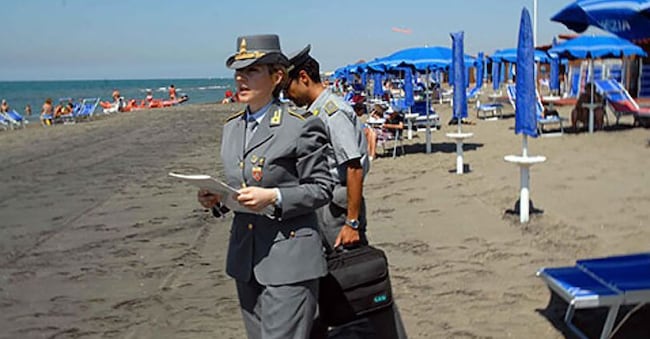
Illegal commercial practices, illegal labour recruitment and tax evasion relating to state-owned concessions. These are some of the offences at the heart of the latest operations carried out by the Guardia di Finanza to protect businesses that comply with the rules and to combat the practices that distort the market by depriving the community of resources. From Treviso to Vibo Valentia, via Rome and Bari, the Guardia di Finanza is continuing its efforts to safeguard the country’s healthy economy and penalise entrepreneurs operating illegally, carrying out wide-ranging checks.

Illegal accommodation

In Rome, as part of the crackdown on unauthorised accommodation, the Gdf has identified and fined four establishments that were operating illegally as hotels. Three of these were formally registered as guesthouses, whilst the other was registered as a tourist rental. The establishments, which are located near Termini station, were fined over 120,000 euros and ordered to suspend their activities until their administrative and tax affairs have been fully regularised.

Loading...

According to the Italian Finance Police’s findings, the three guesthouses each had eight rooms, exceeding the maximum limit of six laid down by regional law. Furthermore, the Gdf noted the absence of the National Identification Code (CIN) – a unique alphanumeric code mandatory for all accommodation establishments – on the outside of the buildings and on online booking platforms.

The premises, registered as tourist accommodation, had 13 rooms with a total of 34 beds. The business was providing customers, without authorisation, with centralised services typical of hotels, ranging from a 24-hour reception to daily linen changes and the serving of food and drink. The owner was charged with failing to register for VAT, failing to keep the mandatory accounting records and failing to have an electronic cash register for the transmission of payment details.

Beach resorts

In Bari, meanwhile, the Guardia di Finanza’s Naval Station has dismantled a complex system of exploitation of seasonal workers at a beach resort. At the heart of the investigation is the offence of illegal recruitment, a phenomenon which, according to the Finance Police, is ‘increasingly common and affects numerous sectors of the maritime economy’. Four people are under investigation, including an employment consultant who is alleged to have ‘adjusted’ the payslips to make the figures add up. The Finance Police have pre-emptively seized all the company’s assets, including property, cars, financial accounts and a state concession.

The investigations have uncovered a criminal scheme designed to exploit the work of lifeguards and other seasonal workers, who were forced to hand back in cash a portion of the wages they received in their pay packets. The cash was then used to pay other workers under the table, particularly during music festivals and other events. According to calculations by the Italian Tax Police, the actual wages of the employees – often young people in their first job, in need and facing complex social circumstances – were estimated to be between 2 and 5 euros gross per hour.

Still on the subject of seaside resorts, the Air and Naval Operations Department of the Guardia di Finanza in Vibo Valentia has uncovered irregularities concerning local IMU taxes, government concessions and state property fees along the coastline. Numerous defaulters were identified who had allegedly failed to pay IMU on properties built on state-owned maritime land held under concession. Specifically, a sole trader operating in the catering and beach resort sectors is alleged to have occupied state-owned land without ever paying IMU for the years 2021 to 2025.

Undeclared work

In Vibo Valentia, between 1 January and 31 July 2026, the Guardia di Finanza carried out 16 inspections of an equal number of commercial businesses operating in various economic sectors. The aim was to curb the spread of undeclared work, which the Guardia di Finanza describes as ‘one of the country’s greatest social and economic scourges, as it fuels exploitation, social injustice, unfair competition, and tax and social security evasion’.

The investigation led to the identification of a total of 98 workers, 30 of whom were working entirely off the books, without a proper contract or even the most basic forms of protection. In a further 13 cases, however, the work was irregular: often, part-time contracts concealed full-time employment with pay below the statutory rate, and, in other cases, it emerged that probationary periods had been carried out entirely without any formal employment contract. The Labour Inspectorate therefore ordered the immediate and temporary closure of six companies, whilst, in one particularly serious case, a business was permanently closed down by the Provincial Administration of Vibo Valentia.

With the arrival of summer, the Vibo Gdf’s inspections then focused on the tourism sector: as part of an operation carried out at a beach resort, fines ranging from a minimum of 20,000 to a maximum of 117,000 euros were imposed.

Loading...

Finally, still on the subject of undeclared work, the Treviso Financial Police carried out inspections at 22 businesses over the weekends in June and July when customer numbers were at their highest. The operation led to the identification of 27 workers employed without proper documentation, 26 of whom were working entirely off the books. The fines will range from a minimum of around 64,000 euros to a maximum of over 371,000 euros. Furthermore, in four of the premises inspected, breaches of the obligation to record sales takings were also identified. The fines amount to 70 per cent of the VAT relating to the unrecorded service or supply, with a minimum of €300.

Copyright reserved ©
Loading...

Brand connect

Loading...

Newsletter

Notizie e approfondimenti sugli avvenimenti politici, economici e finanziari.

Iscriviti