Intellectual property

Daren Tang: ‘Intangible assets as collateral for business loans’

The Director General of WIPO: discussions with Confindustria and a study by Luiss Business School to prepare a pilot project in Italia. “Europe needs funding to help good ideas flourish.”

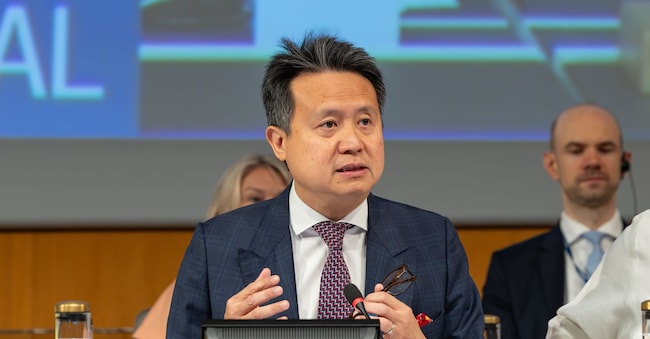
Daren Tang, direttore generale dell’Organizzazione mondiale della proprietà intellettuale (Wipo)

4' min read

Translated by AI
Versione italiana

4' min read

Translated by AI
Versione italiana

A plan to promote the use of intellectual property as collateral for loans. This could open up a new source of funding for Italian SMEs, recognising the value of ideas alongside that of property and machinery. Daren Tang, Director-General of the World Intellectual Property Organisation (WIPO), who was recently on a mission to Rome to meet with institutional representatives and speak at a Luiss Business School conference on intangible assets, outlined the path forward in an interview with Il Sole 24 Ore: a study by Luiss Business School (which has been collaborating with WIPO since 2023 through Global INTAN-Invest, the international research programme established to measure and monitor investment in intangible assets), discussions with Confindustria and the search for partners for a pilot project. ‘Innovative entrepreneurs should be able to access funding by capitalising on the strength of their ideas and their creativity, not just on the tangible assets they own.’

Where does Italia stand?

Loading...

We have had extensive discussions with Confindustria regarding funding based on intellectual property. The Luiss Business School is currently examining this issue: what is happening in Italia, where the country is strong and where it needs to develop further in this area. Based on the findings of this study, we will be able to develop very concrete initiatives. Italia is a prime example of this challenge. SMEs account for 99 per cent of Italian businesses and over 75 per cent of employment. They are also highly innovative: Italia ranks second in the EU for trade marks and designs and fifth for patents. Yet much of this intellectual property is not reflected in businesses’ ability to access funding.

What are the obstacles?

There are three main reasons. Firstly, many credit institutions still lack the experience and tools needed to value intellectual property as a financial asset. Secondly, a reliable valuation of intellectual property can be complex and costly, particularly for smaller loans. Finally, the legal frameworks and markets that enable intellectual property to be used as collateral remain fragmented and underdeveloped in Europe.

So what should we do?

These factors make lenders reluctant to recognise the full value of intangible assets. We are therefore helping them to better understand intellectual property, building local expertise in valuation, and supporting practical initiatives that enable lenders to gain experience in loans secured by intellectual property.

Are there any examples that demonstrate the feasibility of this model?

In the UK, a pilot scheme was launched a couple of years ago by NatWest, one of the British banks. Since its launch, it has granted over 20 loans using intellectual property as collateral. The opportunities in this field are considerable, particularly for an economy such as Italy’s. We are working on this with Confindustria. The challenge is not to create more valuable intellectual property, but to make the value that already exists more visible and usable in the financial markets.

What should we ask European governments to do to help innovative businesses grow?

Loading...

The most important thing is to create financing instruments – in the form of both venture capital and debt – that enable good ideas to be funded and to grow entirely within Europe. Otherwise, European innovators will look elsewhere in the world to find the funding they need to grow.

What are your impressions following your meetings with Italian institutions?

Sometimes Italians are too pessimistic about the future. You have been innovating for hundreds of years. You already have very solid foundations. The modern intellectual property system was established in Venice in 1474. Now you need to ensure that you pay attention to intellectual property and innovation policies, and that these also become an explicit part of public policy.

WIPO data show that Italia is one of the few advanced economies in which, over the last decade, investment in tangible assets has grown faster than investment in intangible assets. Is this a warning sign for competitiveness?

I would regard this as a trend worth keeping an eye on. In Italia, investment in tangible assets accounts for around 15 per cent of GDP, whilst investment in intangible assets is only around 9 per cent. Furthermore, over the last decade, investment in tangible assets has grown more rapidly: by 5.2 per cent per year in real terms, compared with 3.6 per cent for investment in intangible assets. Sweden provides a useful point of comparison: there too, investment in tangible assets accounts for around 15 per cent of GDP, but investment in intangible assets stands at 17.4 per cent. There is no automatic link between higher investment in intangible assets and faster economic growth, particularly in the short term. But the positive signs are clear.

On artificial intelligence: the US, Europe and China are developing different approaches to AI and copyright. How serious is the risk of ending up with a fragmented global system where the use of protected content is lawful in one country but unlawful in another?

The risk is real, but differences between national laws are nothing new. When it comes to AI and copyright, we need to make progress on two fronts. Member States must continue their dialogue on policies and regulations, whilst creators, rights holders and AI developers must build the practical tools and standards that will enable different systems to be interoperable.

Copyright reserved ©
Loading...

Brand connect

Loading...

Newsletter

Notizie e approfondimenti sugli avvenimenti politici, economici e finanziari.

Iscriviti