Space Economics

Data and humanity: how space helps fight climate change

The testimony of Italian astronaut Luca Parmitano, who documented the devastating effects of climate change from above

by Giovanna Mancini

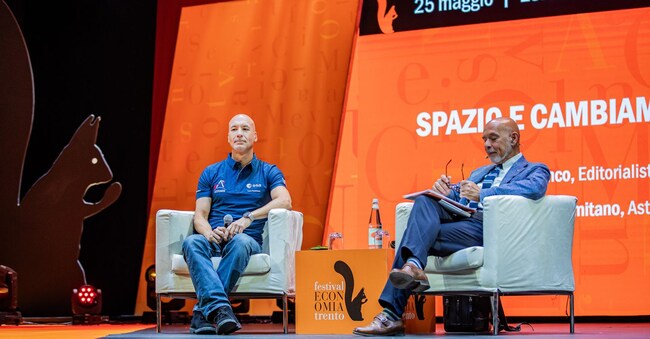
Spazio e cambiamento climatico  Nella foto:  Luca Parmitano, Enrico Franco

5' min read

5' min read

It is said that distance helps to reduce problems, but this is not always the case. There is one problem - a very big problem - that looks even bigger from afar and that is climate change.

Photographing it - in a literal sense - was Luca Parmitano, Italian astronaut of the European Space Agency (ESA), who spoke at the Trento Festival of Economics to discuss 'Space and Climate Change', showing the audience some images he had taken from above (from very high up).

Loading...

Climate Change as Photographed from Space

"Climate change is a process, so from space we cannot see it in a precise manner, but we can document its effects over time,' explains the astronaut, who was in space for the first time (the first Italian to carry out an extra-vehicular activity) in 2013, when the problem had not yet taken on the urgent nature it has today, and returned six years later, when the situation had rapidly deteriorated.

"In particular, I remember my upset when we flew through the Amazon rainforest in 2019," he says. "In 2013, flying over that area of the earth meant flying for about six minutes over an unbroken carpet of green, which gave a great sense of serenity. Just six years later, that carpet had been reduced to a series of patches stolen from the forest to create agricultural areas in which to raise animals to meet the very high demand for beef,' he says. Parmitano points out that his is not a criticism of the local people, who are trying to create the conditions for a better life for themselves, but of the system of unequal distribution of wealth and consumption.

In addition to the deforestation of the Amazon Rainforest, Parmitano and his colleagues have documented many other effects of climate change: huge hurricanes, so vast that they cover the entire Earth's ice cap (like Dorian, which had devastating effects in 2019 on the Bahamas), devastating fires, floods. "Space research can do this to contribute to the fight against climate change: provide documents and data, which will then be used by other scientists and which, above all, should then guide the political choices of Earth's leaders," explains the astronaut.

And he who has ears to hear will hear.

Here, from a distance, perhaps what really changes is the perspective: a perspective uncontaminated by contingent issues, which are certainly important, but which often generate a short-sighted, short-term vision. A perspective that looks at possible developments in research and the effects on the lives of future generations and the planet.

Parmitano: “Il nostro nemico comune è il cambiamento climatico”

Astronauts' message to politics

The message that the Esa astronauts sent, in 2019, to the politicians gathered at the time in Madrid for COP25 stems from this perspective. "There are two ways to keep people together," Parmitano explains. "One is populist, which consists of creating a common enemy around which to unite. The other, the one we in the space agencies choose, is to instead have a common dream, because that of science is a common world, made up of people from different countries and cultures, who nevertheless speak a universal language, that of mathematics and physics'.

The common enemy is already there, unfortunately, and it is climate change. The common dream, in the astronauts' message, is to look at this enemy, recognise it, and face it together.

"In space, we astronauts bring our humanity, which helps to interpret and comment on the images we take," Parmitano says. "But the most important support that space research can give against climate change comes from scientific satellites. Esa has the best and most advanced Earth observation satellite constellation, which provides free information to any research organisation in the world that needs it,' he says.

Space, therefore, can provide data and certainty in observation, tools to take the necessary political actions. It is important, however, that this information is as neutral as possible, that the research is free. This is why the commitment of public institutions to space research is crucial. "The role of the private sector is fundamental,' Parmitano points out. Esa assmebla, builds and finances the satellites, but the components come from companies, many of them Italian. What is changing, however, is the capacity for access to space, which, in the United States, is increasingly in the hands of private companies, which can therefore choose whether to give priority to one type of satellite or another, according to their own objectives. This, in my opinion, is a risk'.

Spatial Research: The Public-Private Relationship

.

Both public and private entities participate in the ESA, and Italy plays an important role in the space economy, which today is worth around $630 billion, with the prospect of reaching $1.8 trillion in 2035. Italy has an aerospace industry worth about 1.5 billion. We are the third largest country in terms of investment in ESA, behind Germany and basically on a par with France. However, Esa's annual investment is one third of Nasa's investment.

"If, as Europeans, we want to play our part and make a contribution to space research with our shared values, we must be able to sit down at the negotiating table with those who are preparing to dominate space today,' says the Sicilian astronaut. 'Today, Europe is lagging behind, especially in the area of telecommunications, where a fundamental game is being played. But we must not throw in the towel. We must invest and commit ourselves to filling this hole. We have the conditions and the skills to do so. We are gearing up to build a bridge until 2030, when we will have our IRIS2 network, equivalent in capacity to StarLink, which is, however, owned by a private company.

Parmitano concluded by outlining some of the main challenges of space research in the coming years: instruments (such as the one to which the Italian scientist Roberto Battiston also contributed) to capture the so-called charged particles of Space, those generated by the great cosmic activities (such as the interactions between stars or between stars and black holes), which are the engine of the Universe. Or missions to bring man back to the Moon or to explore Mars in search of earlier life forms.

Space is curiosity, it is research, it is knowledge. Because, it is true, the urgency for all of us is to put food on the table and pay the rent or the mortgage. But men and women, Parmitano reminds us, are 'mens sana in corpore sano'. They are body but they are also mind and must also feed their thirst for knowledge, their desire to understand the world and the Universe, which distinguishes us from the rest of the animal world.

Copyright reserved ©
Loading...

Brand connect

Loading...

Newsletter

Notizie e approfondimenti sugli avvenimenti politici, economici e finanziari.

Iscriviti