Council of Ministers

Defence: cuts totalling seven billion – projects at risk

The Public Finance Policy Document approved by the Government – which sets out the budgetary framework for the budget – outlines a request for flexibility of 14 billion for 2027 and 14 billion for 2028: 0.3 per cent of GDP for defence (around seven billion less than forecast)

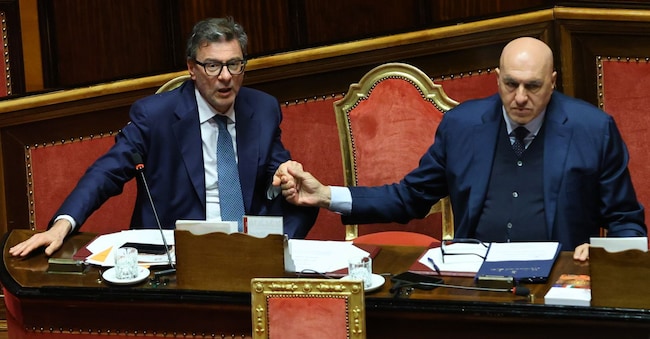
GIANCARLO GIORGETTI, MINISTRO DEL MEF, GUIDO CROSETTO, MINISTRO DELLA DIFESA IMAGOECONOMICA

5' min read

Translated by AI
Versione italiana

5' min read

Translated by AI
Versione italiana

The situation is still evolving. There are still too many variables to be determined to be able to paint a clear picture. There is, however, a starting point. And it gets to the heart of the matter. The Public Finance Policy Document approved by the Government, which provides the budgetary framework for the budget, sets out a request for flexibility of 14 billion for 2027 and 14 billion for 2028: 0.3 per cent of GDP for defence (around seven billion less than expected) and 0.3 per cent for energy per year.

According to a statement from Palazzo Chigi, on 10 September the government submitted a request to the European Commission to activate the national safeguard clause in relation to increased expenditure on energy and security.

Loading...

Speaking at a press conference following the Cabinet meeting at Palazzo Chigi, the Minister for the Economy, Giancarlo Giorgetti, reiterated that the budget would be ‘serious’. As for the measures to be included in the Budget Bill, he pointed out that ‘my answer is probably different from a month ago; the approach must be a touch more cautious’ compared to what had been ‘announced’.

In short, the defence budget – in a ‘particularly complex context in many respects’, to use the phrase employed by Giorgetti, with inflation showing no sign of abating and the spread between BTPs and Bunds having started to widen again – is being cut. Although there has been no shortage of announcements from within the ruling coalition in recent times ahead of the forthcoming budget, the pool of resources looks set to be limited. And some of the proposals outlined may be scrapped.

“I fully understand the reasons behind this decision, which are due to the current economic climate, inflation and the ongoing turmoil in the sovereign bond markets,” commented Defence Minister Guido Crosetto. The important thing is that the 0.3 per cent for 2027 – which had already been budgeted at that level – remains untouched and is used for the priorities identified by the Ministry of Defence. For 2028, a further increase of 0.3 has been planned for the time being, instead of the initial 0.6. I have taken note of this and hope that conditions in 2027 will allow for a subsequent increase. Measures to tackle the high cost of energy are welcome, as they will help alleviate the problems faced by every household.”

Crosetto: action on defence staffing levels to follow the budget

 One issue that will involve the Ministry of Defence, and which will see Crosetto engaged in difficult negotiations with his colleagues in the Government – starting with the Minister for the Economy and Finance, Giorgetti – is that concerning the increase in staffing levels. ‘The issue of staffing levels has not been abandoned, even though it is not included in this bill,’ explained Crosetto during the hearing before the Senate Foreign Affairs and Defence Committee on the bill to strengthen and adapt national defence capabilities, which took place on Thursday 1 October. “It was decided to distinguish the technical provisions, which form the basis of this measure, from those measures that instead involve a structural change to personnel numbers and which therefore require multi-year funding and can only be implemented after the Budget Bill. So we will have two bills to simplify the whole process.” “When I spoke in the past about the possibility of increasing the Reserve component by up to 40,000 personnel,” added the Defence Minister, “I explained that this measure presents multi-year funding challenges that must be addressed through the Budget Act. This is the crux of the matter: the public finance framework requires us to distinguish between measures that can proceed immediately and those that require additional structural resources. Even the plan to increase defence spending by 2026 has had to contend with the constraints associated with the European excessive deficit procedure. Requirements relating to staffing levels, reserves, personnel, specialised roles, infrastructure and accommodation therefore remain part of the overall plan, but will have to be addressed by Parliament at a later stage, in parallel with this legislative measure.”

The Minister: ‘A maximum of 1,200 military personnel for the Cyber Force with current resources’

As regards the size of the Italian Armed Forces’ Cyber Corps, the Defence Minister clarified on the same occasion that ‘it is defined within the scope of the resources we have today’ and expects that ‘by 2026 there may be a maximum of 1,200 out of the 160,000’ total military personnel indicated as the Armed Forces’ current target. In the future, “we may then increase it,” he continued, referring to those specialising in cyber security, “but at present it is defined within the limits of the resources we currently have”.

Strengthening Strade Sicure

Another unknown factor concerns the strengthening of Strade Sicure. On Thursday, the Lega secured the first green light for its resolution – which had been on hold since April – on an issue that had caused rifts within the ruling coalition ever since Crosetto highlighted the need last November to ‘increase police numbers to allow the military to return to their original duties’. Until a few weeks ago, the issue had caused tension, with the League pressing to increase the contingent whilst Forza Italia and FdI were more cautious; then the Defence Committee in the Chamber of Deputies chose to break the deadlock and give the go-ahead to the resolution, which was voted through by the entire majority. The measure aims to strengthen the operation – which, since 2008, has deployed the Armed Forces for preventive and security duties – by increasing the number of military personnel deployed across the country from around 6,800 to 10,000, an increase of 3,200 personnel, all of whom will be assigned to security duties in towns, railway stations and sensitive locations. Furthermore, the plan also provides for the extension of military presence to the 61 provincial capitals currently without such a presence, and the recruitment of new Carabinieri. Beyond the political will to move in that direction, the shortage of resources raises a number of uncertainties.

Cabinet approves proposal to renew defence contracts

 Meanwhile, according to the account given by the Minister for Public Administration, Paolo Zangrillo, the Council of Ministers has given the go-ahead to two proposed contracts covering the period 2025–2027. “I am referring to the local government sector and the security and defence sector,” explained Zangrillo.

Crosetto: 8.9 billion in Safe funds confirmed; the programme is moving forward

In the background, there is another strand of the story, namely that of European funds. Crosetto himself clarified that the funds Italia has requested from the EU in the form of loans under the SAFE programme, totalling 8.9 billion, ‘have been confirmed’ and ‘are moving forward’. ‘They have been approved; we have informed the EU. It’s a technical matter, in short,’ he added. The minister did not comment on the timeframe required to finalise the loan agreement and for the release of the first tranche, which would amount to 15 per cent of the total.

Copyright reserved ©

Brand connect

Loading...

Newsletter

Notizie e approfondimenti sugli avvenimenti politici, economici e finanziari.

Iscriviti