Born

Defence: Drone shot down in Lithuania by two Italian Eurofighter F-2000s. The rules of engagement for the mission on the eastern flank

The air policing mission in the Baltic States, known as Baltic Air Policing, began in April 2004. To date, 17 allies have taken part in safeguarding the airspace of the Baltic Republics: Estonia, Latvia and Lithuania

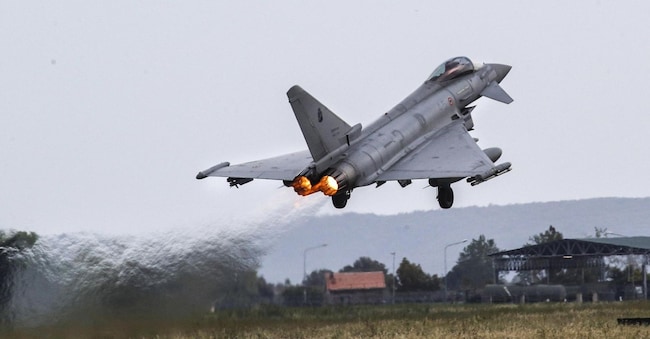
Un caccia intercettore Eurofighter Typhoon italiano in fase di decollo.  ANSA

5' min read

Translated by AI
Versione italiana

5' min read

Translated by AI
Versione italiana

First, the Danish helicopter was narrowly missed by a rocket, then the train was hit on the border between Ukraine and Poland. Finally, a third piece of the puzzle. Late on the evening of Monday 14 September, two Eurofighter F-2000 fighter jets from the Air Task Force Baltic Thunder III of the Italian Air Force took off on a scramble (emergency take-off) from the Šiauliai base as part of the NATO air defence mission on the Alliance’s eastern flank, following a violation of Lithuanian airspace by a drone. The Italian crews intercepted the unmanned aircraft, neutralising it in accordance with the Alliance’s operational procedures. The Ministry of Defence reported the news, specifying that this was the second such incident involving our fighter jets within the space of a month.

Three moves that outline Russia’s current strategy, which is to subject Europe and the North Atlantic Alliance – both of which are committed to supporting Ukraine – to a sort of ‘stress test’. The situation is summed up perfectly in the words of the President of the European Commission, Ursula von der Leyen. “Moscow is putting us to the test, but our resolve is growing stronger,” she said.

Loading...

Drone suspected to be of Russian origin

On 14 and 15 September, Defence Minister Guido Crosetto visited Bulgaria, Poland, Lithuania and Latvia for a series of institutional meetings and to greet the Italian contingents deployed on the Eastern Flank. According to NATO sources, who have launched an investigation, the drone is suspected to be of Russian origin, but confirmation is awaited from the investigations by the Lithuanian authorities and NATO. Crosetto has corroborated this hypothesis: during a media briefing as part of the bilateral meeting held on Tuesday 15 September in Lithuania with his counterpart Robertas Kaunas, he explained that it is ‘likely’ that the downed drone was Russian. ‘Italia,’ added Crosetto, ‘has now been engaged in NATO operations on the eastern flank for over 10 years, with ground troops, the Navy and, in this country, a significant commitment from the Italian Air Force. Just last night, as was the case a month ago, Italian pilots intervened and shot down a threat likely originating from Russia. The presence of Italian aircraft here is clear proof of the value we place on the Atlantic Alliance and what the word ‘Allies’ means to us.”
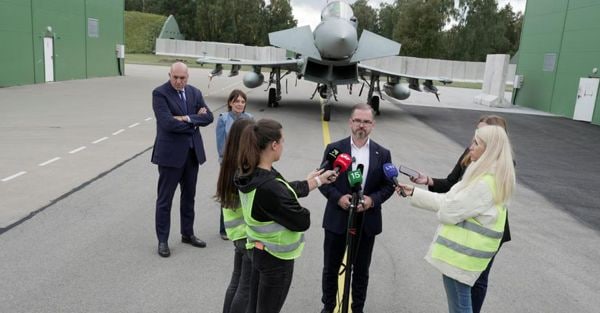
Il ministro della Difesa nazionale lituano Robertas Kaunas interviene mentre il ministro della Difesa italiano Guido Crosetto lo osserva durante una conferenza stampa a Siauliai, in Lituania, il 15 settembre 2026 (foto Reuters)

According to the head of the National Crisis Management Centre (NKVK), speaking on Lithuanian national radio LRT, the drone shot down in the Kaisiadorys district, near the village of Pratkunai, ‘most likely’ originated from neighbouring Belarus, an ally of Russia, and was heading west. “We will not rush to conclusions; an investigation will be carried out and all the circumstances will be assessed,” the army stated. The Lithuanian Foreign Minister, Kestutis Budrys, announced that Vilnius would send a diplomatic note to Belarus to protest against the incident and would consult with its allies. “Once the investigation is complete and it has been established who the drone belongs to, we will take action accordingly,” said Budrys, stressing that “NATO’s eastern flank must be strengthened and its resilience increased”.

As reported by The Guardian, Kaunas explained that an explosive device was attached to the downed drone. During the search of the crash site, “an explosive device was found, which was subsequently defused by bomb disposal experts”, said the Lithuanian minister.

NATO member countries provide the aircraft and resources required for aerial patrols, both individually and as part of multinational teams, under the direction of SACEUR (“Supreme Allied Commander Europe’, a post currently held by US General Alexus G. Grynkewich). Countries that do not possess the necessary air capabilities receive assistance from other NATO members. NATO currently oversees five regional aerial patrol missions. ‘Shooting down a drone, as happened at the hands of a NATO fighter, is simply insignificant in terms of creating a new balance of power in one direction or another; it is merely another small step towards further complicating the already problematic Russian-Ukrainian situation,’ stressed General Leonardo Tricarico, former Chief of Staff of the Italian Air Force and current president of the ICSA Foundation.

The specifications of the Eurofighter Typhoon

The Eurofighter Typhoon (aeronautical designation F-2000A) is the most advanced fighter aircraft developed on the European continent. The aircraft forms part of the national air defence alert system, operated by the Italian Air Force’s air defence units 24 hours a day, 365 days a year, ensuring that fighter jets can take off within minutes to intercept and identify any suspicious aerial targets detected by radar. The Eurofighter, which has recently also acquired air-to-ground capabilities, is the result of industrial collaboration between Italia, Germany, the United Kingdom and Spain. It has a wingspan of 14.74 metres, is 15.96 metres long and 5.28 metres high. Its maximum take-off weight is 23,500 kg. Its maximum speed is 2,495 km/h, with a maximum range of 2,900 km. The crew consists of a maximum of two pilots. Finally, its armament: it is equipped with a 27 mm Mauser cannon and can carry up to 6,500 kg of external payloads (AIM-9L Sidewinder, AIM-120 AMRAAM, Iris-T and Meteor missiles; GBU series guided bombs; auxiliary fuel tanks and laser-aiming pods).

The NATO mission in Lithuania

Over 2,000 Italian military personnel are deployed to protect the Alliance’s eastern flank. Italia is taking part in NATO’s Air Policing operation in Lithuania, deploying Eurofighter Typhoon aircraft to monitor and protect the Atlantic Alliance’s airspace. The Air Policing mission in the Baltic States, known as Baltic Air Policing, began in April 2004.

Since the mission began, NATO fighter jets have been stationed at Šiauliai Air Base in Lithuania. Since 2014, the aircraft have also been based at Ämari Air Base in Estonia. From 2024, Lielvārde Air Base in Latvia will also be able to host the fighter jets involved in the air patrol mission.

To date, 17 allies have taken part in safeguarding the airspace of the Baltic States: Estonia, Latvia and Lithuania. The Baltic Air Policing mission aims to demonstrate the Allies’ collective determination to maintain a strong and united defensive posture, thereby deterring potential threats to security in the region. The mission is conducted under the command and control of one of NATO’s Combined Air Operations Centres (CAOCs) in Uedem (Germany), under the supervision of NATO’s Allied Air Command (AIRCOM) in Ramstein (Germany).

Loading...

In Lithuania, the 32nd Wing Task Force concluded its deployment at the end of March, having clocked up, in 2025 alone, almost 450 flight hours and 34 Alpha scrambles. In April 2025, the 51st Wing Air Task Force entered service in Romania; over the course of four months, it carried out four ‘A’ scrambles and logged over 1,000 flight hours. In Estonia, the Italian contingent of the 4th Wing Task Force, comprising around 150 military personnel, was deployed from August 2025, initially with the F-35s and, from October, with the Eurofighter 2000s, and concluded its mission in April 2026.

The rules of engagement

Although the operational details and the full texts of the ROE (literally ‘rules of engagement’) remain classified for security reasons, the general doctrine makes the opening of fire contingent upon direct and imminent threats, applying very strict proportionality criteria to prevent uncontrolled international incidents. In situations involving unmanned aerial vehicles (UAVs) or non-cooperative intruding drones, procedures and pilots’ discretion may provide for specific authorisations linked to the actual risk posed by the threat.

The Alpha Scramble

Alpha Scrambles are real-life interceptions. They differ from those carried out during training exercises. The latter are known as ‘tango scrambles’. These are operations to defend airspace against unidentified aircraft and involve the immediate take-off of interceptor fighters.

Copyright reserved ©
Loading...

Brand connect

Loading...

Newsletter

Notizie e approfondimenti sugli avvenimenti politici, economici e finanziari.

Iscriviti