Air Force

General Frigerio: We evaluate option of F35 landings on highways in case of air and drone threats

The Commander of the Air Force Command on the sidelines of a conference on geopolitics and aerospace. The Air Force takes stock of drones and strategic resources: work is underway on several fronts to strengthen defence capabilities, and the possibility of landing aircraft on stretches of motorway, as already in use in other NATO countries, is also being evaluated

by Andrea Carli

Aggiornato il 5 febbraio 2026 ore 16:30

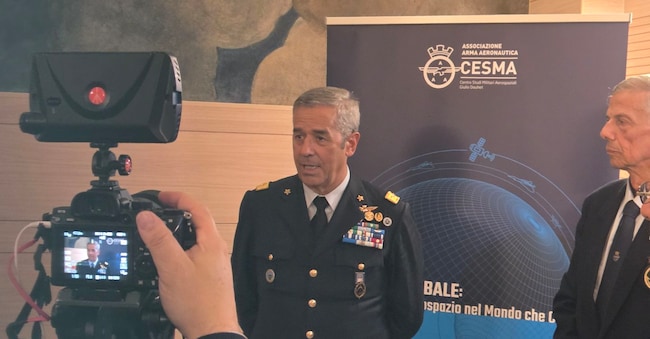
Sulla sinistra il generale di squadra aerea Silvano Frigerio, Comandante del Comando Squadra Aerea dell’Aeronautica Militare, sulla  destra il generale di squadra aerea Giovanni Fantuzzi, direttore del CeSMA (Centro Studi Militari Aerospaziali Giulio Douhet)

6' min read

Translated by AI
Versione italiana

6' min read

Translated by AI
Versione italiana

One of the most difficult security threats to deal with is that of the drones. Those coming largely from the Belarus that violated Poland's airspace in September, or the sightings at the airports of Copenhagen and Oslo, are some of the many examples that the news of the last few months has brought to our attention.

And a confirmation of the fact that aircraft characterised by the absence of a pilot on board, and which can therefore rely on the remote control of a pilot-system operator, are and remain the real challenge, came from Air Squadron General Silvano Frigerio, Commander of the Air Squadron Command and First Air Region of the Italian Air Force, on the sidelines of the meeting held on Wednesday 4 February entitled 'Global Domination: geopolitics and Aerospace in a Changing World", organised by the Cesma (Giulio Douhet Military Aerospace Studies Centre) at the auditorium of the Air Force Building in Rome.

Loading...

The general drew attention to two issues that, in his view, have a direct impact on the readiness and sustainability of the aerospace instrument: the drone threat and the availability of strategic resources and rare earths.

The Air Force Command is the hub of the operational component of the Air Force. It is responsible for the generation of aerospace capabilities, maintaining the readiness of operational units and supporting national and international missions, including joint force and NATO operations. Its action also extends to cooperation in civil emergencies.

The challenge of the 'low cost drone'

The threat that most strikes public attention today, the general noted, is that of 'low-cost' drones. Frigerio explained that this is a problem that is also being addressed jointly with other Armed Forces and allied partners, because countering this type of threat can be decisive.

"This is an issue that is being addressed, also jointly with other armed forces, and also with friendly or allied air forces, because certainly countering such a threat can be vital," he said on the sidelines of the meeting.

The point, he continued, is the demonstrated effectiveness of some Unmanned Aerial Systems (UAS), ccapable of reaching a target with very autonomous guidance systems, in some cases even via fibre optics. The potential impact is high: even limited damage to an advanced platform, such as an F-35, can generate significant economic and operational consequences.

Alongside the operational aspect, there is that of sustainability: often, the means used to neutralise a drone - a missile, for example - costs more than the drone itself. That is why, according to Frigerio, the answer cannot be based only on 'expensive' solutions, but must include more proportionate and replicable tools.

'We have seen the effectiveness of these drones or UAS that can be launched, with an absolutely autonomous guidance system, even perhaps with fibre optics, and arrive to do millions of euros worth of damage,' he emphasised. 'The most classic example is that of a drone that even goes to scratch an F35, you can imagine the damage that is done.

The cost node

Alongside the operational aspect, there is that of sustainability: often, the means used to neutralise a drone - a missile, for example - costs more than the drone itself. For this reason, according to Frigerio, the response cannot be based only on 'expensive' solutions, but must include more proportionate and replicable tools. With this in mind, he explained, the Air Force is working on systems that can guarantee observation and early warning, especially in the presence of attacks conducted with several drones at the same time.

The general drew attention to a practical element: in some scenarios, the threat can be 'covered' because the launch can take place with mobile means and very quickly. The time factor therefore becomes crucial: reducing the seconds needed to detect and react is part of the challenge. 'Against a swarm of drones, one would have to have hundreds of defence systems'.

However, a quantitative issue remains: it is not enough to have a single effective solution. To counter attacks from different directions or with multiple vectors, an adequate number of systems are needed, spread across the territory and integrated into a network.

Hence the priority indicated by the general: to build a protection network starting from the targets defined as "vital" or of "extreme importance", also including "infrastructures such as ports and railway and motorway nodes", in order to guarantee continuity of mobility and essential functions. "Let us remember that (the one represented by drones, ed.) is a threat that in some ways I would define as very lethal because of the effects it can produce," he said.

But above all, a lot of 'cover': we have seen the examples: all you need is a truck that raises the pallet and underneath there are so-called 'Katjuša'-type systems (the Soviet rocket launcher from the Second World War installed mainly on trucks, ed) that shoot out these drones. In three minutes they can arrive on the target. In such a short time it is very difficult to have an effective detection and counterattack.

We are working on it, and there are systems that can be adapted to it. Without naming names of companies, even recently in Sabaudia the Army had a demonstration of the effectiveness of many systems'. All well then? No, something is still missing. "It's also a question here of acquiring enough of them to be able to control and render ineffective a swarm that can come from any direction, at any point. And so you would need to have hundreds of these defence systems,' Frigerio noted.

The idea of landing aircraft on stretches of motorway as already in use in other NATO countries

Thehypothesis of using motorway stretches as an alternative option also emerged. It is a concept known in NATO and already in use in other countries, explain Air Force sources, linked to the logic of rapid dispersion of assets in the presence of threats to main bases.

Rapid dispersal of assets is the ability to quickly redeploy essential aircraft and media to multiple alternative bases in order to reduce vulnerability, increase resilience and ensure continuity of operations.

Frigerio emphasised that we are not faced with an already defined planning: 'This is currently only one of several hypotheses under consideration, and not already in the planning stage,' said the general, clarifying that the comparison with other Atlantic Alliance countries such as Finland, which is already adopting it, is not immediate: in Italia, the structure of the motorway network and the infrastructural conditions make the idea of making a stretch effectively suitable, also in terms of logistics and safety, more complex. In the various phases of the study, one must also take into account the existing infrastructure in terms of power grids, lay-bys, service stations, etc.'.

Industry must go beyond the logic of customer-supplier

On this front, the commander also emphasised a more general point: faster time is needed in the development of capabilities, and this requires a different relationship with industry. No longer just a 'customer-supplier' dynamic, but a joint work to develop, test and bring into production effective solutions. 'Industry can no longer be seen as the one who only commissions the product,' he said. 'We have to work very synergistically, we have to develop the weapon system together, test its effectiveness together, and get to production together very quickly.

The Rare Earth Challenge

The other major challenge concerns resources, in particular the issue of rare earths. Frigerio made it clear that this does not automatically mean that all weapon systems depend on these materials. However, if the supply does not guarantee adequate stocks for any prolonged needs, the risk is to find oneself in difficulty at the very moment when demand is growing.

"I believe that yes, it is a very topical issue," he said, "but it is not that there is a shortage of rare earths, and that there will necessarily be a shortage of all the possible armaments that are in the inventory of the Armed Force (the Air Force, ed.). Having said that,' continued the Commander of the Air Force Command, 'it is clear that if there is not sufficient supply to guarantee stocks that hypothetically we would ever need in an armed confrontation, we would be quite deficient. A blunt spear, and indeed it is one of the priority themes of the Air Force Chief of Staff, is to pursue this supply, which is still a 'competitive' supply'.

The general described the supply and stockpiling of armaments as priority and 'competitive' issues: many states, he recalled, have realised that they do not have sufficient stocks to sustain a prolonged confrontation. Frigerio recalled an often underestimated point in industrial dynamics: when a producing country decides to acquire large quantities of a system, delivery priorities naturally tend to favour national demand.

"All of them (states, ed.) have suddenly realised that they do not have sufficient war stocks to be able to cope with a prolonged armed confrontation, and it is clear that the producing countries may have an advantage in this regard".Therefore, the final reflection translates into a pragmatic line: to also consider diversification of equipment, so as to reduce dependencies and maintain effective operational options even in contexts of strong pressure on production and supply chains.

"This," concluded the Commander of the Air Force Squadron Command, "is certainly a growth that must be assessed by perhaps diversifying the armament endowments, so that if not exactly that armament, one that is in any case effective, that can be deployed. The game is already underway, and the referee of geopolitics has already started the stopwatch;

Copyright reserved ©
Loading...

Brand connect

Loading...

Newsletter

Notizie e approfondimenti sugli avvenimenti politici, economici e finanziari.

Iscriviti