
Defence, 'review Nato spending at 5% of GDP': then majority backtrack. Opposition on the attack
Moral suasion by the government: the passage committing the government to 'maintain a realistic and credible commitment to NATO, confirming the achievement of 2 per cent of GDP for defence spending and promoting a review of more ambitious targets (such as 5 per cent) in the light of the economic situation and national priorities' disappears from the motion in the Senate on the economic implications of energy security

Key points
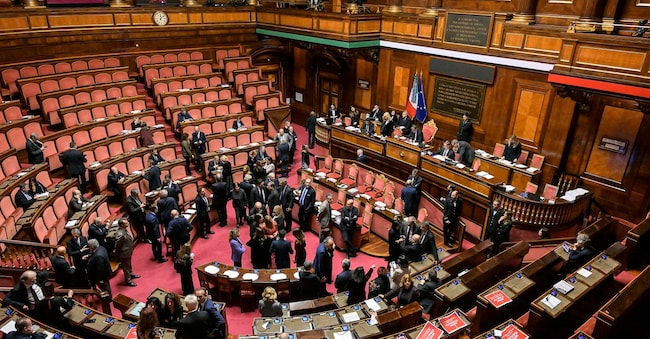
A mess. The majority in the Senate has had to make a U-turn on the motion on the economic effects of energy security: in fact, the request to re-evaluate the raising of defence spending to 5% of GDP, a commitment made personally by Prime Minister Giorgia Meloni last year at the NATO summit in The Hague, the Netherlands, after pressure from the US administration led by Donald Trump, disappeared from the text at the last minute. Officially that passage was inserted 'by mistake'. But it was the government itself that intervened to 'whitelist' the centre-right's motion. All this while the EU Safe loan to reinforce defence capability and achieve the more ambitious military spending targets agreed at Nato has ended up in limbo despite Crosetto's pressing (who made it known that he had sent two letters to the Mef, which have remained unanswered so far) after what Giorgia Meloni called the 'new priorities' took over: finding the resources to cope with energy price rises.
Deleted Passage on Defence Expenditure
In the new document signed by the majority group leaders and approved by the House, point 8 disappeared, which committed the government 'to maintain a realistic and credible commitment to NATO, confirming the achievement of 2 per cent of GDP for defence spending and promoting a review of the more ambitious targets (such as 5 per cent) in the light of the economic situation and national priorities, including investments in energy security and critical infrastructure, in order to ensure effective collective defence without compromising the sustainability of public accounts'.
Energy Commitments
Other commitments to the government remain, including the one "to continue the action at the European level for greater flexibility in the stability and growth pact, with exclusion or derogation for investments in energy security, transition and critical infrastructure, in order to support inclusive and sustainable growth without resorting to procyclical austerity". As well as "to continue and strengthen the strategy of diversification of sources and routes of energy supply" and "to maintain and strengthen measures to contain the cost of energy for households and businesses, with particular attention to the most vulnerable groups and SMEs"
The executive's moral suasion
The executive would have been unaware of the initial version of the text. After the circulation of the draft in the press, a moral suasion by the executive branch, starting with the Defence Department, would have intervened to remove the 'incriminated' part, destined - in the original formulation - to open a new front with the tenant of the White House, after the recent clashes. A scenario that the government intends to avoid. In particular, Defence Minister Guido Crosetto was keen to remind us of the commitments made.
Romeo (League): Nato spending? Sensitive topic, better to discuss it in the majority
The leader of the League in the Senate, Massimiliano Romeo, pointed out that the issue of NATO spending requires, in his opinion, an internal confrontation within the majority: 'It was a motion from everyone, then we realised that it was not the case to discuss this issue, which is a delicate subject, where there are different sensitivities, there is Crosetto who is for Defence, Giorgetti who says 'prudence in accounts', Meloni who is playing an important game in Europe. So instead of discussing it in the House, we thought it was better to discuss it in other fora and when a balance is found, at that point, we will go to the House." "We were wrong to include the part" on defence spending, admitted in explanation of vote Leghist Claudio Borghi, who added: "It's a motion that talks about energy, it's right to discuss that. For military spending there will be time for a more in-depth discussion'. In the same vein is the leader of Fi's group in the Senate Stefania Craxi, who downplays the controversy: "The assessment was made by Parliament, I would like to stress that. We are talking about a subject that is being discussed at European level. It was neither the time nor the place to discuss it today. We should not make a case out of it'.


