

Depression disease of the century with 20% more cases: here's why the cure starts with listening to young people
From youtubers to experts and industry to the secular and Catholic third sector: recipes to stem the pandemic gripping western society with a major impact on the new generations called upon to lead the country tomorrow

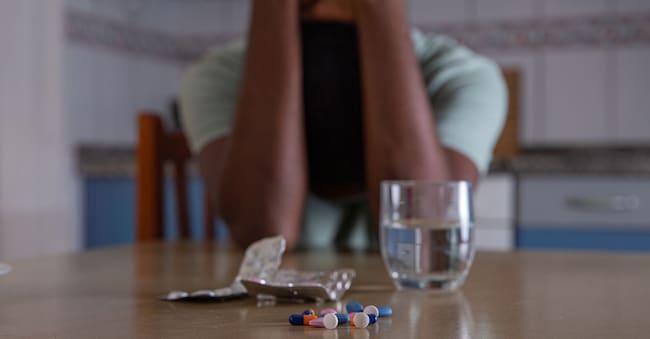
"The problem for my generation at the moment is not so much eliminating the stigma because - on the contrary - in the digital spaces we inhabit most people talk about it perhaps even too much: mental health has become a trend and if on the one hand this has helped to diminish prejudice, on the other it brings with it a dangerous 'aesthetisation of malaise' with a tendency to self-diagnose disorders forgetting that talking about them does not mean curing oneself. So while on the one hand I would urge institutions to consider digital spaces as places of prevention, on the other I think it could be the classic 'dog biting its own tail' because those who design these spaces do not have our mental health as their ultimate goal but our greater permanence, with profit in mind. For the dynamic according to which social works and that is that it feeds me with content designed especially for me that gives me this constant 'dopamine rush', theoretically I am always more inclined to stay'. It's up to influencer Sofia Viscardi, a youtuber since the age of 14, to tear the veil off the theories that previous generations line up in an attempt to solve the excruciating puzzle of the psychophysical well-being of the entire population, but especially of our children, who at an increasingly early age manifest discomfort if not actual pathologies. "Mental health does not only mean the absence of pathology, but also the ability to manage all the constant overload that comes our way, that confuses us and imposes on us the continuous comparison with unreal, modified and filtered models of success. All this puts us under pressure and is not good for our mental health. We need a new literacy,' he adds.
It is no coincidence that one of the five chapters of the National Action Plan on Mental Health, developed by the maxi-working table coordinated by the psychiatrist Alberto Siracusano, is dedicated to the developmental age and to the difficult transition to adult structures and services. A planning tool - just published in the Official Gazette - that from now until 2030 will have to come to terms with a reality that is among the toughest both in terms of staff shortages and the need to build a network that is trained and ready to intervene in the territory as a team. With the ability, as Siracusano himself emphasises, "to keep within the crucial action of the Third Sector", which in this field is led by patients' family associations.
Even putting aside the sore point of psychiatric health in prisons and Rems - to which the Plan devotes two chapters - the work to be done is daunting and even the resources with the 240 million euros allocated by the last budget law, 30 million of which are dedicated to recruitment, are really only a first, albeit important step. The quota earmarked for mental health has always been among the most miserable in public health funding.
The numbers
Now, at least on paper, a change of pace is being attempted: this was discussed at the meeting organised in Rome by the 'Courtyard of the Gentiles' - the foundation set up by Cardinal Gianfranco Ravasi to unite believers and non-believers in a debate on the great contemporary challenges - and Angelini Pharma. With a focus on young people, under the motto 'We need prevention and dialogue'.
The numbers speak for themselves: for the World Health Organisation (WHO), depression will be the main cause of disability in the world in 2030 and is already branded as the 'disease of the century', with a 20% increase in cases in 10 years. In Europe, depressive symptoms affect 24% of the under-25 population and suicide is the second leading cause of death. Young people who have to deal, the experts point out, with the constant and rapid change of their reference contexts and who at the same time are exposed to the pervasive - often distorted - reality of social networks, whose incessant use risks becoming a powerful amplifier of isolation and suffering.
Synergies in the field
Faced with a malaise that is rampant but all too often transparent, and with respect to which the institutions, society as a whole and families are not adequately equipped - partly because of the difficulty of interpreting the new ways of expressing themselves, communicating and inhabiting the digital world of their children - in mental health it is necessary to invest with teamwork. Each for his or her own role: "As an industry, we have a twofold duty," warns Angelini Pharma CEO Sergio Marullo di Condojanni, "to promote awareness in order to remove cultural resistance to the treatment of psychological distress, and to invest in research and development in order to equip healthcare professionals with the tools they need to foster the wellbeing of the population and the community. Public, private and civil society must work in synergy, because no one can win this challenge alone: it is with this spirit that we wanted to organise this event together with the Courtyard of the Gentiles, convinced that the mental health of young people is the most urgent strategic investment for the future of the whole of society'.
For Cardinal Ravasi, 'mental health is one of the great cultural and social challenges of our time, because it touches the very heart of the person, of his relationships and of his future, especially in the younger generations. Only through an open and plural dialogue can we transform malaise into an opportunity for awareness, care and hope'.

