

Diet: Watch out for the 'buffet syndrome', countermeasures to reduce calories
According to a study, there is a relationship between food availability, variety of dishes and caloric intake that can increase by up to 75 per cent if you triple the number of dishes on offer
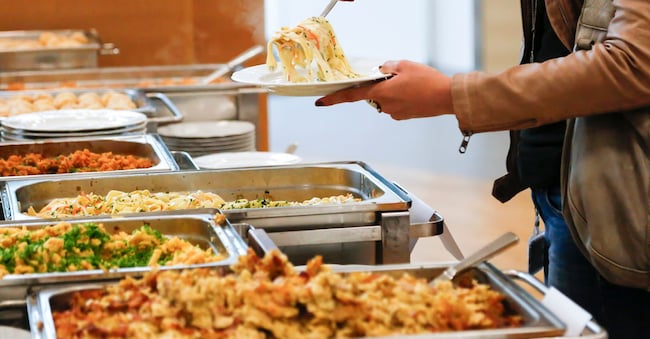
The eye wants its share. We know that. But that the sight and appetite dictated by an abundance of available dishes can become such a threat that the calorie intake is thrown off is just too much. Yet the 'buffet syndrome' exists. And now science clearly confirms its nutritional, as well as psychological, 'heavy' impact in every sense. In fact, a study published in Appetite shows that there is a relationship between the availability of food, the variety of dishes and calorie intake, with an increase in calories ingested of up to 75% if one triples the number of dishes on offer, resulting in greater variety. Thus, greater food variety is shown to affect the amount of food people serve themselves before they put their fork to their mouth, increasing both the weight of the food selected and the amount of calories in the dishes. The research was conducted by experts at Pennsylvania State University (first name John Long).
At the table with the virtual buffet
The study examined 50 adults between the ages of 18 and 65 and was conducted in the laboratory in three different sessions. On each occasion, participants selected a meal they wished to consume from a virtual reality buffet. Three models were proposed, with different numbers of foods. 9, 18 or 27 choices. The buffet included a similar proportion of high-energy-density foods, such as biscuits, and low-energy-density foods, such as vegetables, regardless of the number of food options available. Participants were asked to abstain from exercise, food and caffeine for several hours before the visit to ensure they were hungry. They wore the visor and selected foods as they would have done in a real buffet, using video-game-style controllers in each hand. The system recorded the weight and calories of the selected meal, along with the amount of food, including those with high and low energy density.
How much variety matters
The analysis of the data clearly shows that the more availability there is in terms of offerings, the more food is consumed. Participants who went to the counter with 9 dishes selected on average just over 600 grams of food. People at the virtual buffet on 18 or 27 dishes selected more than 900 grams. Not only that. Although they did not overdo it with the weight of the food placed on the plate, with a particularly rich offer, the calories increased. Those who went to the buffet with nine dishes selected an average of 850 calories of food. But it rose to 1,320 calories - about 55 per cent more - when 18 foods were offered, and to almost 1,500 calories when 27 foods were offered. In practice, the situation was in danger of spiralling out of control: there would be a 75 per cent increase compared to what the same participants had consumed from the nine-food buffet.
Made-to-measure bowls
Having said that of course there were also psychological analyses of the research participants that showed that the more conscientious subjects were able to exercise greater self-control at the buffet, the research brings to the table factors that appear to be of great importance in terms of public health. "This study reminds us that when we are faced with many different options, we naturally tend to eat more," says Daniela Martini, Professor of Human Nutrition at the University of Milan. "Variety, if concentrated at the same time, in fact keeps stimulation high and delays the sense of satiety. This in no way means that the diet should be monotonous: on the contrary, variety throughout the week is essential to ensure nutritional balance and adequate nutrient intake'.
In short, food variety is a good thing, according to the dictates of the Mediterranean diet. The problem can arise when the variety is simultaneous, abundant and immediately accessible, as is the case in buffets or large food offerings. "In these conditions we are more inclined to serve ourselves more generous portions and increase our calorie intake," Martini concludes. Fortunately, there are simple strategies that can help us not to overindulge without giving up the pleasure of food. A simple idea is to use smaller plates, since the size of the container influences the quantities we serve, or to serve oneself only once, avoiding repeated tastings. Of course, the advice to start the meal with vegetables or foods with a lower energy density is always valid, so as to better modulate the appetite'.

