Online

Digital media, the fighting space for women's rights

From Argentina to Wrath, from South Korea to Gaza, social networks offer a voice for women's movements

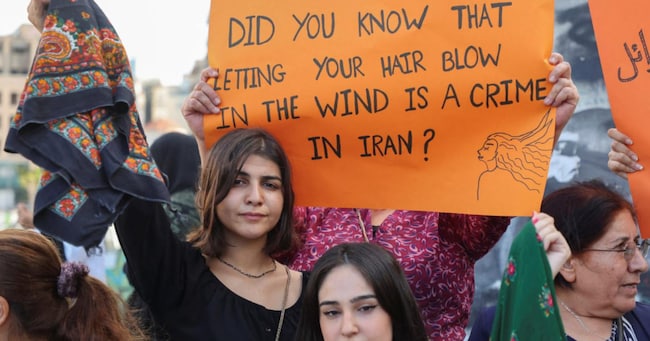
Women take part in a sit-in following the death of Mahsa Amini, at Martyrs' Square in Beirut, Lebanon September 21, 2022. REUTERS/Mohamed Azakir

4' min read

4' min read

Redefining power relations. Disclose the stories that are being hushed up. Networking and generating an important contagion effect on common goals. Although the Internet and digital media are not particularly protected spaces for women - who represent the category most affected by online hate speech according to the latest map by Vox (Italian Observatory of Rights) - they can represent powerful counter-narration and denunciation tools all over the world.

This is what happened with the issue of gender-based violence, capable of aggregating protest movements like few others because it is directly linked to fundamental human rights. In representing and making the threat of violence perceived by the general public (and not only by women movement activists), the role played by the media is decisive because they contribute to disseminating the global narrative, transforming 'a topic that is talked about' into a real 'mobilisation'.

Loading...

In Latin America

.

In Argentina, feminist groups had already been using activist tools such as e-mail and YouTube in a pioneering way since the early 2000s. The decisive change of direction came in 2015 when, following the discovery of the body of Chiara Páez - a 14-year-old girl killed by her boyfriend because she was pregnant - journalist Marcela Ojeda wrote from her Twitter profile: 'Women, all of them. Don't we want to be heard? They are killing us'.

The Argentinean collective NiUnaMenos (NUM) took up the tweet and relaunched the hashtag #NiUnaMenos, which became trending topics on social media: on 3 June of that year, the indignation spread online, demonstrating its offline power by bringing thousands of women to the packed streets of Buenos Aires and 120 other cities in the country. 'Vivas nos queremos (we want to stay alive)' demanded the Argentine women, indicating their claim: not only not to be killed, but to live with dignity.

A battle that is always topical, as evidenced by the anti-feminist policies pursued today by Javier Milei: the Argentine president, for example, aims to amend the Micaela Law enacted in 2018, which established compulsory training on gender-based violence for all people working in public service and government.

In Asia

.

The denunciation of systemic violence against women has also evolved in movements in South Korea: on 17 May 2016, a young 23-year-old woman was murdered by a stranger in the public toilet next to Gangnam metro station in Seoul. A feminist group opens the Twitter account @0517am1 and invites people to leave a post-it note and a chrysanthemum at the site of the murder, launching the hashtags #GangnamMurderMan and #BathroomMurderer so that women could publicly share their experiences of violence. Prompted by messages on social media, women of all ages organised a small event in Gangnam that soon turned into a permanent protest site, replicated in other cities across Korea. With the Gangnam murder mobilisations, the digital activism of Korean feminist movements gained new political strength by becoming visible in the public space and linking the online and offline dimensions.

From the US to Europe

.

The following year, 2017, was the year of the cinematic #MeToo, which, from Hollywood around the world, definitively sanctioned the 'agency' and relationship power of digital media for women. In the wake of the #MeToo (3,228,241 posts on Instagram), more recently, Spanish feminist movements denounced abuse in Spanish football by launching the hashtag #SeAcabó following the non-consensual kiss given by Luis Rubiales, president (now suspended) of the Spanish Football Federation, to the footballer Jennifer Hermoso. First appearing in Hermoso's complaint post, the hashtag generated a series of responses not only from teammates but from the entire sporting world. Helping to change its rules and culture.

Loading...

Iran

A virtuous result, but not a foregone conclusion since, in the virtual dimension dominated by algorithms, the risk is that of self-referentiality and the creation of 'niches' in which the message echoes among networks aligned on the same values without spreading beyond the bubble. How do we overcome this danger? By producing a new culture, capable of transcending the confines of the space in which women situate themselves, and by developing a public discourse that promotes democratising actions from below.

This is what women in Iran are doing by also using digital media to drive the country's freedom. While the Iranian government plans to use facial recognition technology on public transport to identify women who do not wear the hijab, Iranian girls continue to specialise in Stem disciplines - 70 per cent of female graduates are in the field - and to make their skills available to disseminate, filter and repurpose the narrative of what has become an international movement: Woman, Life, Freedom.

In a country where the media is under tight government control, social media is a lifeline for citizens, providing them with access to impartial information and the opportunity to document what is happening: in the investigation opened by the United Nations, the videos and images shared by the protesters were used to shed light on the abuses committed by the Iranian police forces and authorities who, already during the demonstrations against the fuel price increase in 2019, had closed access to the web altogether and, on the occasion of the demonstrations following Amini's death, intensified control over the web by applying a digital curfew and preventing access to WhatsApp, Instagram, Skype, Viber and LinkedIn.

Gaza

This strategy was also reiterated in Gaza, where attacks last October cut off internet and electricity in the Palestinian enclave, preventing the Strip's residents from showing the world what is happening on the ground. "I don't know how long I will live, so I just want to share this memory of mine here before I die. I will not leave my home, come what may. My biggest regret is not having kissed a boy. He died two days ago': these are the messages one can read from Gaza on Queering the map, an online map where all LGBTQ+ people can anonymously share significant moments of their lives and their journey of self-understanding by placing a pin on geographical places that have special meaning for them.

Storytelling to tell the world, beyond the chronicle of traditional media: this is how the digital becomes a space to be inhabited, no longer 'divorced' from reality but capable of shaping it.


Copyright reserved ©
Loading...

Brand connect

Loading...

Newsletter

Notizie e approfondimenti sugli avvenimenti politici, economici e finanziari.

Iscriviti