
Utility bills: discount from 2027, a new decree to set a cap on gas prices
The agreement reached at European level is, for the time being, a preliminary political agreement, which requires further technical discussions

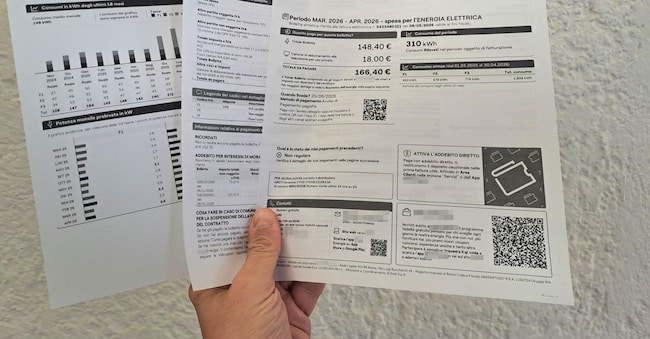
Italia has reached a preliminary agreement with the European Commission on the energy bills decree which, once the mechanism – a cap on the price of gas paid by thermal power stations – is activated, will help to keep down the costs borne by end users on their bills. However, it will still take some time to make this reduction possible: the political agreement, announced by the government in recent days, must be followed by a technical compromise and the finalisation of a new decree, the timeline for which has not yet been clarified (there is talk of the end of the year so that the reduction can come into effect from January 2027) and which will, in effect, amend the previous measure, which provided for a cut in the cost of so-called ETSs, but was blocked by Brussels.
Estimates of the amounts
The agreement, the scope of which will be finalised as soon as the last technical issues have been resolved, aims to set, for a transitional period of at least one year, a price cap on gas at around 60 euros per megawatt-hour (MWh). Palazzo Chigi, commenting on the agreement in recent days, has set the benchmark at 59 euros per MWh: the final figure will be known once the government has finalised the technical details and notified the European Commission of the text of the new Article 6. If this is the figure, the difference compared with the current market price – now between 85 and 90 euros – will be around 25 euros per MWh. This will have positive implications for households which, having a variable-rate contract indexed to the PUN (the single national price), are hit hardest by price surges on international markets: the savings estimated by experts are around 10 per cent. Support will also be provided for businesses, which will benefit from around 1.3 billion (according to the Ministry of the Environment’s estimate) derived from the sale of gas stored by the GSE and Snam, which will also be used to reduce the bills of SMEs and energy-intensive businesses.
The meeting point with the EU
The political agreement with the EU represents a compromise between Italia’s demands – which sought a cap on gas prices of around 40 euros per MWh, as vociferously called for by the president of Confindustria – and the EU’s position, which wanted to set this threshold at 80 euros per MWh. In the end, a middle ground was found. This is not entirely new: the measure was already authorised in 2022 in Spain and Portugal, which had set a temporary cap of 40 euros per MWh – albeit in a different context – for six months, with an increase of 5 euros per MWh for each subsequent month.
In fact, the agreement with Italia makes it possible to overcome certain distortions in the electricity market. The wholesale price of electricity in EU countries is set every hour based on the production cost of the most expensive source required to meet demand. Italia’s energy mix is dominated by the most expensive source – gas – in electricity generation. This accounts for 70–75 per cent of the cost of consumption hours on electricity bills. The procedure for the measure now involves, as mentioned, the technical finalisation of the measure, followed by notification to the European Competition Authority – which must verify that it does not constitute state aid – and then the adoption of the decree setting the ‘cap’. ARERA, the competent authority for the sector, will be responsible for governing the regulatory framework and ensuring the measure’s costs are covered.
Brussels’ halt
Originally, with the February ‘Bollette’ decree, the Italian government had planned to reduce electricity bills by cutting the cost of the ETS mechanism – which is incorporated into the price of gas paid by thermal power generation – at source, with producers to be reimbursed via their bills. However, the measure was blocked by the European Commission, which set certain conditions, requiring Member States to implement only temporary measures. Consequently, the government decided to switch to a different approach, drawing on the experience already gained by other countries.

