
Discovering Azienda Gentile: how the company of the future is being built
Companies and their leaders have the task of responding to change by carving out a new outfit for the organisation, capable of withstanding the stresses of phenomena such as Great Resignation or Quiet Quitting

4' min read
4' min read
Reconciling the new needs of workers (and of younger workers in particular) without jeopardising the stability of operations, riding the wave of digital transformation to boost growth by leveraging training and reskilling, attracting talent and increasing the level of employee engagement by taking greater care of personal well-being: the pieces that make up the 'perfect' post-pandemic enterprise are many. And not so easily accessible. The issue to be tackled is well known and concerns the paradigm shift of work in the company, which compared to the strongly hierarchical structure of the recent past is now nourished by other strategic components, starting with a more balanced balance between professional and private life.
In this changed scenario, companies and their respective leaders have the task of responding to the change by carving out a new outfit for the organisation, capable of withstanding the stresses of phenomena such as the Great Resignation or the Quiet Quitting and of being easily worn by figures with more developed digital skills. Managers, in other words, are called upon to manage a fundamental - and necessary - stage in the evolution of work and corporate welfare, as well as of leadership models, by putting the person back at the centre of every process.
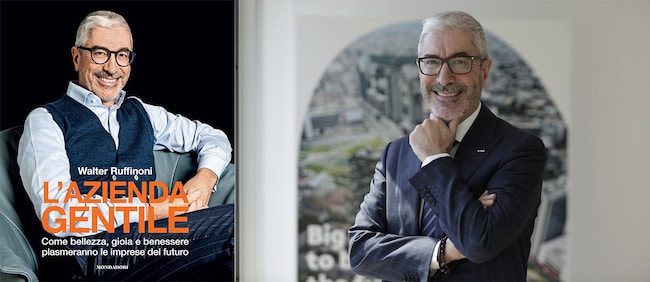
How can they meet this challenge? Walter Ruffinoni, Ceo of Ntt Data in Italy, has tried to answer this question in a book, "L'Azienda Gentile. How Beauty, Joy and Well-being will shape the companies of the future' (Mondadori, 2023), which tries to draw new contours of being a company, a company that must reflect the principle of technological innovation at the service of the human being and whose peculiarities are the ability to be welcoming, generous, open and able to create a community of motivated people.
The changes triggered by the pandemic
."Once the Covid 19 emergency was over,' the author explained to Sole24ore, 'we returned to normal life, but we did not return to work as before, and I personally observed this phenomenon in my company. The reason? A lot of dynamics have changed, also thanks to the entry into the field of Gen Z: if the pandemic has put people in front of the major priorities in life, technology has unhinged two key factors such as space and time, understood as working hours'. The picture taken by Ruffinoni thus brings into focus a 'disruption' that has challenged a consolidated model such as 'office productivity' to the benefit of remotely conducted activity, obscuring the logic of 'command and control' in favour of an approach based on trust and empowerment of workers with respect to set objectives.
Who within the organisation has to manage this complex and delicate transition phase? The opinion of the CEO of NTT Data, a company where the ratio between face-to-face and remote working is 1 to 4 (that's four days of remote working per week), is very explicit in this regard. "The CEO cannot do it alone but has to act as an enabler to involve all the other players in the company. Leaders play a decisive role in this process, also in view of the fact that part of the middle management is still convinced that we must return to the model of being present at the desk from 9.00 am to 6.00 pm: overcoming the challenge of being architects of one's own career by embracing change therefore requires a significant step of growth'.

