

Do LED face masks work? From wrinkles to acne, here are the effects
The team of doctors and fact-checking experts from the National Medical Association addresses the main health concerns

Key points
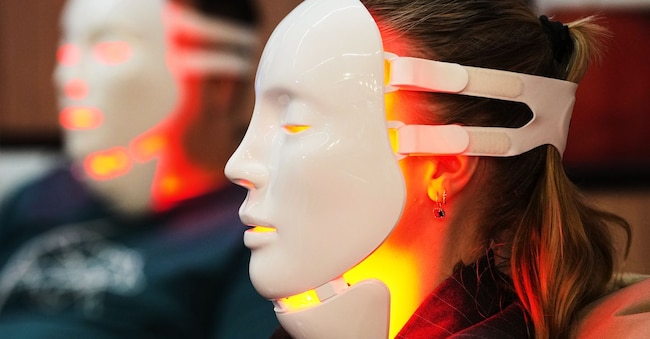
Is it really enough to spend just a few minutes a day wearing a light-emitting mask to achieve younger-looking skin with fewer spots? That’s the promise of LED masks, devices that have become widely popular and are now easy to find online too. They utilise what is known as photobiomodulation, i.e. the use of light to stimulate the skin without heating it. The claims are tempting, but are the results really as advertised? And are the at-home versions as effective as treatments carried out by a specialist? Let’s see what the scientific research actually says.
What are LED masks and how do they work?
These are devices that emit coloured light via small light-emitting diodes (LEDs): usually red, blue or a combination of the two, and sometimes even near-infrared light. They do not emit ultraviolet rays: photobiomodulation uses visible and near-infrared light, which is non-ionising. According to the most widely accepted theory, this light is absorbed by a component of the cells’ mitochondria, called cytochrome c oxidase, and stimulates energy production (ATP) and the regulation of certain molecules within the cell. In practice, the light triggers biochemical reactions, such as collagen synthesis, without causing heat damage. The different colours of light serve different purposes: red light is used primarily for its anti-ageing effect, whilst blue light has an antibacterial action and is used to treat acne.
Do they really work against wrinkles?
There does appear to be some effect, albeit a modest one. A systematic review with meta-analysis found that LED light reduces wrinkles and fine lines to a statistically significant extent compared with control groups. A randomised controlled trial conducted using professional-grade devices also showed benefits: wrinkle reduction reached 36 per cent in the group combining two wavelengths (830 and 633 nanometres), whilst the increase in skin elasticity reached 19 per cent in the group treated with 830-nanometre light alone, compared with baseline levels. However, these findings should be interpreted with caution: the available studies are often few in number, small in scale and have protocols that vary greatly, to the extent that the authors of the reviews themselves note that it is difficult to draw firm conclusions.
Do they work against acne?
In medical treatments, blue light acts on acne by causing an oxidative reaction on the skin. The evidence of its effectiveness, however, remains weak. A Cochrane systematic review analysed 71 randomised controlled trials, involving a total of 4,211 participants (with a median of just 31 people per study), and rated the quality of the evidence as low to very low. Overall, the various light therapies did not show a clinically significant benefit compared with placebo, no treatment or standard topical treatments. A preliminary study conducted using a home-use mask (emitting light at 415 and 633 nanometres), however, reported that 86 per cent of participants achieved an improvement of at least one grade on an acne assessment scale: an encouraging result, but one derived from a study without a control group and funded by the device manufacturer, and therefore requiring confirmation through independent, controlled trials.
But are the masks you buy yourself just as good as the ones used by a dermatologist?
Not exactly. Masks for home use deliver much lower doses of light: around 1–5 joules per square centimetre per session, which is below the range (roughly 20–60 joules per square centimetre) considered optimal for fully activating the cellular mechanisms of photobiomodulation. This results in more superficial penetration of the skin and reduced stimulation, with effects that tend to be limited and predominantly cosmetic, as well as a lack of independent validation of efficacy. Professional systems, in general, are backed by more robust evidence than home devices. It is no coincidence that a dermatologist at the Mayo Clinic notes that, as the results are modest and the devices can be expensive, she does not currently recommend them.

