
'Do not underestimate the resilience of the German economy'
For Germany's ambassador to Rome, Hans-Dieter Lucas, increased European investment in defence is also important for achieving a balanced transatlantic relationship with the United States. Relations between Germany and Italy are 'excellent'

4' min read
Key points
4' min read
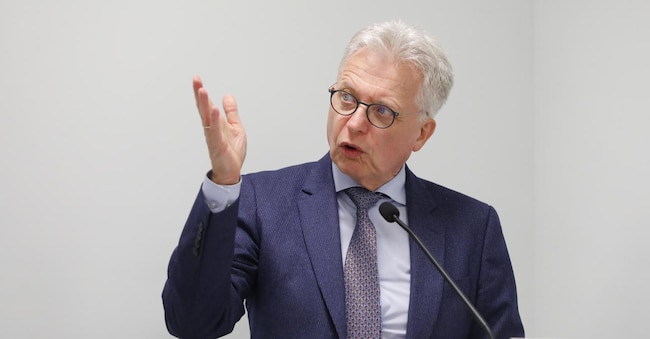
'Do not underestimate the resilience of the German economy': Germany's ambassador to Italy, Hans-Dieter Lucas, is confident of its solidity despite the current difficulties.
The economic ties between Italy and Germany are deep. How do you assess bilateral relations?
They are really excellent. They are built on a solid foundation. We are both founding members of the European Union and have a strong sense of responsibility for Europe. The German-Italian Action Plan, signed a year ago by Chancellor Scholz and Prime Minister Meloni, has further strengthened our ties with strategic projects such as the South H2 corridor for green hydrogen from Africa. The excellent quality of relations was also manifested recently in President Mattarella's state visit to Germany, as well as in the joint commemoration of the two heads of state in Marzabotto, on the 80th anniversary of that horrible war crime committed by the Germans. And President Mattarella said that Marzabotto is no longer something that separates us, but something that unites us more. Italy and Germany share a number of very important points. In the field of common and security policy, we agree on practically all strategic issues: from the threat posed by Russia and Ukraine's support in the face of Russian aggression, to the Middle East, the relevance of Africa and the nature of transatlantic relations. Migration is an issue we see as a common challenge and Germany and Italy have basically accepted the compromise found in Brussels last year in the framework of the EU Asylum Pact, which aims to reform the asylum and migration management system in the EU. Economic relations are very strong, evidenced, for example, by the merger between Lufthansa and Ita Airways and the new joint venture between Leonardo and Rheinmetall. Germany is Italy's most important trade and economic partner. I am very optimistic about the prospects for relations between Germany and Italy.
Trump's victory threatens to sour US-EU relations. What can we expect?
Chancellor Scholz had an excellent phone call with President-elect Trump. It was a constructive conversation in which the chancellor congratulated Trump and said that Germany attaches the utmost importance to transatlantic relations and that we want to work closely with the Trump administration. The main opposition party also strongly supports this idea, as well as the effort to invest more in defence. Germany already spends around 2.1 per cent of GDP today. We want to strengthen the European pillar of the Nato and at the same time strengthen the EU. This is also important to achieve a balanced transatlantic relationship, with more European investment in defence. As far as trade is concerned, we will see what the Trump administration will propose.
In Germany there is a debate about the debt brake. What are the roots of German caution?
The debate is about the possible modification of the debt brake, but none of the centre-right or centre-left parties question the brake as such. There is a general awareness among the population that sound public finances are really important. First of all, because if you accumulate debt, it will be the next generations that have to repay it. It is therefore a question of generational solidarity. Secondly, public finances are important for the stability of the financial system. We saw this with the euro crisis. And it is no coincidence that we introduced the debt brake in the Constitution in 2009. Even at the European level, we all agree on the importance of sound public finances. That is one of the reasons why we have the Stability Pact, whose recent reform was a very important and successful compromise for Europe.
Stagnant economy, political crisis. Germany no longer looks like the solid country that Europe used to rely on.
The German political class is very aware of the importance and responsibility Germany has for Europe and in Europe. The end of the traffic light coalition is not the end of the world. In February there will be elections and I am convinced that we will have a very stable government. It is clear that the German economy faces a number of challenges that Italy and other European countries are also dealing with: high energy prices, a lack of skilled workers, a very difficult geopolitical environment and strong competition from the US and China. But the foundations of the German economy are very solid. I would not be too pessimistic about the medium- and long-term prospects: do not underestimate the resilience of the German economy.


