Dolce&Gabbana bring homage to the multiform beauty of Italy and a tribute to the city to Rome
The exhibition 'From the Heart to the Hands' will be on until 13 August at the Palazzo delle Esposizioni, with a tour enriched by new rooms

4' min read
4' min read
In addition to applying it to their haute couture and haute jewellery fashion shows, which have been touring Italy since 2012 and which this year will stop off in Rome, from 12 to 16 July, Dolce&Gabbana have chosen the same "Grand Tour" formula for "Dal cuore alle mani" (From the heart to the hands), the exhibition that tells their story and their vision, also conceived as a tribute to Italy itself and its heritage of craftsmanship, art, places, stories and people. An exhibition that, after its inauguration in April last year at the Palazzo Reale in Milan and its passage to the Grand Palais in Paris, where it closed on 2 April, has just landed in Rome, in the monumental spaces of the Palazzo delle Esposizioni.
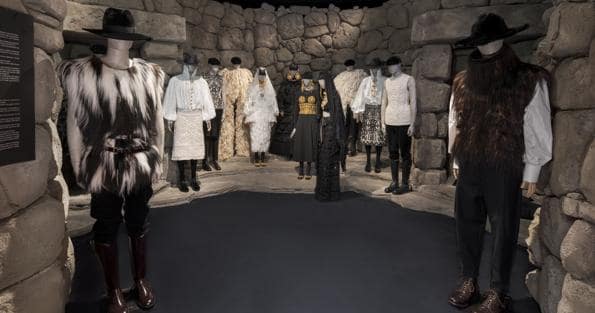
The multiple tributes of the exhibition therefore also involve the largest exhibition and cultural space in the centre of the Capital, which with this event draws the attention it deserves. On the other hand, those ample neoclassical spaces designed by Pio Piacentini and inaugurated in 1883 were created precisely to give the newly-born Italian State a place to 'exhibit' the best of its creativity. And they are therefore ideal to host the fourteen rooms of the exhibition "From the heart to the hands", which in the layout curated by Florence Muller and with set designs by Agence Galuchat is thus enriched by three rooms: the first, "Sardinian Art", is a tribute to the richness of the island's traditional heritage and the beauty of its ancient megalithic architecture, with some creations presented last year in Sardinia and immersed in the walls of a nuraghe, with the background music of the Bitti tenores; the second, "Anatomia sartoriale", the most minimalist and architectural, with its soft lighting highlights the value of the base of Dolce&Gabbana, thus corsetry and the study of the shapes of the human body; finally, the "Cinema" room, a real room where one can sit and watch the documentary "Devotion" with which Giuseppe Tornatore in 2020 narrated the genesis of the Alta Moda collection, and then the fashion show in Palermo, with original music by Ennio Morricone.
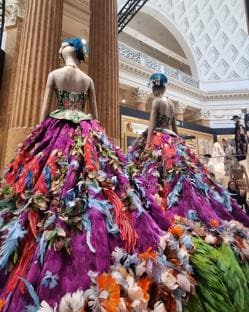
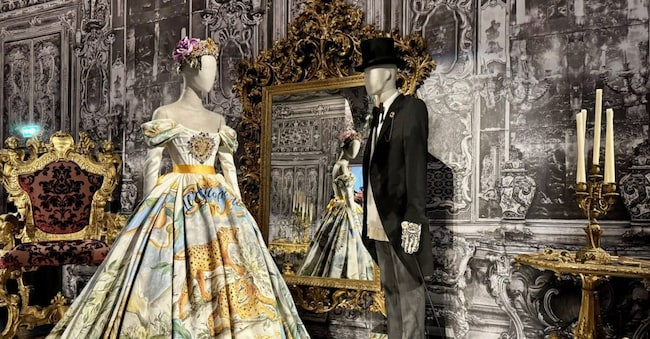
For the rest, the 200 textile art creations, jewellery and accessories follow the route that has already won tens of thousands of visitors in Milan and Paris. The opening room, embellished by a perimeter of canvases by Anh Duong, former model for the brand and then artist, evokes the long and rich Grand Tour of other fashion and jewellery events. All along the 1,500 square metre exhibition route, homage is paid to classical antiquity, Byzantine mosaics, the art of Raphael, Botticelli and Caravaggio, opera and the cinema of The Leopard. And every dress, piece of jewellery or shoe, exalts the love for Italy's craftsmanship: it is not only the purely sartorial art (the dress made with thousands of coloured feathers by the Florentine Mazzanti workshop, worn by Naomi Campbell on Lake Como in 2018, is to be admired at length), or the art of inlay or mosaic, but also arts considered 'minor' such as that of the Apulian basket-makers, with woven silk imitating wicker giving life to a dress-corsetto.
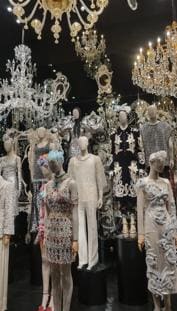
This homage also continues in the setting itself, with Sicilian floor tiles by Bevilacqua, a Caltagirone workshop, and chandeliers by Barovier & Toso, including one from Dolce& Gabbana's first shop in Milan, chandeliers that in turn evoke the Murano district and are reflected in the mirrors by Barbini, another historic Venetian atelier. In the room dedicated to the collection of garments inspired by Byzantine mosaics, Venice again, with the Orsoni Venezia 1888 company that created the frame mosaic.
The beating heart of the exhibition, however, is the room where an atelier has been recreated, with models, fabrics, needles and scissors, mannequins, and where three seamstresses work live, to give an up-close view of the genesis of Dolce&Gabbana haute couture, with a transposition in a reduced version of the atelier in Milan, where 120 people work.