
Dolce&Gabbana between church-inspired tailoring and patronage
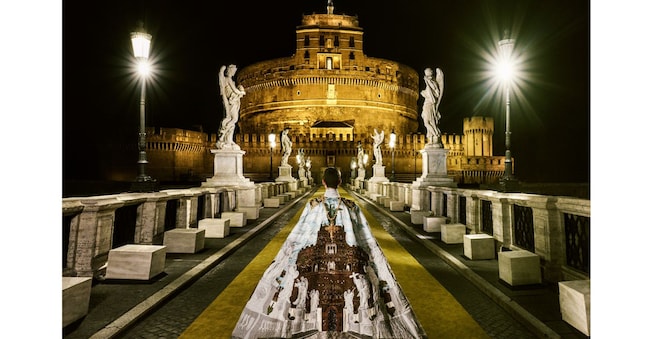
For the first time, Ponte Sant'Angelo became a catwalk for over 100 models of the Alta Sartoria fashion show. The company will finance the restoration of some works in Castel Sant'Angelo and the lighting system of Villa Adriana

3' min read
3' min read
Assuming the devil exists, at least in his earthly incarnations, let him still wear Prada: the release of the sequel to the 20-year-old film is scheduled for 2026, and images of the looks of leads Meryl Streep and Anne Hathaway are starting to circulate. Jing Daily, a Chinese website dedicated to the global fashion system and its ramifications in China, asked Does the devil still wear Prada? A question that - going beyond fictional characters, Hollywood caricatures and individual brands - brings attention to the role fashion plays in our societies.
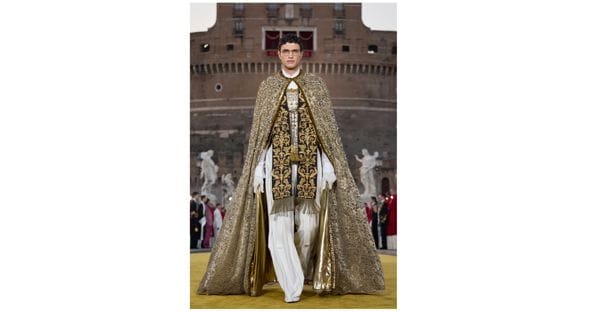
Dolce&Gabbana's haute couture fashion show in front of Castel Sant'Angelo in Rome last 15 July was not only a feast for the eyes of those who love textile craftsmanship and creativity: it also reminded us that in the millennial history of the Church (not only the Catholic Church) and the Vatican, fashion, in the broadest and noblest sense of the term, has always had a place.
The presentation of more than one hundred men's looks, made up of unique pieces, was part of the events that Domenico Dolce and Stefano Gabbana have been organising every summer since 2021 in the most evocative locations in Italy. It had never happened, however, that the Sant'Angelo bridge became a real catwalk, framed by the angels sculpted by Bernini and his workshop pupils. The risk that a clash between the sacred and the profane might be perceived has been completely averted, not least because the dress codes inside the Church, studied without prejudice, represent a sort of ante litteram haute couture.
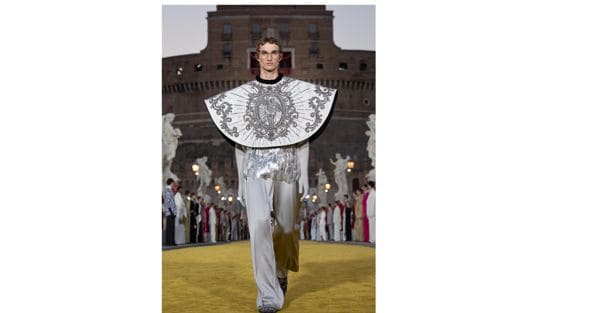
"We did long and passionate research by observing works of art and reading essays on the subject," explained Andrea Marchesi, head of haute couture at Dolce&Gabbana. "We were inspired by the silhouettes of the cardinal's robes but also by the works of art that one comes across at every step, at every glance, when one is in Rome. It was a beautiful creative and textile challenge, which was meant to be a tribute to the millenary aesthetic codes but also to the craftsmanship know-how that we still have in Italy and that allowed us to conceive and give life to these garments and accessories".
The events in Rome were also an opportunity to reaffirm Domenico Dolce and Stefano Gabbana's commitment to the Italian cultural heritage, to which the textile and craft tradition rightfully belongs. In Rome, as we know, there is so much more to witness a millenary architectural history.


