
Draghi: 'Trump brutal wake-up call, EU learns to get along'
Former Italian Prime Minister Mario Draghi, in his speech at the Rimini Meeting, also spoke about common debt for large defence, energy and tech projects

3' min read
Key points
3' min read
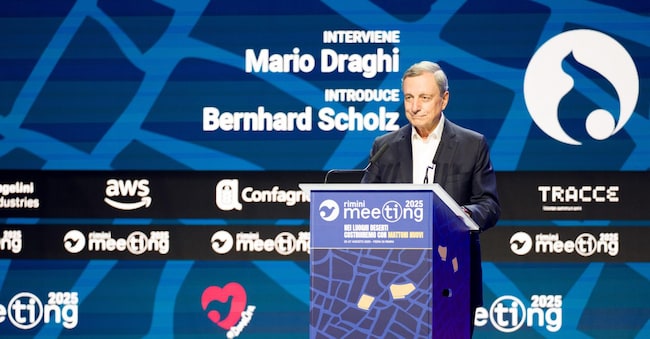
"For years the European Union believed that the economic dimension, with 450 million consumers, brought with it geopolitical power and international trade relations. This year will be remembered as the year in which this illusion evaporated". Thus the former Prime Minister Mario Draghi in his speech at the Rimini Meeting entitled 'Which horizon for Europe'. "We had to resign ourselves," he explained, "to the tariffs imposed by our largest trading partner and long-standing ally, the United States. We have been pushed by the same ally to increase military spending, a decision that perhaps we should have taken anyway - but in forms and ways that probably do not reflect Europe's interest'.
Draghi: EU marginal and spectator, from Ukraine to Gaza
"The European Union, despite having made the biggest financial contribution to the war in Ukraine, and having the biggest interest in a just peace, has so far played a fairly marginal role in the peace negotiations," Draghi added in his speech at the Rimini Meeting. "In the meantime China has openly supported Russia's war effort" and "European protests have had little effect: China has made it clear that it does not regard Europe as an equal partner and uses its control in the field of rare earths to make our dependence increasingly binding". In addition, the EU 'was a bystander even when Iran's nuclear sites were being bombed and the Gaza massacre intensified', he said to ungodly applause. "These events have done justice to any illusion that the economic dimension alone ensured any form of geopolitical power."
Skepticism for the EU, now must change
For Draghi, 'it is therefore not surprising that scepticism towards Europe has reached new peaks. But it is important to ask what the object of this scepticism really is. It is not, in my opinion, scepticism towards the values on which the European Union was founded: democracy, peace, freedom, independence, sovereignty, prosperity, equity' and 'social protection, we have a social welfare system that is probably the most developed in the world'. "Rather, I believe," the former premier added, "that the scepticism concerns the European Union's ability to defend these values. This is partly understandable. Models of political organisation, especially supra-state models, emerge in part to solve the problems of their time. When these change to such an extent that the pre-existing organisation becomes fragile and vulnerable, it must change'.
Common debt for major EU projects such as defence
Hence the warning. "Only common forms of debt can support large-scale European projects that insufficient fragmented national efforts would never be able to implement. This is true: for defence, especially for research and development; for energy, for the necessary investments in European networks and infrastructure; for disruptive technologies, an area where the risks are very high but the potential successes are crucial in transforming our economies'. Draghi recalled his speech a few years ago in Rimini on 'good debt and bad debt', pointing out that today 'in some areas good debt is no longer possible at the national level because the investments made in isolation cannot reach the size needed to increase productivity and justify the debt'.

