
Draghi: also use duties against unfair competition
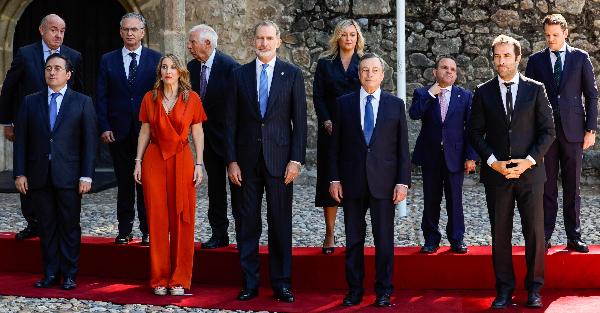
The former ECB president and Italian prime minister spoke at the Monastery of San Jeronimo de Yuste in Extremadura, where he was awarded the Carlos V European Prize by King Felipe VI of Spain

3' min read
3' min read
Duties can be one of the answers to unfair competition in international trade. This was said by former Prime Minister Mario Draghi speaking in Spain. "The first European response to changing world trade rules should be to try to repair as much damage as possible to the multilateral trade order by encouraging all willing partners to recommit to rules-based trade. The second response should be to encourage foreign direct investment, so that manufacturing jobs stay in Europe'. This was said by Mario Draghi speaking at the Monastery of San Jeronimo de Yuste in Extremadura, where he received from King Felipe VI of Spain the Carlos V European Award. "The third response should be the use of subsidies and tariffs to compensate for the unfair advantages created by industrial policies and real exchange rate devaluations abroad. But if we take this path, it must be within the framework of an overall pragmatic, cautious and consistent approach,' he added.
"EU must grow faster and better"
.'The EU will have to grow faster and better. And the main way to achieve faster growth is to increase our productivity,' stressed the former Prime Minister and former President of the European Central Bank in his acceptance speech. "We also have to cope with new demands: adapting to rapid technological change, increasing defence capacity and achieving the green transition," Draghi signalled.
"Increase internal demand in the EU and reduce dependencies"
."The paradigm that brought us prosperity in the past was designed for a world of geopolitical stability, which meant that national security considerations played a limited role in economic decisions. But geopolitical relations are now deteriorating. This change requires Europe to take a fundamentally different approach to its industrial capacity in strategic sectors such as defence, space, critical minerals and parts of pharmaceuticals. And it also requires reducing our dependence on countries we can no longer trust'. Thus, in another passage, Mario Draghi clarified his recipe for revitalising the European economy.
"Huge benefits from common European debt"
.It is only one passage in a long speech devoted to the focal points of a new European industrial policy, but Mario Draghi does not forget his past as a central banker and the financial aspects of greater European integration. "Speaking of common financing at European level. You all know what my point of view is, so I don't need to repeat it,' he says in Spain where he receives a prestigious award. "We would benefit enormously from some form of common financing, but I don't want to reiterate today things I have said many times in the past."
"The first thing we need, therefore, is a common assessment of the geopolitical risks we face, shared by the member states and able to guide our response. Then, we will need to develop a real 'foreign economic policy' that coordinates preferential trade agreements and direct investments with resource-rich countries, stockpiling in selected critical areas and creating industrial partnerships to secure the supply chain of key technologies," Draghi explained. "For companies to increase investment and production capacity, Europe will have to not only increase the level of demand through higher spending, but also ensure that this demand is concentrated within our borders and aggregated at European level. The most efficient way to generate this demand would be to increase common European spending. But in the absence of such a centralised approach, we can achieve a lot by coordinating public procurement policies more closely and applying more explicit local content requirements for products and components produced in the EU,' he emphasised.

