
Draghi: 'The effects of Hormuz may last for years'. 1.2 trillion a year needed
The former prime minister was awarded the Charlemagne Prize in Aachen. "Additional strategic expenditure has risen to almost EUR 1.2 trillion per year on average"
From our correspondent Beda Romano
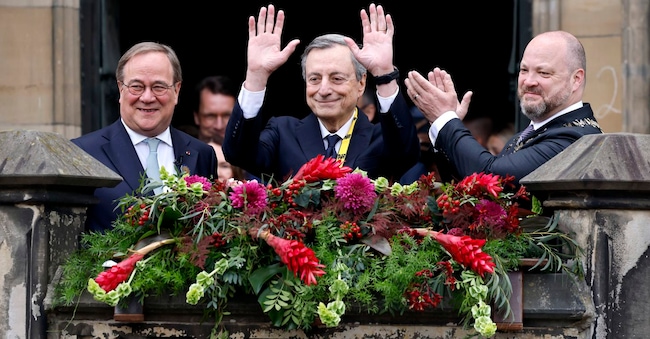
BRUSSELS - Italy's former prime minister and former central banker Mario Draghi received today, Thursday 14 May, in Aachen, Germany, the well-known Charlemagne Prize. In a speech, the economist took up some of the topics he had already discussed, from pragmatic federalism to good debt. Above all, he revised his attitude towards the United States. He said that the new aggressive American posture must be in Europe's eyes 'a moment of revelation'.
Precisely the new attitude of Washington, today embodied by President Donald Trump, was the starting point of the former Italian prime minister's reasoning. The former president of the European Central Bank explained: "The world that once helped Europe generate prosperity no longer exists. It has become tougher, more fragmented and more mercantilist. Across the Atlantic, we can no longer take it for granted that the custodians of the post-war order remain committed to preserving it'.
In this sense, the economist warned of the possibility of Washington ignoring "the rules that the United States once championed". In short, the assumptions on which European development was based for years - i.e. the openness of trade, the guarantee of security provided by the United States, the stability of the international order - no longer hold and the continent is now faced with a 'tougher' world, in which for the first time, Mario Draghi said, we would be 'truly alone together'.
In the past, Mario Draghi had had an accommodating attitude towards the United States, whether out of political realism or cultural frequentation. Today the climate has changed, especially since the US may have become a threat. According to the former president of the European Central Bank, European fragility stems from a fundamental contradiction: Europe opened up to the world without having completed the construction of its own internal market.
The economist, who speaks of an 'asymmetric economy', then warned of the consequences of this imbalance: excessive dependence on foreign demand, energy and strategic vulnerability, and technological backwardness. In this context, explained the former Prime Minister of Italy, the lesson is that external hardness requires internal depth'. Both on the purely economic front and on the more political side. Let us start with the former.


