
Draghi: the only way forward for the EU is pragmatic federalism
This was said by the former premier in Oviedo where he was awarded the prestigious Princesa de Asturias Prize for International Cooperation

Key points
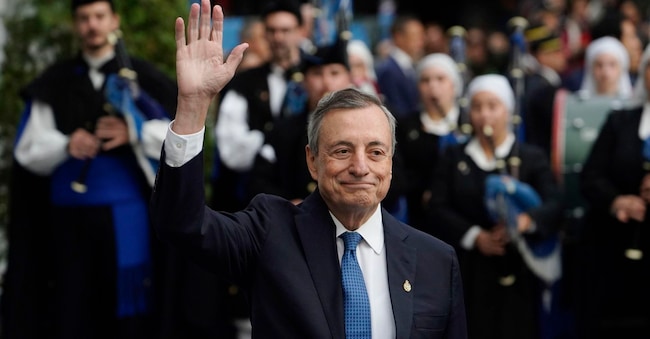
The world has changed, Europe is under attack and struggling to respond. It has only one way forward: 'a pragmatic federalism' that allows it to move forward on strategic issues. Mario Draghi returns to talk about the present and future of Europe. He did so in Oviedo, at the Campoamor Theatre, where he was awarded the prestigious Princesa de Asturias Prize for International Cooperation. According to the jurors, Draghi is 'a key figure in the defence of European integration and international cooperation'. And it is once again to the Union, for which he drafted the Competitiveness Report, that the former ECB president addressed his warning.
Draghi: almost every principle on which the EU is founded under attack
Draghi's starting point has been the same for months now: 'almost every principle on which the EU is founded is under attack. The world has changed and Europe is struggling to respond'. This is the 'breaking point' - already underlined in May in Coimbra, at the Cotec, in the presence of the President of the Italian Republic Sergio Mattarella - from which Draghi also made his speech in Oviedo. He put forward a proposal that fits in well with current events in Brussels, namely the debate on the overcoming of the unanimity quorum in some key EU decisions.
Pragmatic Federalism
For Draghi, that overcoming, from a normative point of view, is impossible today. It must, however, be implemented in practice. "It is a federalism based on specific themes, flexible and capable of acting outside the slower mechanisms of the EU decision-making process". It would be built by "'coalitions of the willing' around shared strategic interests, recognising that the different forces in Europe do not require every country to move at the same pace", is the thesis of the former Italian prime minister.
The divisions in the EU
His speech comes just a few hours after a European Council where, once again, conclusions on Ukraine were approved by 26 members, i.e. without Hungary, and where the proposal to use Russian assets for repair loans to Kiev came to an abrupt halt, amidst vetoes by Belgium and doubts in several capitals, including Rome. Even on the major issue of competitiveness and its relationship with the Green Deal, the 27 leaders have shown more than one crack. An extraordinary European Council will be held on 12 February on this very dossier. Draghi and Enrico Letta, author of the report on the single market, will be present.
Reacting to the crisis
"We built our prosperity on openness and multilateralism: now we face protectionism and unilateral actions. We believed that diplomacy could be the basis of our security: now we see the return of military power as a tool to assert our interests. We promised leadership in climate responsibility: now we see others retreating while we bear rising costs,' Draghi recalled. Europe, he emphasised, has always reacted to crises. It did so after the sovereign debt crisis, or after the Covid. The situation today is different and more complex. Draghi summed it up by asking the audience in Oviedo a question that remains unanswered for now: 'How serious does a crisis have to become for our leaders to join forces and find the political will to act?

