Conference in Brussels

European Union, von der Leyen: 'Competitiveness mission unfinished'. Draghi: 'Inaction threatens our sovereignty'

In Brussels the conference 'One year after the Draghi report'. Von der Leyen and former ECB and Italian Council President deliver keynote speeches

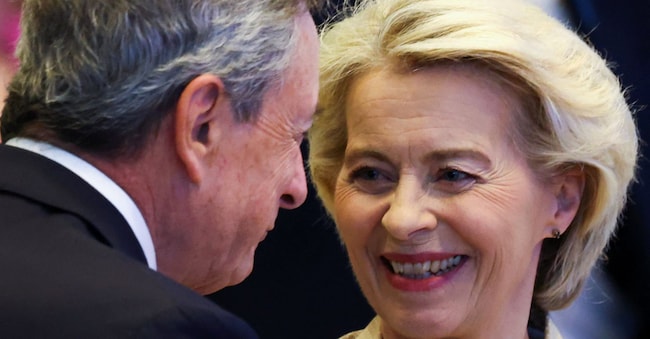
Mario Draghi con la presidente della Commissione Europea Ursula von der Leyen a Bruxelles per la conferenza “Un anno dopo il rapporto Draghi”

7' min read

7' min read

One year after the presentation of the Draghi plan by the former ECB president, the European Commission takes stock of the debate triggered by the 170 proposals put forward to revitalise Europe's competitiveness.

A un anno dal piano Draghi

The proceedings opened with keynote speeches by European Commission President Ursula von der Leyen and former ECB and Italian Council President Mario Draghi.

Loading...

Competitiveness: von der Leyen: 'A lot done but mission not accomplished'

Commission President Ursula von der Leyen responded to criticism about the slow implementation of the so-called 'Draghi agenda' for European competitiveness by presenting a list of what has been done in the first nine months of work of the second EU executive she leads. Not starting from scratch, then. Clean industry pact, 'gigafactory' for artificial intelligence, new state aid framework, affordable energy plan, savings and investment union, action plans for cars, steel and chemicals, 'the biggest defence investment wave in our history', the new single market proposals, the start-up/scale-up and quantum fund, six simplification packages on the way:

"All this gives a sense of the urgency that we have promised and we will continue to track relentlessly until we have completed everything. In any case, one cannot yet speak, he acknowledged, of 'mission accomplished'.

Mission of the decade is to become one of the AI leaders

.

"Of course, the rest of the world is also running. Global investments are soaring. So, we have to stay focused and work hard. This is not a 'mission accomplished'. This is the mission of the next decade: to make Europe one of the leading continents in artificial intelligence,' she added.

"We have created artificial intelligence factories and will soon turn the best ones into Gigafactories. The goal is that our extraordinary innovative start-ups can access the computing power and test and train their models, especially with sectoral applications in mind. And the response from the European private sector has been impressive. Our initial goal was to mobilise EUR 20 billion of investment to develop our Gigafactories. We received EUR 230 billion in proposals from the private sector. And later today, during this conference, we will sign the first pilot projects,' he announces.

Supercomputer Leonardo, come sarà l’AI Factory di Bologna

Von der Leyen to Draghi: 'Thank you for your rigour and vision'

"Today marks one year since the publication of the Draghi report. But I would like to go back two years, when I first called you, Mario, to propose that you undertake this new mission. I remember that the offer intrigued you, but you had one condition: this new report had to make a real difference. You were not interested in writing another academic paper, you wanted a roadmap for action. And that was exactly what we were looking for'. Commission President Ursula von der Leyen continued: 'You and your team spent a whole year analysing Europe's strengths, weaknesses and possible solutions. As soon as the report was published, the whole of Europe turned its attention to you. So, first of all, I would like to thank you, dear Mario, for your rigour, your vision and your service to Europe. Thank you, Mario'.

Von der Leyen: 'Roadmap on single market, removing barriers'

"Now to the challenges: of course, I know that many obstacles remain. A start-up in the field of artificial intelligence based in Portugal or Romania must be able to grow without difficulty throughout our continent. And today this is often not the case. Our single market is far from complete. Internal barriers within the single market are equivalent to a 45% tariffs on goods. And a 110% tariffs on services, according to the IMF. This cannot be. It should not be easier to make a fortune overseas than beyond Europe's borders,' said Ursula von der Leyen. "We started to tackle these barriers - the so-called 'terrible ten' - with our Single Market Strategy. Now it needs to deliver results as a matter of urgency. That is why we have announced a roadmap for the single market until 2028. It will link our work on capital, services, energy, telecoms, the fifth freedom for knowledge and innovation, as well as the 28th regime for innovative companies with concrete deadlines," he stressed.

Von der Leyen: 'The EU should take charge of its security'

.

"There is another vital area in which we can no longer afford to be overly dependent on others: defence. A more independent Europe of defence will not happen overnight, it will take years to be up to the task. But it is absolutely clear that Europe must now take on the lion's share of its own security,' the European Commission president continued, highlighting the success of the EUR 150 billion Safe instrument for joint defence procurement.

Difesa, l’Ue ripartisce 150 miliardi: basteranno?

Draghi: 'EU inaction threatens its sovereignty'

.

After the President of the European Commission, Mario Draghi took the floor. "One year on, Europe is in a more difficult situation. Our growth model is fading. Vulnerabilities are increasing. And there is no clear path to finance the investments we need. We have been painfully reminded that inaction threatens not only our competitiveness, but also our very sovereignty,' said the former ECB president.

Draghi: 'Citizens are disappointed by Europe's sluggishness'

"European citizens and companies appreciate diagnosis, clear priorities and action plans. But they also express a growing frustration. They are disappointed by the EU's slowness. They see us unable to keep up with the speed of change elsewhere. They are ready to act, but fear that governments have not grasped the gravity of the moment,' the former premier said. 'Too often excuses are made for this slowness' and 'this is complacency', he stressed, urging 'new speed' and results 'within months, not years'.

Draghi: "Progress on AI but gap with US and China remains clear"

"In some areas, Europe is making progress. Plans are underway to build at least five AI gigafactories, each with more than 100,000 advanced Gpu. The capacity of the data centres is set to triple in the next seven years. A major telecommunications reform is planned by the end of the year. Asml's recent investment in Mistral is a promising sign for the internal AI ecosystem. Adoption is also increasing: according to the EIB, European companies are adopting advanced technologies at a similar pace to their US counterparts, albeit from a lower base,' said Mario Draghi, who added: 'But the gap is stark. On the AI front, the US produced 40 large basic models last year, China 15 and Ur only 3. Among SMEs, AI adoption is still low, between 13 and 21 per cent. And in the most strategic field, that of AI based on European intellectual property to consolidate our core industries, progress is minimal'.

Draghi: '2035 rules for cars are based on assumptions that are no longer valid'

Mario Draghi believes that the decarbonisation targets for the automotive sector 'are based on assumptions that are no longer valid' and that 'the transition must be flexible and pragmatic'. In general, the relaxation of some of the most burdensome sustainability reporting requirements is not enough. The forthcoming revision of the CO2 regulation (which envisages a halt to the placing on the market of new petrol and diesel cars from 2035) 'should follow a technology-neutral approach and take stock of market and technological developments'.

Draghi emphasised that the 2035 deadline for zero emissions was supposed to trigger a virtuous circle: stringent targets would stimulate investment in charging infrastructure, grow the domestic market, spur innovation in Europe and make electric vehicle models cheaper. Adjacent sectors - batteries and chips - were expected to develop in parallel, supported by targeted industrial policies. However, this 'did not happen'. The installation of charging points must accelerate three or four times over the next five years to achieve adequate coverage. The market for electric vehicles has grown more slowly than expected. Draghi continues: 'European innovation has lagged behind, models remain expensive and supply chain policies are fragmented. Then the European car fleet of 250 million vehicles is ageing and CO2 emissions have decreased little in recent years.

Finally, there is a need for an integrated approach to the increase of electric vehicles, taking into account supply chains, infrastructure needs and the potential of zero-carbon fuels.

Von der Leyen incontra i leader industria automobilistica europea

Draghi: 'Energy prices too high, tech transition at risk'

"Natural gas prices in the EU are still almost four times higher than in the US. Industrial energy prices are on average more than twice as high. If this gap is not reduced, the transition to a high-tech economy will stall. Energy is as crucial as technology in driving artificial intelligence,' said the former Italian premier. 'The electricity demand of data centres in Europe will increase by 70 per cent by 2030. Energy already accounts for up to 40 per cent of their operating costs,' he added.

Draghi: 'Willing coalition and common debt for common projects'

Mario Draghi indicated that there is no more time to lose for the EU and that the real question that needs to be answered is 'how to increase the speed' of European action for competitiveness, economic security and independence. While in some areas the EU 'can do more with the powers it already has' with regulations, 'it now needs to show that it can adapt to a rapidly changing technological landscape'. In other areas, 'deeper reforms are needed: of competences, decision-making and financing. Ultimately, in some crucial areas, Europe must start acting less like a confederation and more like a federation. But such reform will take time, time that we may not have'.

That is why 'progress could depend on coalitions of the willing, using mechanisms such as enhanced cooperation. Even without treaty changes, Europe could already do much more by concentrating projects and pooling resources'. And 'the next logical step would be to consider joint debt for common projects, either at EU level or among a coalition of member states, to amplify the benefits of coordination'.

Draghi: 'Agreement on tariffs largely on US terms'

"The US has imposed the highest tariffs since the Smoot-Hawley era. China has become an even stronger competitor. We have also seen how Europe's ability to respond is limited by its dependencies, even though our economic weight is considerable. Dependence on the US for defence was cited as one of the reasons why we had to accept a trade deal largely on American terms,' Mario Draghi concluded.

Copyright reserved ©
Loading...

Brand connect

Loading...

Newsletter

Notizie e approfondimenti sugli avvenimenti politici, economici e finanziari.

Iscriviti