Interview

Letta: 'Completion of the single market in 2028 last chance for the EU'

The former prime minister welcomes the indication in the State of the Union Address of a deadline to finalise a decisive process for global competition: 'Create a lot of expectations, if they were frustrated it would be detrimental to Europe'

from our correspondent Beda Romano

6' min read

6' min read

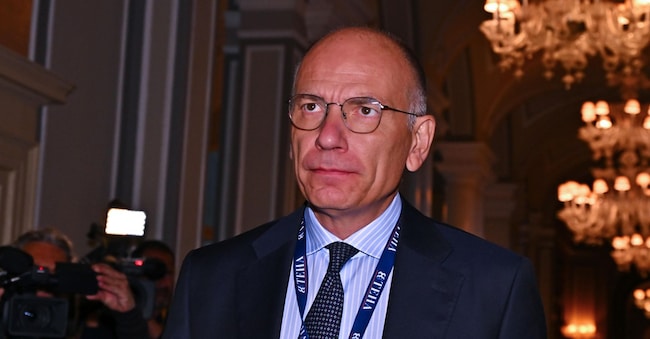
BRUSSELS - It has been an eventful week this week, marked among other things by the long-awaited State of the Union address by the President of the European Commission. Criticised on many sides, Ursula von der Leyen took the opportunity to double down, promising new initiatives in defence and the economy. We asked Enrico Letta, 59, former Prime Minister (2013-2014), now dean of the IE School of Politics, Economics & Global Affairs in Madrid and author of a well-known report on the completion of the single market in 2024, for an interpretation of the European moment.

Mrs. von der Leyen's speech provoked mixed reactions. It pleased many national governments and generally the centrist bloc in the European Parliament. Much less so to the commentators who found it opportunistic and wishy-washy. What did you think?

Loading...

There is actually an interesting mismatch. I would explain it this way. Today, politics prevails. Twenty years ago, economics prevailed. Even in Ursula von der Leyen's speech there was a strong demand for politics from the listener. Unfortunately, Europe as it is organised is able to offer more economics than politics. The important economic passages in the speech were overpowered by the political dimension, which is in fact still in the hands of the member states rather than the top EU institutions. These have more power in the economic field than in the political field, and lack the tools to meet the enormous expectations that are mostly political.

The world stage in the hands of predators, as Giuliano da Empoli has called them (The Hour of Predators, Einaudi, 2025), does not help. The world stage in the hands of predators, as Giuliano da Empoli has called them (The Hour of Predators, Einaudi, 2025), does not help.

Absolutely. Donald Trump himself has an all-political, all-identity message, whereas the European construction with its successes - the single market and the euro - is a very economics-based construction. On the foreign policy and power policy front, Europe is in obvious difficulty. This seems to me to be the key to answering your question about the contrasting way in which the speech of the president of the Commission was received.

You said earlier that there are important economic passages in the speech. Which ones in particular caught your attention?

Among other things, the president announced a roadmap between now and 2028 to complete the single market, especially in finance, telecommunications and energy. For me, 2028 is a new 1992, the year in which all energies were mobilised for the birth of the single market. My generation was born and raised pro-European with an eye on 1992 and the four freedoms of movement (capital, people, goods and services, ndr). The idea of a new deadline is very important. Policies without deadlines are academic activities.

We are, however, at a stage where the Member States are very weak - just look at Paris, Warsaw, and even Berlin. Is this a realistic path?

Europe is disarmed in the current international context of power. However, I am certain that by strengthening the single market and the euro between now and 2028 we will gain a place in the world. The single market as well as the global and digital euro, which Fabio Panetta promoted at the European Central Bank before becoming governor of the Bank of Italy, can be the tools to enable us to become more powerful in the world. Allow me a somewhat forced image: if we continue to ape Trump we lose because we Europeans cannot do Trump. Full stop. We need more Jacques Delors and Romano Prodi and less Donald Trump and Viktor Orbán.

Are you optimistic?

It seems to me that we got off on the right foot. The rotating presidency, in the hands of Denmark, has convened a ministerial meeting for 29 September to which I have been invited. The aim is to speed up the completion of the single market. The Danish presence at the head of the Council is a good thing because Denmark, which for years opted for opting out of the integration process, is today among the most fervent supporters of the single market.

Usually, the weakness of member countries is not a harbinger of greater integration. But the international context is undergoing a revolution. Is it possible that national weaknesses may paradoxically lead to greater unity among the Twenty-Seven?

In part, this is what is already happening. I note that many countries are increasingly looking favourably at the possibility of creating a 28th regulation for European companies (without harmonising existing national regimes, but creating one from scratch, ndr). It is the right method, very pragmatic. It avoids the ideological struggle between national and European flags. The cancellation of national rights is not at issue. The question is to build a kind of fast-track that at the European level allows us to be more effective, more competitive and to simplify the rules. It is the way to enable many to be pro-European without being forced to make expressions of faith in Europe.

There is indeed a growing realisation that in the age of predators, no European country is capable of standing alone.

You may have noticed that political debates about leaving the EU or the euro have disappeared from all countries. Frexit, Italexit, Dexit. Nobody talks about it any more. Not even in France. Let us not forget that the country accepted the euro with a very narrow majority, 51 to 49%, in the 1992 referendum. After all, the euro, the single market, Europe have become incontournables (indispensable, ndr). There is an underlying consensus around the great instruments of Europe - the euro and the single market - among both governments and citizens that there never was before (confirmed by the latest Eurobarometer, ndr). This is a positive fact. I very much appreciated President Sergio Mattarella's speech in Cernobbio. This is not the time to feel sorry for ourselves. There is no alternative. It is not possible to imagine individual countries going their own way in the era of Donald Trump and Vladimir Putin.

At the same time, strong criticism of both the European Commission and national governments emerges from the polls.

Yes. Because of the war, fear and uncertainty spread and create resentment. That is why we have to start again from the things that work, again the euro and the single market. We also need a big commitment from the business world to support the 2028 project, as happened in 1992. Then the business sector understood the great benefits of the single market. Even today it would benefit greatly to complete, for example, the energy union. After all, it is the key to enable Italy to reduce prices greatly. Unlike Germany, we do not have the budgetary space to use public money. There would also be advantages from a financial point of view. If the merger between UniCredit and Commerzbank is blocked today, it is because financial union has not yet been completed. Italy has a great interest in the completion of the single market, if only because it is a major exporting country. This is also why we launched the Arel Single Market Lab in Italy (a research project aimed at developing proposals to strengthen the economy and European integration, ndr).

To conclude, let us return to the working method of the President of the Commission, which provokes eyebrows in not a few sectors of the European establishment. Over the past year, little has been done to adopt the reforms proposed by you and Mario Draghi in your respective reports. Is Ursula von der Leyen's centralised management also to blame? Has the time come to give full powers to the commissioners?

It seems to me that the President's speech on Wednesday was an attempt to remedy this problem. In her speech she took up the two reports, and gave the commissioners the task of taking them forward. It is obvious to me that these reports will be put into practice if there is a mix between the work of the Commissioners and the Commission offices and the political investment of the Commission leadership. After all, Project 2028 is a bit of a last chance. Many expectations have been created around the solutions proposed by the two reports. If these expectations were to be frustrated, it would be very damaging for Europe's credibility.

Copyright reserved ©
Loading...

Brand connect

Loading...

Newsletter

Notizie e approfondimenti sugli avvenimenti politici, economici e finanziari.

Iscriviti