Training

Drone pilots and data analysts: the new professions in the agri-food sector, emerging from technical colleges

There are 24 ITS Academy foundations in the food technology sector offering 53 training programmes: the aim is to address the difficulties in finding suitable candidates, as reported by 45 per cent of companies

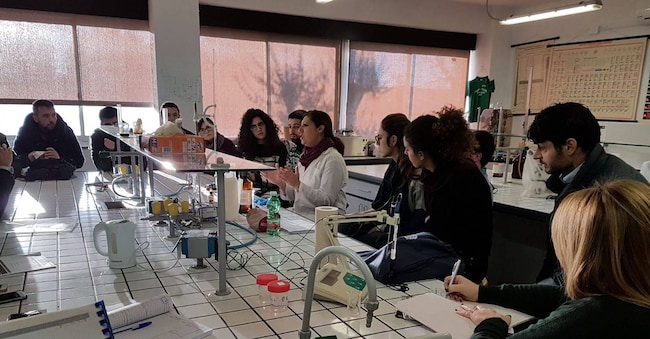
Un laboratorio  dell’Its Academy di Locorotondo (Bari)

4' min read

Translated by AI
Versione italiana

4' min read

Translated by AI
Versione italiana

Professionals capable of ensuring the traceability of a batch of wheat from the field to the shop shelf, drone pilots who map water stress in an olive grove, and data analysts to process sensor data in a greenhouse. These are just a few examples of the new professions in agribusiness. These are the specialists that companies are seeking but cannot find. The Italian agri-food sector is seeing jobs evolve faster than it can train people for them. This gap has been highlighted by a recent Excelsior-Unioncamere study, which found that by 2025 over 45 per cent of companies in the sector reported recruitment difficulties, compared with 26 per cent in 2019.

The offer addresses technological shortcomings

Part of the answer lies in the ITS Academies, tertiary vocational training institutions which, following the school-leaving certificate, provide a two-year course leading to a higher technical qualification recognised at Level 5 of the European Qualifications Framework. There are 24 ITS Academy foundations in Italia specialising in agri-food technology, offering 53 training programmes as recorded in 2026 by the national monitoring survey carried out by Indire on behalf of the Ministry of Education: ranging from precision agriculture to food safety, and from digital traceability to the sustainable management of water and soil.

Loading...

The agri-food sector accounts for 10.5 per cent of the national supply and is the fifth-largest technological sector. This year, by the time the enrolment deadline was extended to 9 November, the Foundations had received over 5,000 expressions of interest and, in the last two weeks alone, nearly 500 requests for guidance. In 2024, according to the latest figures available on the Indire website, there were 1,435 enrolments and 895 graduates. Students are primarily choosing courses linked to quality assurance, such as ‘Quality Manager’ and ‘Food Control’, to name but a few. Interest is also growing in specialist areas such as ‘Extra Virgin Olive Oil Manager’, ‘Bakery Production Manager’ and ‘Cereal Trading Manager’.

(Almost) guaranteed employment

This success is due to the virtual guarantee of a job upon completion of their studies. Within a year of graduating, 74.5 per cent of its graduates – three out of four – are in work, and 87.3 per cent of them – almost nine out of ten – are in a job relevant to their field of study.

43 per cent of training hours are spent on work placements, which is slightly above the national average; two out of three courses make use of Industry 4.0 enabling technologies, and almost half of the laboratory hours (46.2 per cent) are devoted to digital skills.59.2% of work placements take place in businesses with fewer than ten employees, the highest proportion of all regions.

Over 40 per cent of students are over 25 years old, a sign that the agri-food ITS is also a choice for those changing career paths or retraining. And this is the area where Southern Italy has the greatest presence: in the 2013–2024 data series, 34.1 per cent of agri-food courses took place in the South and on the islands, compared with an average of 21.4 per cent.

Room for growth

The report also clearly highlights areas for improvement. In this region, 62.4 per cent of enrolled students graduate, compared with the national average of 75.7 per cent; businesses account for 37.5 per cent of the Foundations’ partners, compared with 53.3 per cent across the system; advanced apprenticeship schemes, which allow companies to hire students straight away and train them whilst they are studying, are virtually non-existent here (0.8 per cent of those enrolled).

It is this monitoring itself that highlights the key factor: when companies are involved in designing the courses, the training success rate exceeds 80 per cent, almost 14 percentage points higher than for courses without their involvement.

The role of businesses is crucial

The challenge now is to bring more businesses into the Foundations. A national project funded by the NRRP (‘supply chains of the future’) aims to strengthen synergies and further promote the development of ITSs in the agri-food sector. The project is led by the three “ITS Academies”, all part of the national AgrITS network: the ITS AgriPuglia in Locorotondo as lead partner, alongside the ITS Agroalimentare Teramo and the ITS TAGSS in Sardinia.

The aim is to introduce young people to careers within these sectors before they choose their post-diploma path, in order to raise awareness and reduce drop-out rates, which in this area affect over 25 per cent of those enrolled. The project brings together students, families, businesses and ITS institutions, through local events and free online career guidance tests.

Loading...

“To continue innovating, we need specialised staff, and no company can any longer afford to train a technician from scratch over two or three years. Technical jobs are not second-class jobs, neither in terms of income nor dignity,” says Francesco Casillo, CEO of the milling group and president of the Its Academy AgriPuglia Agribusiness School Foundation in Locorotondo, the only institution dedicated to the agri-food sector in one of Italia’s most agricultural regions: in 15 years, 75 courses, 834 qualified technicians and, according to the Foundation’s data, 87 per cent employed within a year. For the two-year period 2026–28, it is offering 11 free courses totalling 1,800 hours, of which 1,000 will be spent in the workplace from the first year, which can also be undertaken as advanced vocational apprenticeships.

Copyright reserved ©
Loading...

Brand connect

Loading...

Newsletter

Notizie e approfondimenti sugli avvenimenti politici, economici e finanziari.

Iscriviti