
Drone shield with a national network of sensors: the plan at Monday's Supreme Defence Council
Defence Minister Guido Crosetto speaks of 'a unified strategy against hybrid drone warfare: a timely modern information sharing chain between Defence, Interior and Enac'

Key points
One air shield but also its own fleet of drones capable of facing possible attacks in hybrid warfare: this is the plan on which, according to reports in the Ansa, the Defence is already working and which could be one of the topics on the table at the nextDefence Council convened by the President of the Republic Sergio Mattarella for next Monday, 17 November, which has as its agenda the examination of the evolution of the current conflicts but also the assessment of hybrid threats and the possible repercussions on the security of our country.
In Berlin, the summit of defence ministers from Italy, France, Germany, Poland and the UK
First, however, on Friday 14 there is the summit in Berlin for the E5, the European Defence summit uniting five nations: Italy, France, Germany, Poland and the United Kingdom. After the cancellation of his visit to Washington, where he was supposed to meet Pentagon chief Pete Hegseth, Minister Guido Crosetto is heading to the German capital for a meeting that will also be attended by the High Representative of the Union for Foreign Affairs and Security Policy, Kaja Kallas. National programmes, such as the anti-drone programme, will be discussed, but they will be coordinated at the European level (and with Great Britain): one of the examples is the continental air shield and the organisation of a single Union defence. Another theme could be the strengthening of the Ukrainian arms industry and aid in a war that sees Kiev retreating.
Crosetto: information sharing chain between Defence, Interior and Enac
Italy meanwhile already has clear ideas on how to move. Moreover, Crosetto himself reiterated that we must "prepare ourselves" to face the incursions of the drones that have been flying over the skies of Europe for months, in some cases blocking several airports, and he spoke of "a unified strategy against hybrid drone warfare: a chain of timely modern information sharing between Defence, the Interior and Enac". The main aim is to avert risks and sabotage in this international crisis with hybrid attacks. The plan that Defence is studying concerns the national security of all infrastructures: they are to be monitored and protected in the future, including airports.
The case of the Rome airports
Such as the system already in operation at Rome's airports, where in the event of the detection of an unauthorised drone, there is a control mechanism by which - if the flying object is at a short distance - it would be possible to locate its remote control in order to quickly trace who is operating it. Otherwise, when confronted with drones that are considered threats, the protocol is to shoot them down.
The air shield
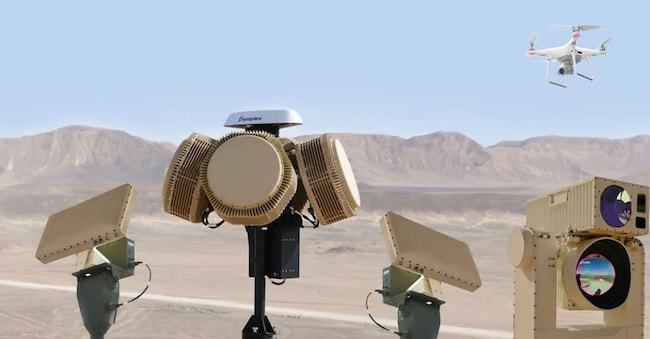
With regard to the air shield, long-term plans include the purchase of new Samp-T, the anti-missile system developed in cooperation with France, two of which have already been supplied to Kiev and one currently deployed in Estonia. Considering that Italy has only two Samp-Ts deployed on its territory, the numerical requirements would be much higher, but more launchers and a large number of Aster missiles (costing around two million euros each), which can be deployed both on land and at sea, would also be needed. A fleet of newer generation drones (i.e. cheaper and smaller) is also lacking, but the possibility of acquiring anti-drone systems with lasers in the future cannot be ruled out. On the other hand, a plan for its own fleet of drones on a national, but also European, scale involves industrial partnerships such as the joint venture between Leonardo - which would supply sensors, cameras and other technologies - and Baykar, a Turkish company that designs drones. It goes even further, and there is the idea of involving other countries that have become leaders in this sector, such as Ukraine and Poland (especially regarding mini-drones). Investments will be needed, but there are also plans to reduce costs as much as possible, also in view of the fact that it is not considered costly to use expensive aircraft such as kamikaze drones. For an effective defence, however, a European network will be needed in order not to thwart the efforts of the individual nations: this is why the Berlin summit will need to be united in order to lay the foundations for a shield that can protect Europe.

